


Uncertainty, Inflation, and AI: The Forces Reshaping Print

“Two forces are having a greater effect on the industry than anything else, they are deeply affecting every corner of the industry,” Andy Paparozzi, chief economist at Alliance Insights, said on Tuesday morning at the annual PRINTING United Expo Media Day, which brings together international media for a day of education and Expo sneak peeks from exhibitors. “Uncertainty, the most since COVID-19, and operating cost inflation, substrates, materials, energy, transportation, labor, overhead, and operating cost inflation created by war and erratic tariff policies. The second force is the fourth great industrial revolution driven by AI, big data, the Internet of Things, cloud computing, quantum computing, and smart robotics.”
During the opening Research Breakfast on PRINTING United Expo’s media day, Paparozzi and Amy Servi-Bonner, VP of Printing AI, took the stage to share “The Forces Reshaping Print: Where the Industry Is Headed Next.”
Throughout the presentation, Paparozzi referenced the Alliance Insights State of the Industry (SOI) reports, sponsored by Canon USA, and described an industry squeezed by rising costs, and urged printers to pursue "ruthless efficiency” and higher-value growth. Servi-Bonner followed with a candid look at the state of the printing industry and the impact AI can have on knowledge sovereignty.
Paparozzi opened with first-half 2026 results. Sales rose 4.1%, but real sales rose just 0.5%. Operating cost inflation reached 5.7% against price increases of 3.6%, and 73.7% of SOI participants reported profitability that was flat or lower.
The presentation projected the next six months, "and probably longer," would be "as challenging as the last six."
In terms of challenges, the SOI panel reported some of their biggest concerns moving into the second half of 2026 to be the economy and business conditions (56.2%), maintaining profitability (52.1%), and rising transportation costs (49.7%), with other concerns including increasing sales, rising substrate costs, tariffs.
“Even if the war ends very soon, and even if we get stable trade agreements very soon … it's going to take time for those benefits to work through the economy,” he noted. “If we don't get those treaties and the end of the war, the problems are only going to deepen, and the majority of the participants in our research recognize this.”
Paparozzi shared what sets the profit leaders of the future apart from the competition. These leaders are ruthlessly efficient; creators of profitable growth; agile, innovative, and receptive to change; and AI empowered. AI is moving rapidly, with Paparozzi noting that the industry is building a workforce for the AI era. In fact, 37.7% of the SOI panel participants expect AI skills to be "very important/essential" over the next 2 to 3 years, yet 47.2% do not offer AI training and do not plan to over the next two years.
“The profit leader of the future will be willing to move ahead during periods of extreme uncertainty, and we've got a lot more uncertainty ahead of us,” he said. “The natural tendency, during periods of extreme uncertainty is to sit tight until there's some clarity. The opportunity, however, is to create clarity by moving ahead with capital investment plans, workforce development, diversification plans, and the other foundations of sustained profitability.”
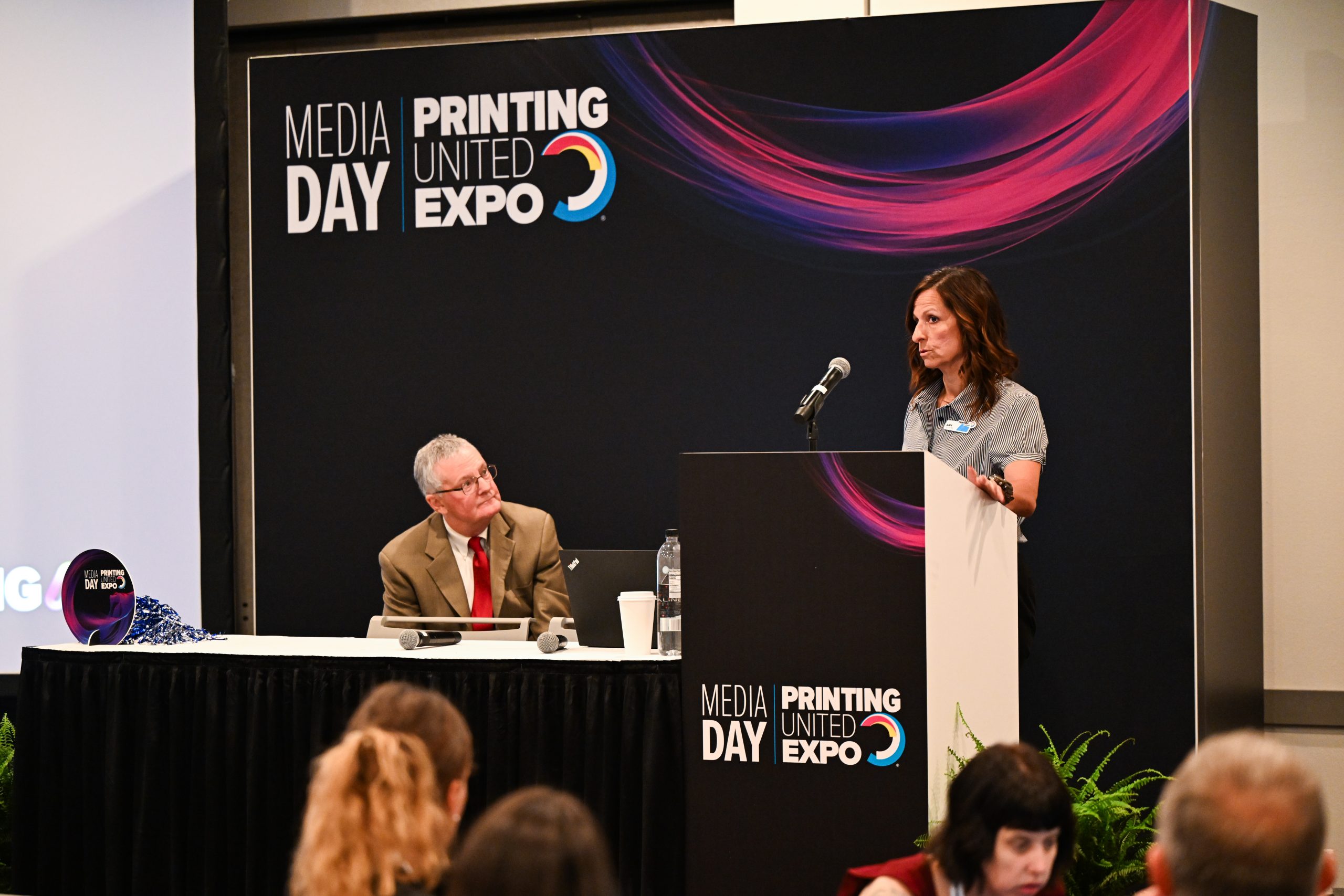
Andy Paparozzi, chief economist at Alliance Insights, opened Media Day at PRINTING United Expo sharing, and was joined by Amy Servi, VP of PRINTING AI, who spoke about “Knowledge Sovereignty" and the AI opportunity.
AI Adoption Outpaces Readiness
Before turning over the mic to Servi-Bonner, Paparozzi shared a link to Alliance Insight’s latest AI study, marking the segue to the next portion of the session looking at the status of AI adoption.
Servi-Bonner then stepped up to the mic and shared a statistic as a backdrop to the conversation about AI.
“The average commercial inkjet operator in this country is 48 years old, so roughly 17 to 20 years away from retirement,” she said. “That sounds like a very long time, but if you think about it, as that window starts to close, how fast, or at all are people even trying to get that information out of those folks' heads? … If their knowledge walks out the door with them, your company doesn't just lose an employee, it loses part of its operating system.”
She noted that 80% of critical production knowledge "Lives in people. Not systems" and the cost of losing one person at $80,000 to $200,000 per exit. What does that mean and how can AI mitigate some of the risks associated with the loss of human intel.
“It's the single biggest AI opportunity in this industry right now, ahead of automation, predictive maintenance, and generative content,” she said.
The answer, she shared, is in the concept of "Knowledge Sovereignty.”
“Knowledge Sovereignty is the state in which an operation's most critical institutional knowledge is owned, preserved, and deployed internally,” she said. “Not vendor dependent. Not platform dependent. Not person dependent. … This is the first step in applying AI to this industry, not the last. You cannot responsibly automate a decision, or hand any part of a workflow to AI, until you know what your best people actually know. Knowledge Sovereignty isn't a nice to have next to AI adoption. It's the prerequisite for doing AI adoption responsibly.”
Before closing, Servi-Bonner shared two examples of what PRINTING AI calls an “AI Employee,” a specific AI trained on a real operation’s actual knowledge, and the importance of this type of tool, before turning back to the benefits of using AI to address Knowledge Sovereignty.
"The question isn't whether you can afford to capture that knowledge,” she said. “It's whether you can afford not to.”
Canon: 'We're Building What's Next'
As the title sponsor of PRINTING United Expo 2026, Canon USA (Booth N5801) took the stage first. Rolando Martinez, senior director of production print marketing, noted that Canon is not just asking “What’s next?”
“We're building what's next,” he said. “Our strategy is focused on three core promises: continued technology innovation, purposeful portfolio expansion, and unwavering elevated customer support.”
He noted that Canon is the official imaging sponsor of Formula Drift, a motorsports series in which drivers slide cars sideways through turns. At its 9,600-sqft booth, Canon will display print applications featuring the photography of Larry Chen, official photographer for Formula Drift.
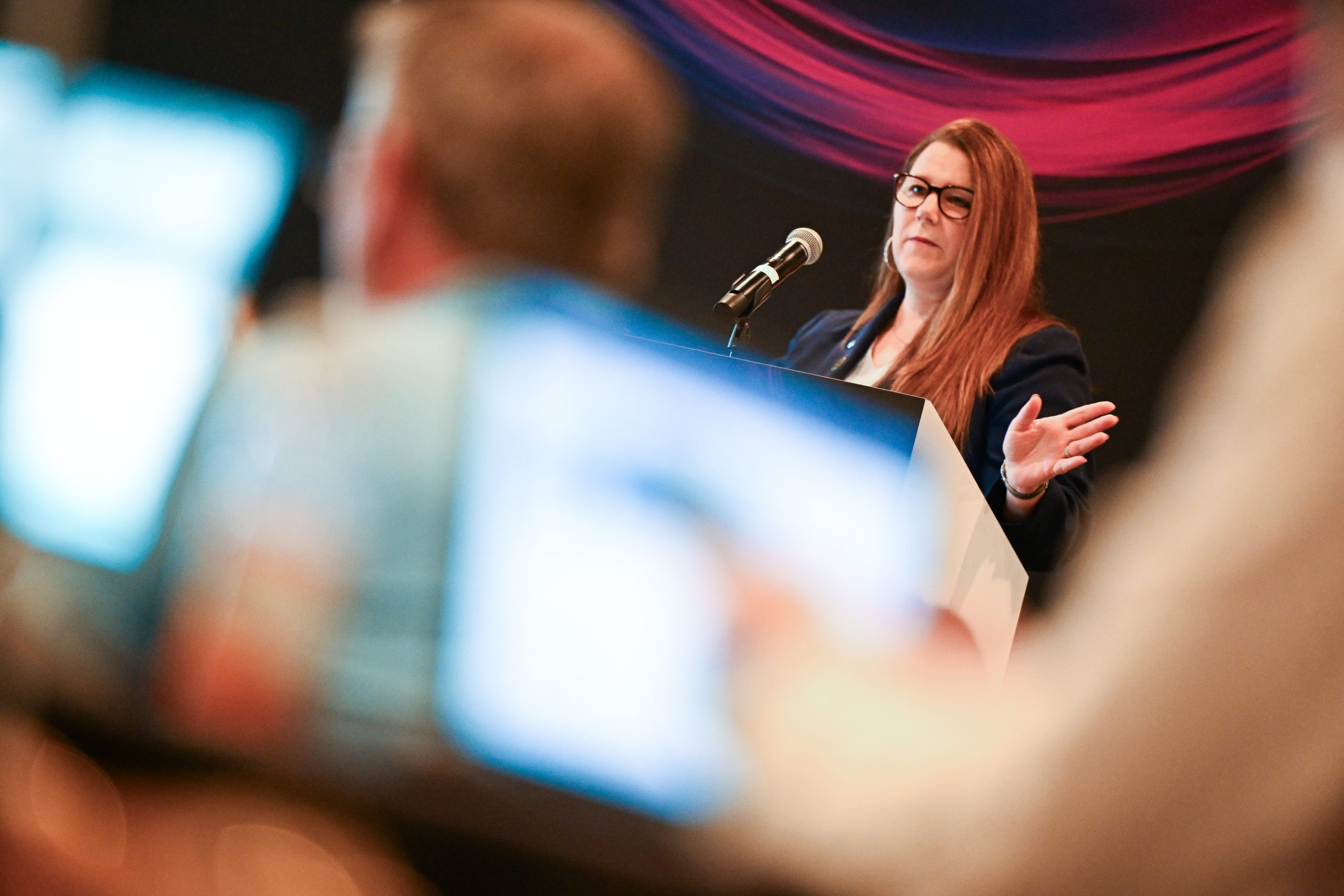
Lisa Weese, director of product strategy, presented for Title Sponsor Canon USA.
Martinez also noted that Canon equipment will be at several booths such as Duplo, Lexjet, Colex, and DigiTech. This is because, in the real world, Canon equipment does not operate in a silo. “We build technology designed to fit seamlessly into all these workflows,” he said.
At its booth, Canon will focus on what he called three game-changing solutions: the varioPRINT iX1700 B3+ sheetfed inkjet press; the new varioPRESS iV7 B2+ size inkjet press; and the Colorado XL series wide-format printer.
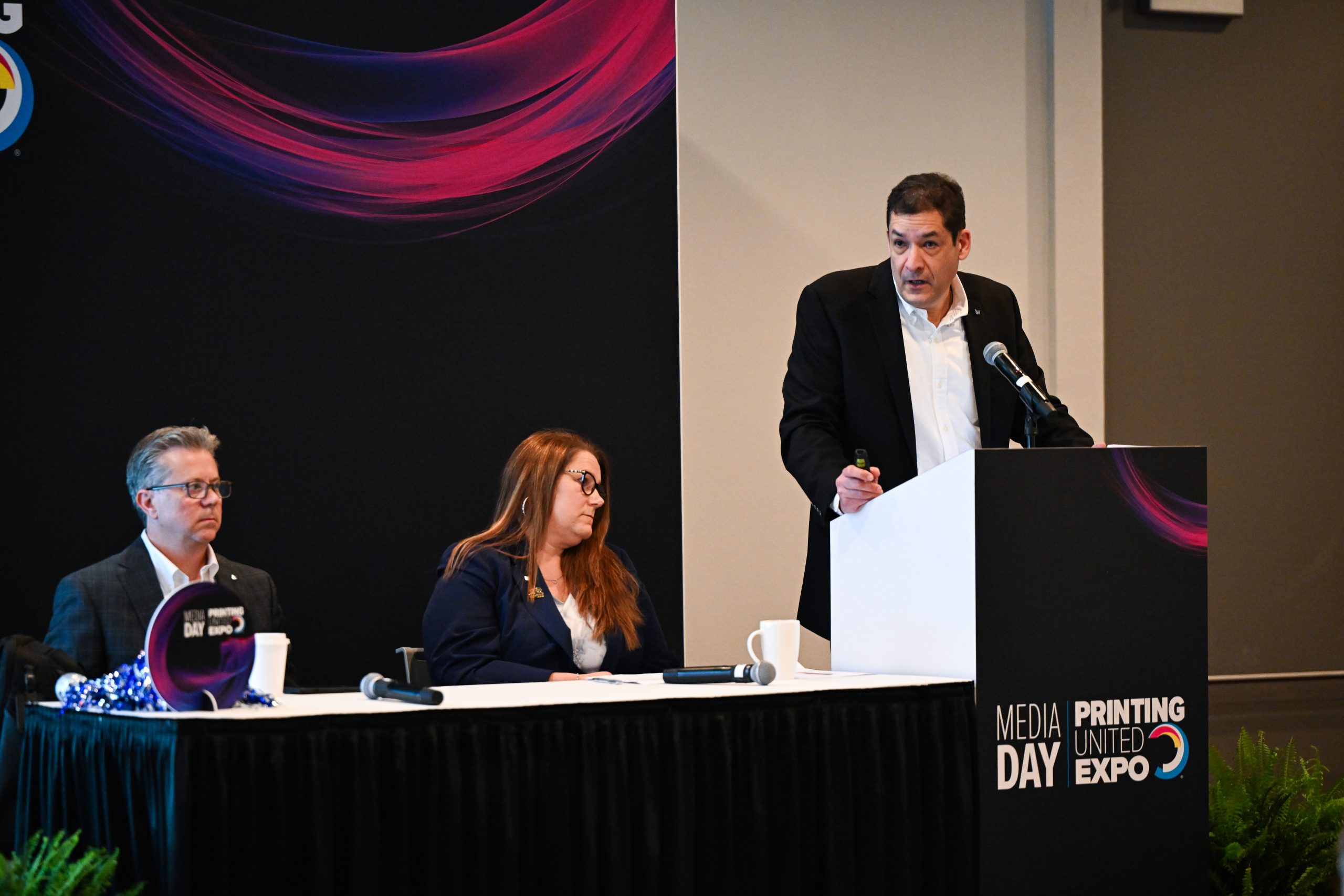
From left: Canon USA's Rich Reamer, Lisa Weese, and Rolando Martinez speaking at Media Day.
“They're not just incremental upgrades; they're game changers that are built to redefine productivity, quality, and production print overall.” Martinez said.
Lisa Weese, director of product strategy, noted that IDC ranked Canon the worldwide leader for high-speed inkjet in 2025 and the worldwide leader for production toner in 2026.
“I think what it shows is that it's not just about the presses, but it is about the full stability of Canon as an organization and the future of where we're taking this industry,” she said.
This year Canon is marking the 20th anniversary of both the imagePRESS and varioPRINT Titan lines and will be celebrating those products in its booth. Canon will also be showing the new imagePRESS V900 II color digital press, with print speeds up to 90 letter ppm. This latest evolution delivers enhanced durability, stable image quality with a new drum, and optimized serviceability, she said.
The varioPRINT ix1700 will be running at the booth, she noted, with samples available. Though general availability of this entry-level inkjet press won’t start until Jan. 2027, she said Canon has been doing a “controlled rollout,” with 12-15 installations so far.
Due to its size, the new varioPRESS iV7 will be featured in a virtual display, with samples available. Weese expected the first installation to happen later this year.
Richard Reamer, senior director of Large Format Product Planning and Strategy, noted that the Colorado XL series will be running at Canon's booth, printing up to 10-ft wide. Also at the booth will be the new 36" imagePROGRAF TM-610M, one of several additions to the TM series lineup. It’s Canon’s first printer with an integrated scanning solution.
The DigiTech Texas ST2/X1 4'x8' UV LED flatbed printer will also be on display, boasting speeds up to 2,024 sq. ft./hr. It accepts media up to 4x8’ and 6” thick, Reamer said. He also showed a video of a robotic arm flipping and moving substrates onto conveyor belts and said this will be demonstrated at the Expo.
“Automation is really the way of the future,” Reamer said.
Müller Martini Connects the Finishing Line
Do you hear the steady beat of change? That question drove the narrative of Müller Martini's (Booth N6129) Media Day presentation.
“We are convinced that change is necessary and gives rise to amazing opportunities for innovative business models,” Mauro Valle, solutions manager for Müller Martini North America, said, adding that smart factory and print-on-demand are not just expressions but rather revolutions.
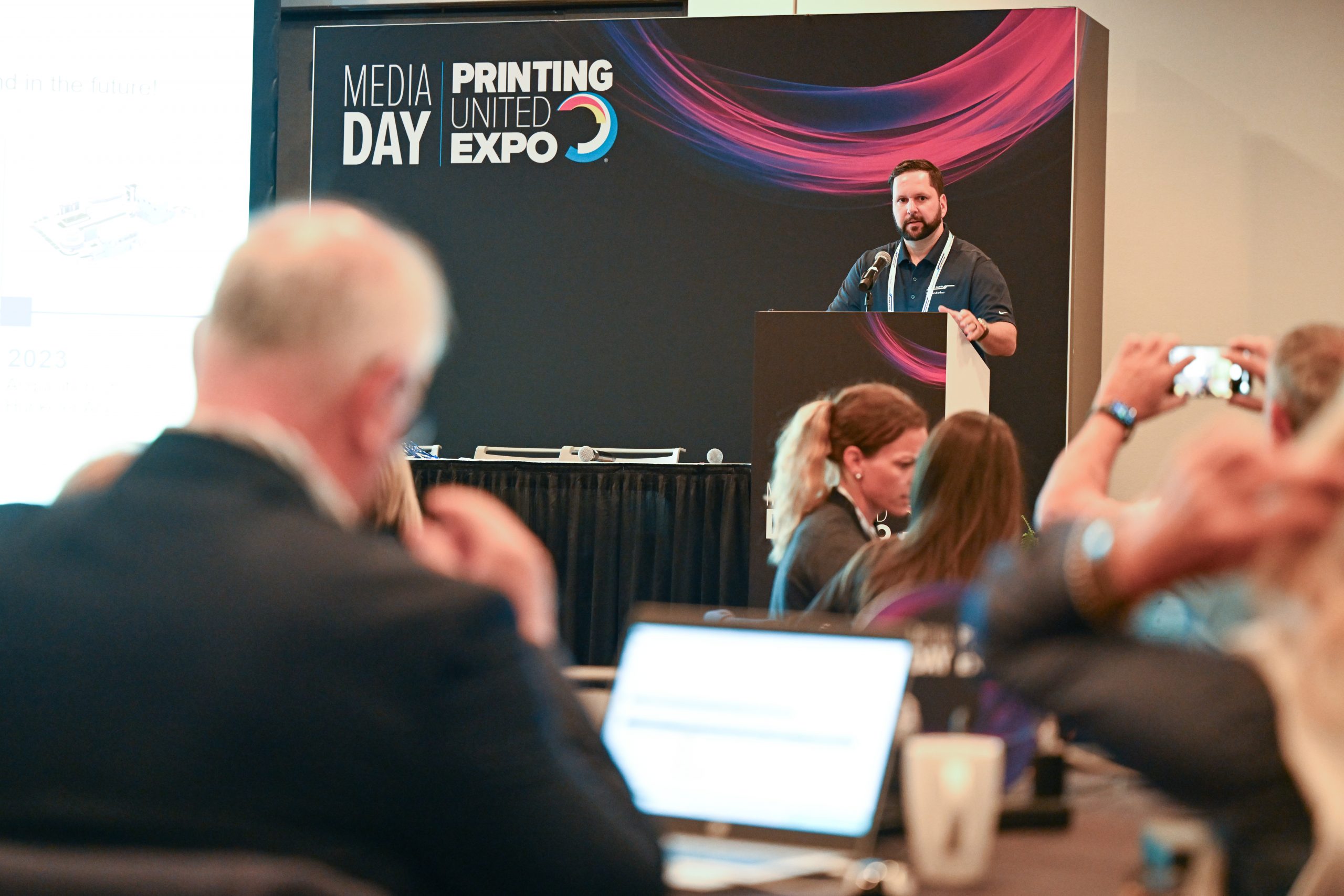
Mauro Valle, solutions manager for Müller Martini North America, addressed the history and the future of Müller Martini and Hunkeler.
Valle provided an overview of the company’s 80-plus year history. He highlighted several notable points, including the centralization of the spare parts warehouse (2013); the acquisition of the IP of the HEIDELBERG portfolio for saddle-stitching and perfect binding (2014); the acquisition and integration of KOLBUS’ bookbinding business; and most recently, the acquisition of Hunkeler AG (2023).
With the Hunkeler acquisition, Valle explained that Müller Martini maintained both brands, making it a dual brand company.
“With both brands we’re able to serve our customers better by providing more equipment into different markets and provide more needs,” he said. “Coming together allows us to also join forces. This means that we’re going to have more developing power.”
In addition, the “Stronger Together” theme means the teams are also going to eliminate duplicating jobs – not just on the development side but on the customer side.
Live From the Floor
Following the Hunkeler acquisition, it became important for Müller Martini to partner with print partners and finishing partners. Valle said some of these partners will be in Müller Martini’s booth (Booth 6129). He then proceeded to show a layout of the booth.
Making its debut at PRINTING United Expo is the Separo PRO, a high-performance destacker that automatically separates stacked book blocks and feeds them into the downstream binding process. It also allows printers to run glued book blocks followed by cut-sheet book blocks. Valle encouraged attendees to see it perform live in-line with the Vareo PRO perfect binder as part of the connected softcover book-production workflow.
InfiniTrim and automated palletizing are another show highlight. Finished books will be trimmed by the InfiniTrim three-knife trimmer and automatically palletized using a Solema robotic solution.
Hunkeler’s GEN8 will be integrated with a Heidelberg folder, producing 3-up postcards and folded flyers. The line will feature the Hunkeler WI8 Web Inspection System for reliable quality assurance throughout production.
The Smart Way
Valle finished his presentation with a discussion of the Smart Factory – Finishing 4.0. The four components include:
- Automation: “A decisive factor for customization, variability, and smart functions.”
- Connectivity: “The basis for efficient production and smart services. Data analysis as the basis for the right decisions.”
- Variability: “The option of making physical changes from product to product. The possibility of customizing the content of print products.”
- Touchless Workflow: “The combination of connectivity and automation: production changes without the involvement of the operator.”
Before he exited the stage, Valle encouraged the audience to stop by their booth for a chance to win a flight to Hunkeler Innovationdays.
Fujifilm: Automation, Embellishments, and More
In his Media Day presentation, Andrew Gunn, head of print-on-demand solutions at Fujifilm (Booth N6042), highlighted the company’s portfolio of multi-platform production solutions, ranging from back-office and lower-volume machines to higher-volume solutions. Several of these will be on display at booth N6042, including the ApeosPro family, the Revoria 285, the Revoria 2100, and the new Revoria Press PC2120. A virtual display of the J Press FP790 flexible packaging press will also be available.
From a broader perspective, Gunn recognized that PSPs are facing a range of pressures.
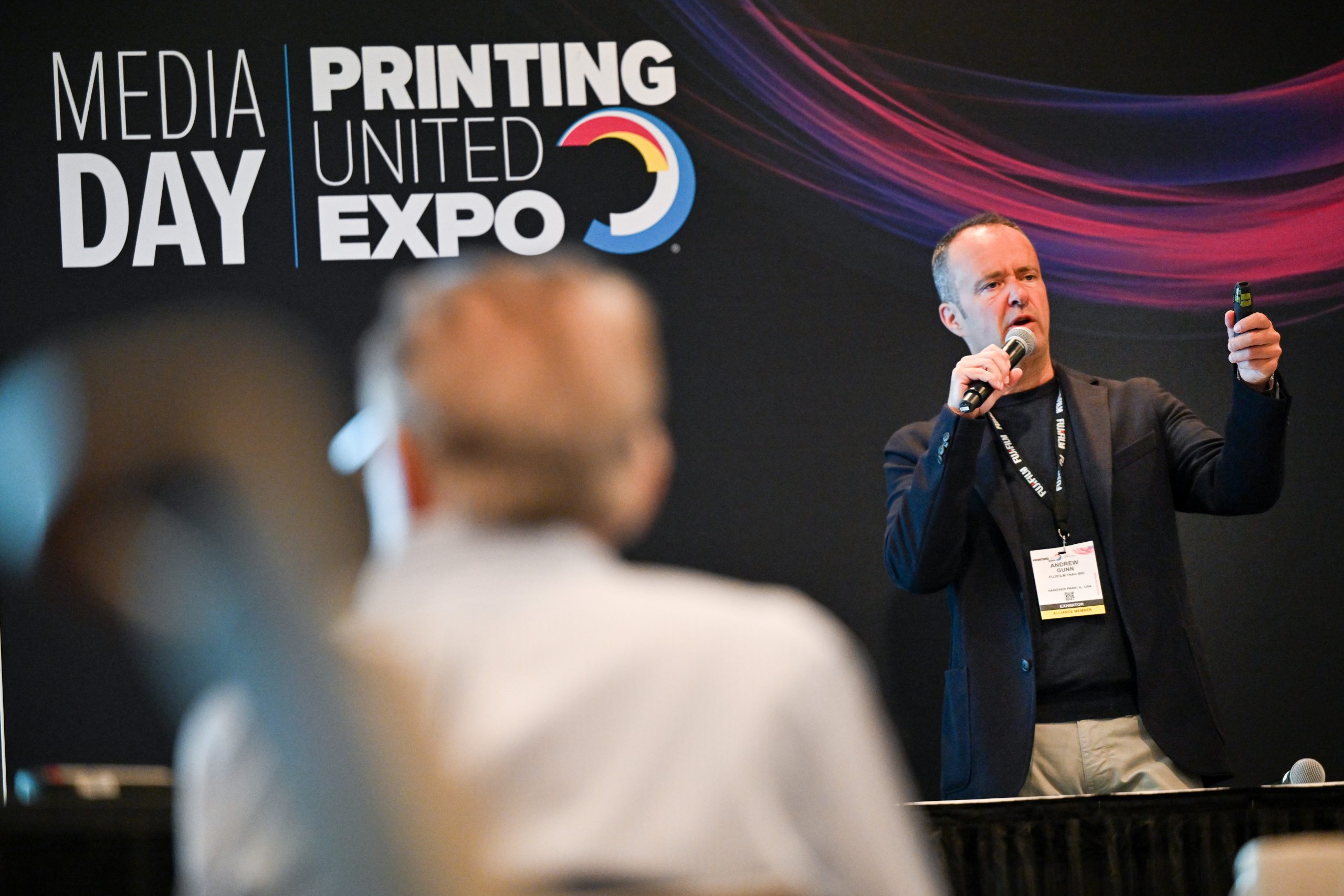
Andrew Gunn, head of print-on-demand solutions at Fujifilm, discussed the challenges printers face and how Fujifilm can meet their needs.
“We’re always talking about how the pressure to do more with less is really relentless,” he said. “So, there’s faster turnaround times that are required, smaller skilled labor forces, the rising material costs, constantly evolving standards, ever-increasing competition, and squeezed margins. That’s fancy speak for ‘I want it free, I want it yesterday, and it better be good.’ At Fujifilm, one of the things that we’re always trying to figure out is how to solve for those customer pain points.”
That motivation is evident in the Revoria line of presses. Gunn specifically highlighted five ways PSPs can make more with Revoria devices:
- Benchmark CMYK: Create more accurate, consistent print on tight deadlines.
- Media maximization: Produce jobs efficiently on more types and sizes of media.
- CMYK+ expansion: Enable inline digital CMYK+ embellishments to help boost impact and profits.
- Intelligent automation: Make more sellable prints per shift with smarter workflows.
- Consistent support: Get 360-degree support from the Fujifilm team.
Of note, Gunn pointed to the digital CMYK+ embellishment expansion as something that will grow in importance. So, Fujifilm has developed its Aspire program to help support PSPs as they design, price, market, and sell embellishments.
“The whole part of the Aspire program is helping our customers get to that next level, so when a customer says to you, ‘Well, nobody’s asking for embellishments,’ you are prepared,” Gunn explained. “… We need to kind of show the market how digital embellishments are going to be that [big] thing. And we need to make it easy for them, but easy in a way that’s repeatable and understandable.”
But, in Gunn’s eyes, embellishments alone won’t keep profits up.
“I always say the shiny stuff gets customers in the door, but it’s the automation that keeps them in the black — or the [Fujifilm] green, if you will,” he said.
Agfa: Automation With a Purpose
“Automation for automation’s sake doesn’t always deliver what we expect.” That was the theme Deborah Hutcheson, director of business development, Agfa (Booths C1149, C1161), stressed during her Media Day presentation.
She began her presentation with a closer look at how Agfa positions itself around innovation, productivity, efficiency, sustainability, and, of course, quality. And none of that happens in a vacuum — Hutcheson notes that many of the innovations in the presses they offer today have features and advances that come from conversations with customers.
She also highlighted the latest presses in the portfolio — especially the presses that will be running live at PRINTING United Expo, at booths C1149 and C1161. These include:
- The Jeti Tauro H3300 XUHS. One of the fastest presses in the lineup, this machine can run at speeds up to 13,778 sqft/hr, and comes in both four and seven-color configurations.
- The Onset Pathera FB3216. This flatbed press can produce up to 292 beds/hr, and is designed for both display and signage work, as well as packaging applications.
- The Bronco H3300 HS. This roll-fed system can operate in single or dual-roll configurations, and can run at speeds up to 4,844 sq/hr.
- The Anapurna Ciervo H3200. As Hutcheson said, “the herd grows.” This latest press in the portfolio has dual-roll capability and can run at speeds up to 192 sqm/hr.
Beyond the technology innovations, Hutcheson also highlighted the company’s sustainability focus "Deep behind each of these product developments is the core belief in sustainability,” she said. “We're focused on what we can do to improve the sustainability journey for our customers and for ourselves. Any way that we can reduce our total carbon footprint, we can reduce our impact on the market and on the environment."
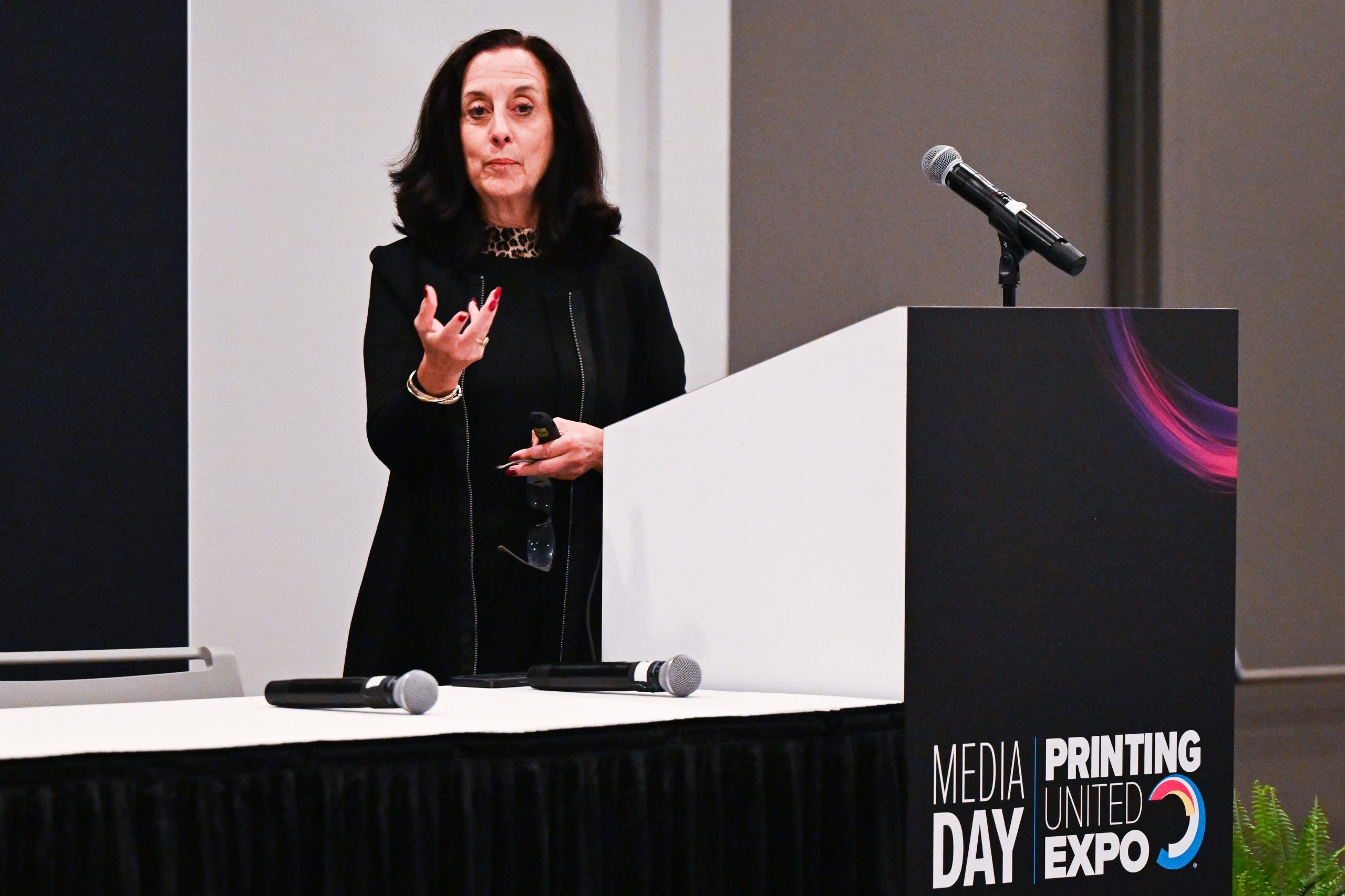
Agfa’s Deborah Hutcheson walked Media Day attendees through the company’s PRINTING United Expo lineup, stressing automation, sustainability, and innovation.
That philosophy is illustrated in the company’s focus on innovating around LED curing, thin-ink technology, automation, and IoT-enabled diagnostics that help support lower energy use, reduced waste, lower ink consumption, and improve uptime.
“At the end of the day, we're trying to reduce the total cost of print manufacturing, we're trying to reduce touch points, we're trying to drive quality,” she stressed.
Durst at 90: Investing for the Long Haul
Next up in the Media Day lineup was Durst (Booths C1614, C1514). Led by Becky McConnell, marketing manager for Durst Image Technology U.S. During her presentation, McConnell highlighted new printing technology from Vanguard, expanded software capabilities, and developments across the group as Durst celebrates 90 years of innovation.
Big News from Vanguard
Perhaps one of the more notable points of the presentation was the media’s exclusive sneak peek at Vanguard’s brand new Cumberland flatbed printer, which McConnell described as “a major advancement in productivity.” Available with two or three rows of printheads, the Cumberland features a new printhead arrangement, larger ink tanks, and compatibility with automation that connects printing to cutting.
The Cumberland introduces linear drives on both axes to Vanguard’s lineup, alongside variable drops as small as four picoliters. Operator-focused features include a digitally controlled vacuum system, movable registration pins, foot pedal controls, and a nine-zone vacuum table.
“This goes back to the fact that as print service providers need to do more with less, we want to make it as easy to run these machines as possible,” McConnell said.
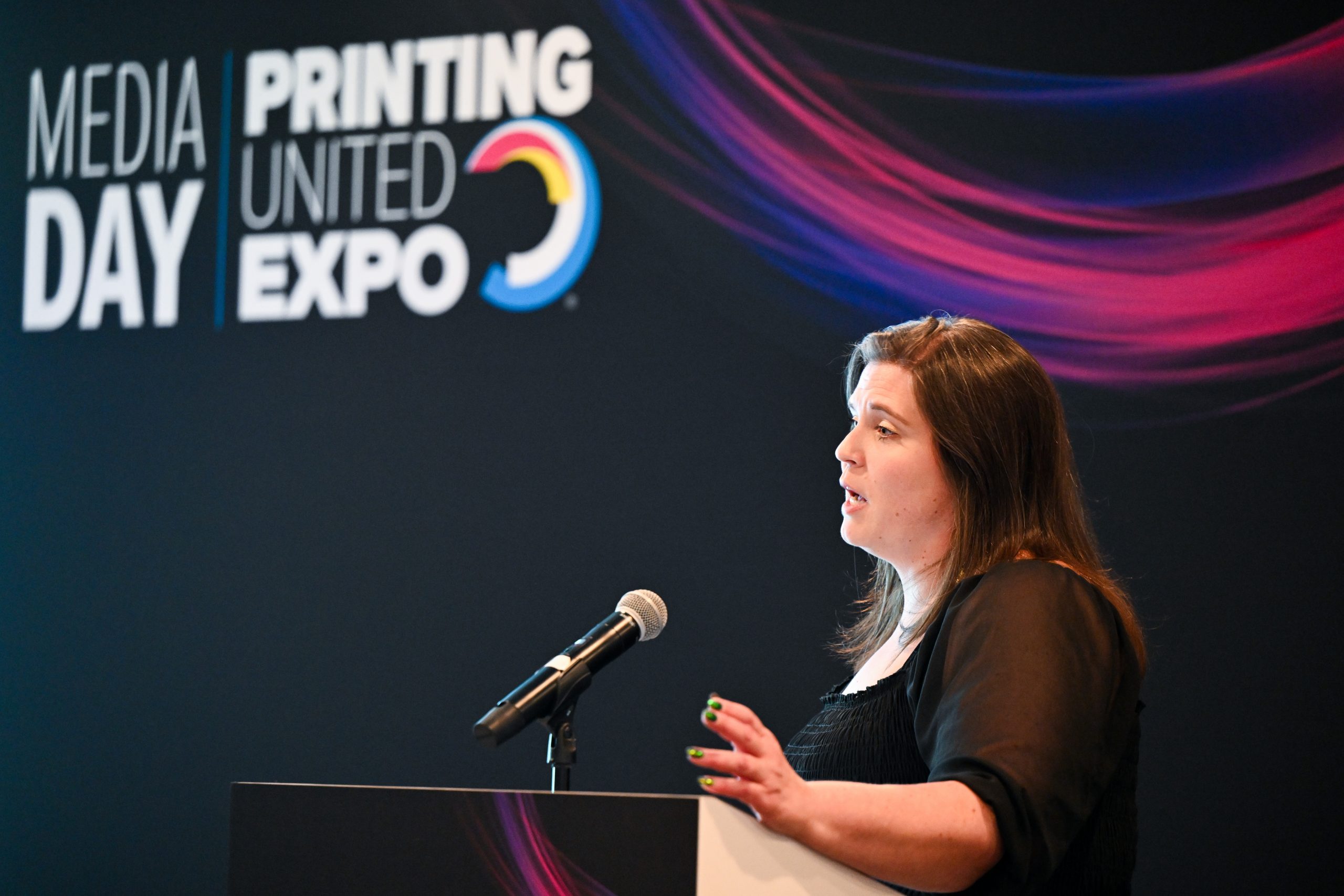
Becky McConnell, marketing manager for Durst Image Technology U.S. shares insights about what Durst is highlighting during the Expo.
Durst’s Lineup
Making its North American debut, the P5 350 Core hybrid printer was positioned as an entry point into Durst’s P5 platform. Its configurable design supports up to 10 channels, rigid and flexible materials, and varying levels of automation. Businesses can adjust their configurations as production needs change, including adding color channels or expanding automation.
“It's a printing solution that evolves with PSPs,” McConnell said.
McConnell also emphasized operator accessibility as print providers contend with hiring and training challenges. Equipment that is easier to learn can help businesses reduce the burden associated with turnover while keeping production moving. The Core also offers an option for specialty applications alongside higher-volume equipment, allowing shops to pursue additional work without diverting their fastest machines.
Durst’s broader lineup includes the P5 350 HS hybrid printer and P5 350 HSR roll-to-roll printer. Features discussed included faster media changeovers, simultaneous job processing, double-sided printing, inline finishing, and media handling designed to support industrial production. Durst Workflow and Analytics rounded out the offering, helping users manage PDF workflows, visualize printer data, and make informed production decisions.
Maintaining output quality remained central to its development. McConnell said, “We have a great reputation for printing great output, and we needed to stay there even with raising the productivity level.”
Software and Beyond
Beyond printing equipment, McConnell covered digital cutting technology from Hassler Solutions (Booth #C3204), a Durst Group Company, and the Open Software Initiative, which extends software capabilities beyond Durst systems. GMG Americas was announced as a reseller of initiative products, expanding access to its portfolio.
Another focus was Kyveris, described as Durst’s strategic intelligence system for digital production. By bringing files, machines, software, and data together, the system aims to optimize production performance.
Across the presentation, the emphasis was consistent: connect equipment, software, and finishing capabilities to help print providers manage growing demands with greater efficiency and flexibility. The approach puts long-term adaptability at the center of investment
Adobe: Every File Print-Ready Before It Hits the Press
Adobe (Booth N653) opened its Media Day 2026 presentation with a problem most print service providers know by heart: files are arriving faster, from more places, and in worse shape than prepress departments can handle by hand.
"The amount of online job ordering has exploded," said Mike Scrutton, Director of Print Evangelism and Customer Liaison, Adobe. "This is the norm now. It's not the exception."
Customers now upload files built in tools ranging from Adobe apps to Figma, order runs of dozens rather than thousands, and expect delivery within days. That leaves no room for manual intervention. "The truth that PSPs tell us is that if I have to open a file that's been uploaded by a customer once, I'm losing money on this job. There's not enough margin for me to be doing manual inspection [and] manual correction of files," Strutton said.
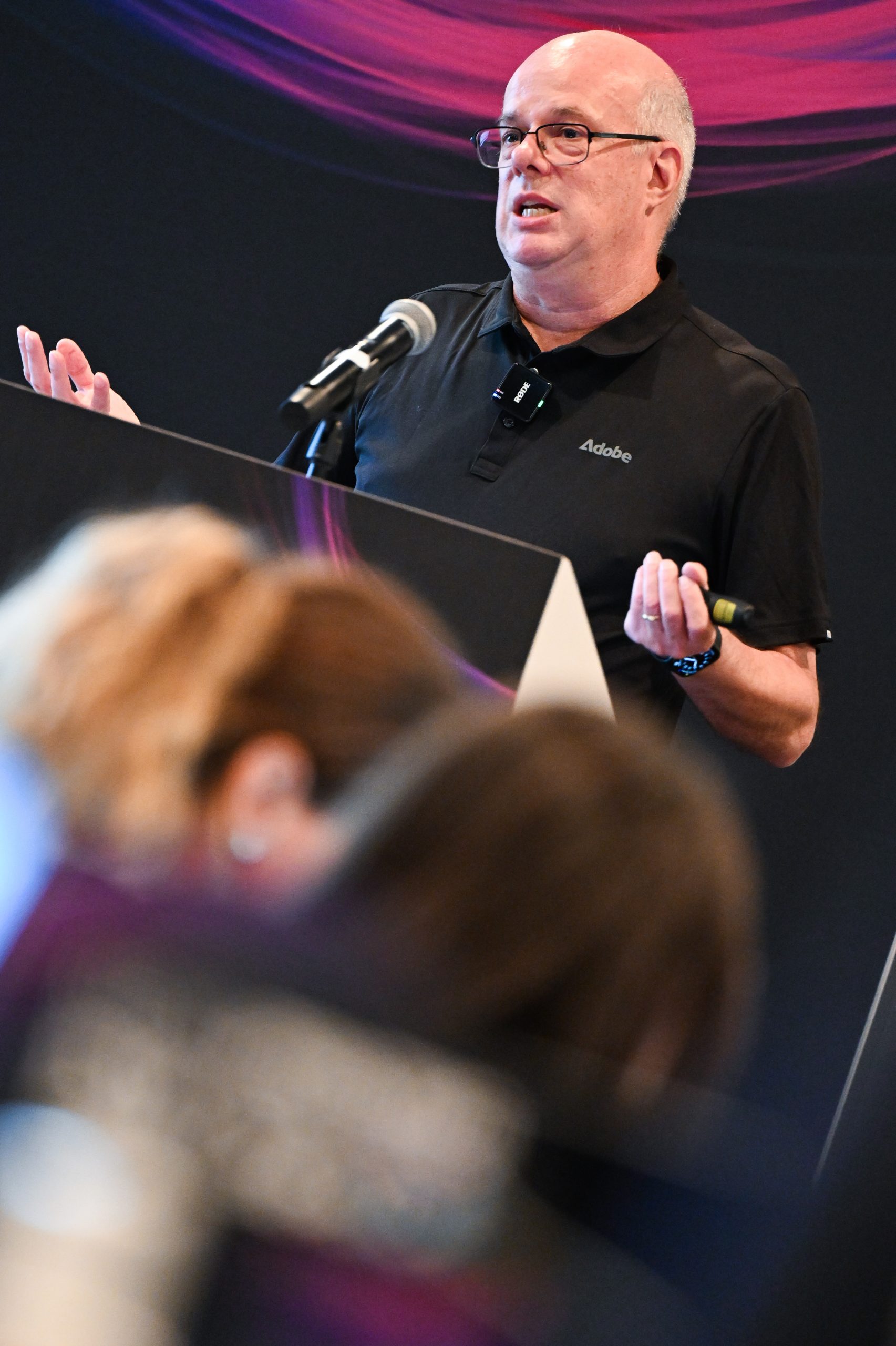
Mike Scrutton, Director of Print Evangelism and Customer Liaison, Adobe, addressed challenges print service providers face.
Embellishment adds another layer of pressure. Metallics, digital foiling, and spot UV command higher prices, but Strutton argued that the additional prep work can erase the gain—boosting the top line while dragging down the bottom line. Meanwhile, experienced prepress operators are retiring, and fewer graphic arts graduates are entering the print industry.
"We want our people in our print shops focusing on the relationships that they have with their customers," he said. "Making sure they're on brand, that they're understanding and delivering what the customers ask for, and not on the grunt work."
Adobe's answer is Adobe Print Services, which sits as an AI layer between document creation, whatever the application is, and the press room. “Adobe Print Service is there to make every file print-ready before it gets to a press room” Scrutton says. It has three components.
Adobe Print Ready corrects, enhances, and optimizes incoming PDFs. Its AI-powered Smart Select tool inspects each job, identifies issues, and hands the fixes to another agent in the system. Reports and previews let operators review changes before output. "We're always keeping humans in the loop. We're not just doing this blindly," Strutton said. Print Ready also borrows Photoshop filters for image scaling, targeting the smartphone photo that "looked fine on my phone. Why did it print blurry?"
Adobe Finish Ready handles what happens after printing: generating bleeds, including on non-rectangular signage files, creating cut paths for laser and flatbed cutters, and nesting jobs on press sheets.
Adobe Print Embellishment Ready translates embellishment data in a PDF into instructions for inline or offline finishing equipment. It can also suggest where spot UV might enhance a plain CMYK or RGB file, opening upsell opportunities. Print providers investing in high-end finishing, Strutton said, are "only going to make money from their high-end solutions if they can keep those devices fed with high-quality content."
"We're shipping it now," he said. As with Adobe's other print technologies, the suite is provided to partners as a software development kit.
Then came what Strutton called a California press conference tradition: one more thing. "The PDF print engine that you've known and loved for the last 20 years is now GPU ready," he said. He described it as "a simple drop-in for our partners."
Xerox, Konica Minolta and ECO3 are demonstrating partner products built on Adobe technology at PRINTING United Expo this week. Adobe will also appear in the Printing AI Pavilion, where Strutton speaks Wednesday at 10 a.m. on what to trust AI to do.
Mimaki: Big, Small, and Fluorescent
At the beginning of his Media Day presentation, Josh Hope, director of marketing at Mimaki USA (Booths C1761, C3279) mentioned the company has much to cover at these types of events, and this year would be no different. He outlined a handful of new product releases, covering flatbed UV printers and a family of textile-focused solutions.
Hope began with an overview of the new JFX220-2515, a UV flatbed that offers a bed size of 89x59”, allowing room for a 4’x8’ board and then some. He highlighted new features including a new bed vacuum system offering ten-times the power, the addition of fluorescent pink and yellow inks, and long-throw printing that ensures accuracy at distance of up to 18.5mm from the print head. He shared the printer is 200% more productive – a development enabled by the addition of dual CMYK, as well as offering enhancements that save time and help ensure quality. Both hard and soft inks enable a wider variety of printed applications.
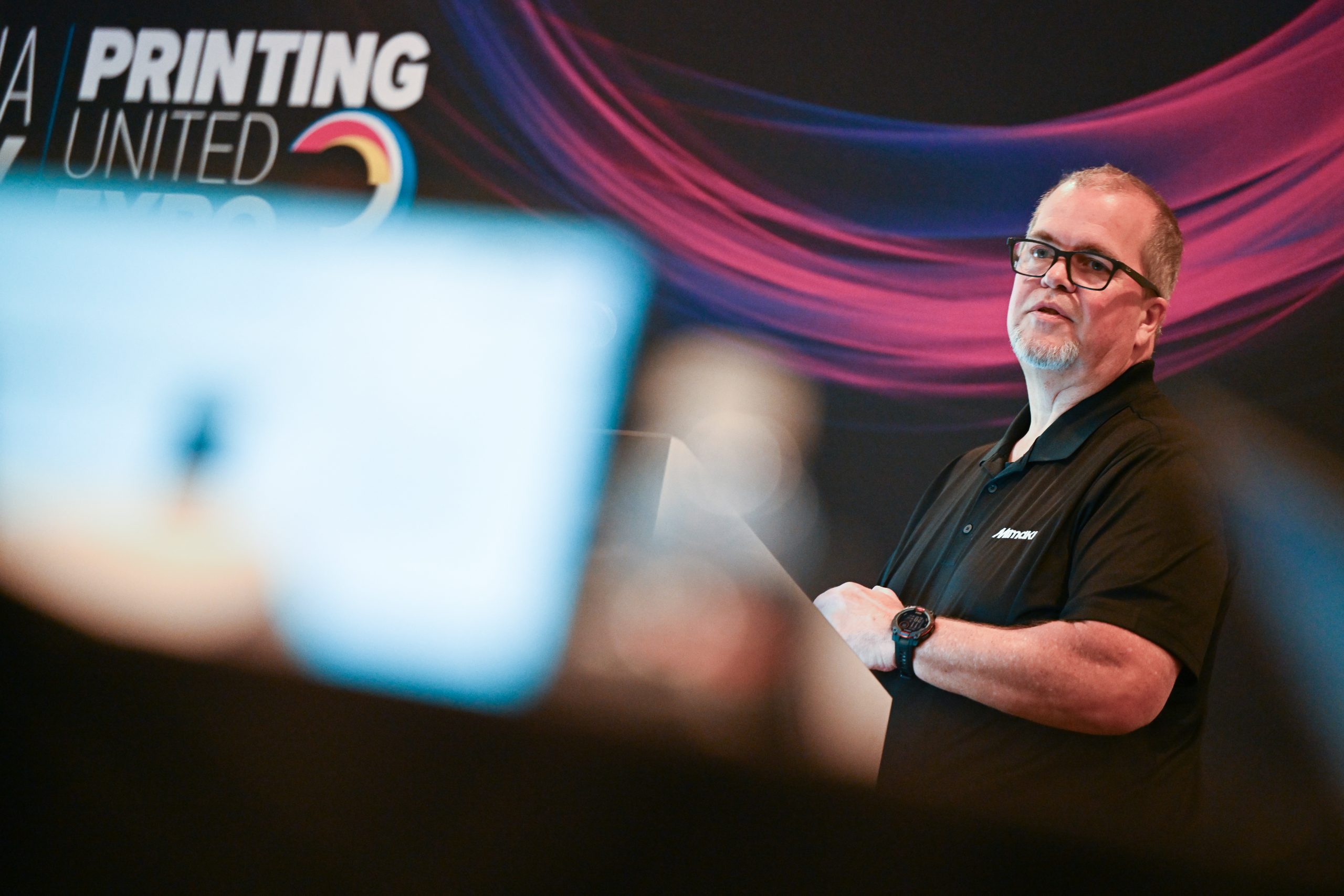
Josh Hope, director of marketing at Mimaki USA, shares what the company is showcasing at this year's Expo.
Also new at PRINTING United Expo is the UJF200 series of benchtop UV-LED flatbed printers. These new systems – one with a bed size of 16.5x11.8", and the other coming in at 16.5x24" – both now use a single printhead, allowing simpler maintenance and is able to print texture to a depth of up to 2.5mm as well as Braille. These systems also include fluorescent ink capability.
Strengthening Mimaki’s storied history in textile printing development, Hope briefly spoke of the TxF330-800, a well-equipped dye-sublimation printer offered at an entry-level price point.
Mimaki’s releases at this year’s PRINTING United Expo are not limited to printers. He also announced the L-mecanica LAR-63, a 64” heat-assisted laminator manufactured by a company recently acquired by Mimaki.
Hope shared that Mimaki is currently taking orders for the systems mentioned above. Most will begin shipping in October.
BELLA+CANVAS: A New Chapter Under SanMar
Diving into the rich history of BELLA+CANVAS (Booth C1195), Carissa Richmond, director of National Sales, gave members of the media insight on the company’s roots in apparel and fashion. Richmond spoke on its industry-leading development of women’s styles and walked through its most recent acquisition by SanMar.
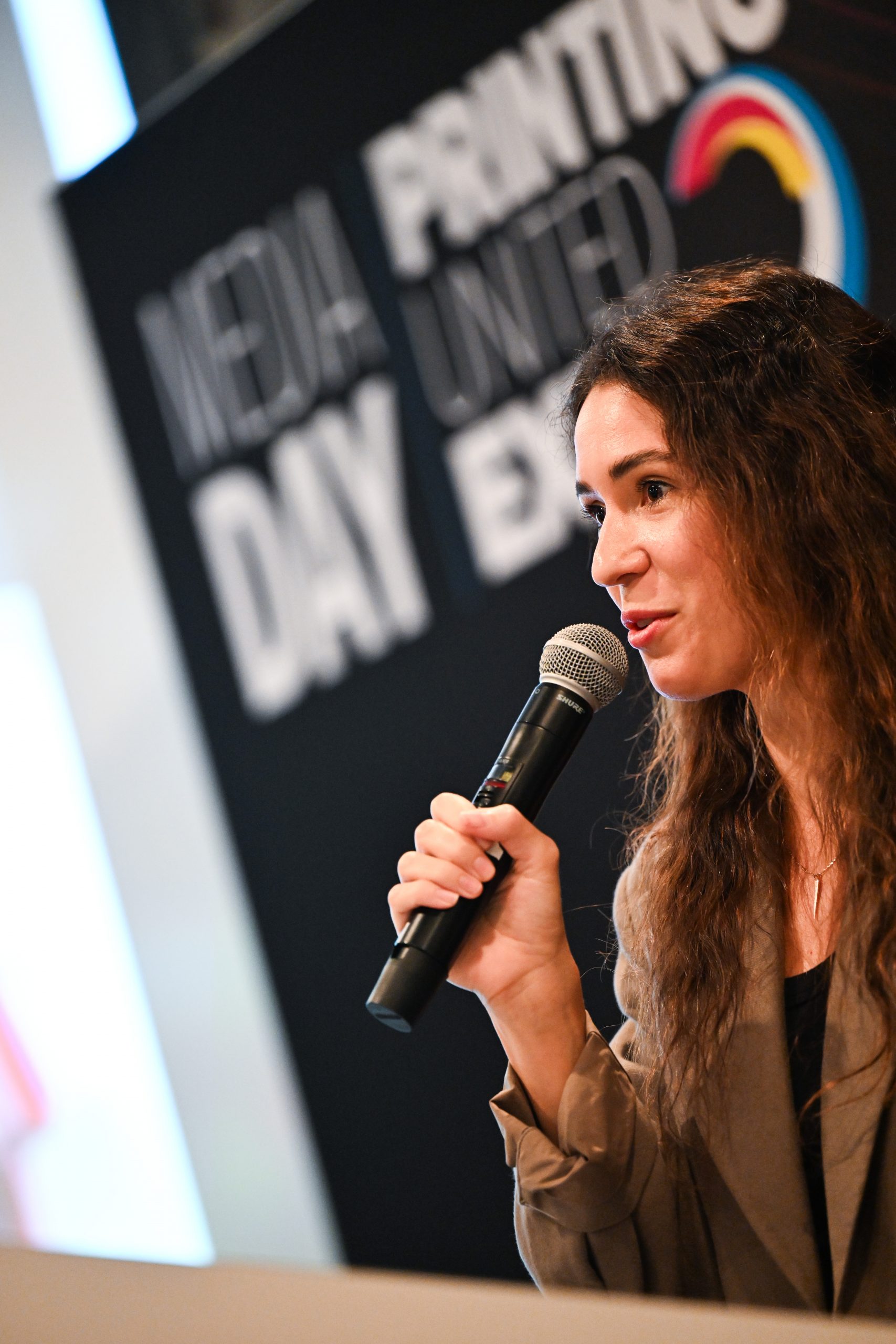
Carissa Richmond detailed BELLA+CANVAS’ rich history in apparel as well as its involvement in PRINTING United Expo 2026.
The news was big in the apparel industry, Richmond noted. “We couldn’t be more excited for this next chapter of the brand,” she told the crowd. “BELLA+CANVAS is one of the biggest fashion brands in our industry, and SanMar is one of the biggest distributors, so to have that infrastructure on the back end to support us, we couldn’t be more excited … for this partnership.”
She also outlined the company’s newest styles, starting with the fall 2026 lineup that was released in July. She also previewed what the brand has in store around January 2027, teasing that there will be approximately 23 new styles coming in that line.
For these big reasons, Richmond explained that it was important that BELLA+CANVAS have a strong presence at PRINTING United Expo 2026. As a diamond sponsor of the event, BELLA+CANVAS was engaged in multiple areas of the show floor. Not only could attendees experience its products firsthand in its booth (C1195), but they could engage with the brand in the Apparelist Live! Theater.
The company also sponsored two happy hour events in the Apparel Zone (C1485) on Sept. 23rd and 24th from 3-5 p.m. In addition to Expo-hours engagement, BELLA+CANVAS partnered with MADE Laboratory for an after-hours event, Print’s Not Dead, held at the Punk Rock Museum on Sept. 23.
“We have a lot going on,” Richmond said. “This is a great way to connect with our customers. …Please come by, touch and feel everything that we have new coming through the pipeline.”
STAHLS' Powers On-Demand Fulfillment as Branded Merch Meets the Moment
STAHLS' (Booths C2161, C2449, C4211) is connecting e-commerce, production routing, and decoration through its Fulfill Engine, giving businesses a way to expand their branded merchandise offerings without necessarily adding inventory, equipment, or staff.
During Media Day, Josh Ellsworth, chief revenue officer at STAHLS', outlined how the company is responding to buyers' demand for speed, choice, and flexibility. Fulfill Engine can capture orders across platforms including OrderMyGear, Chipply, commonsku, and Shopify, as well as through its own web store solution.
From there, the platform handles production routing across a catalog of more than 8,000 products spanning apparel, drinkware, home accessories, technology, and more. It determines where blank products are sourced and which production facility handles each order based on factors including speed, cost, capacity, and proximity to the customer.
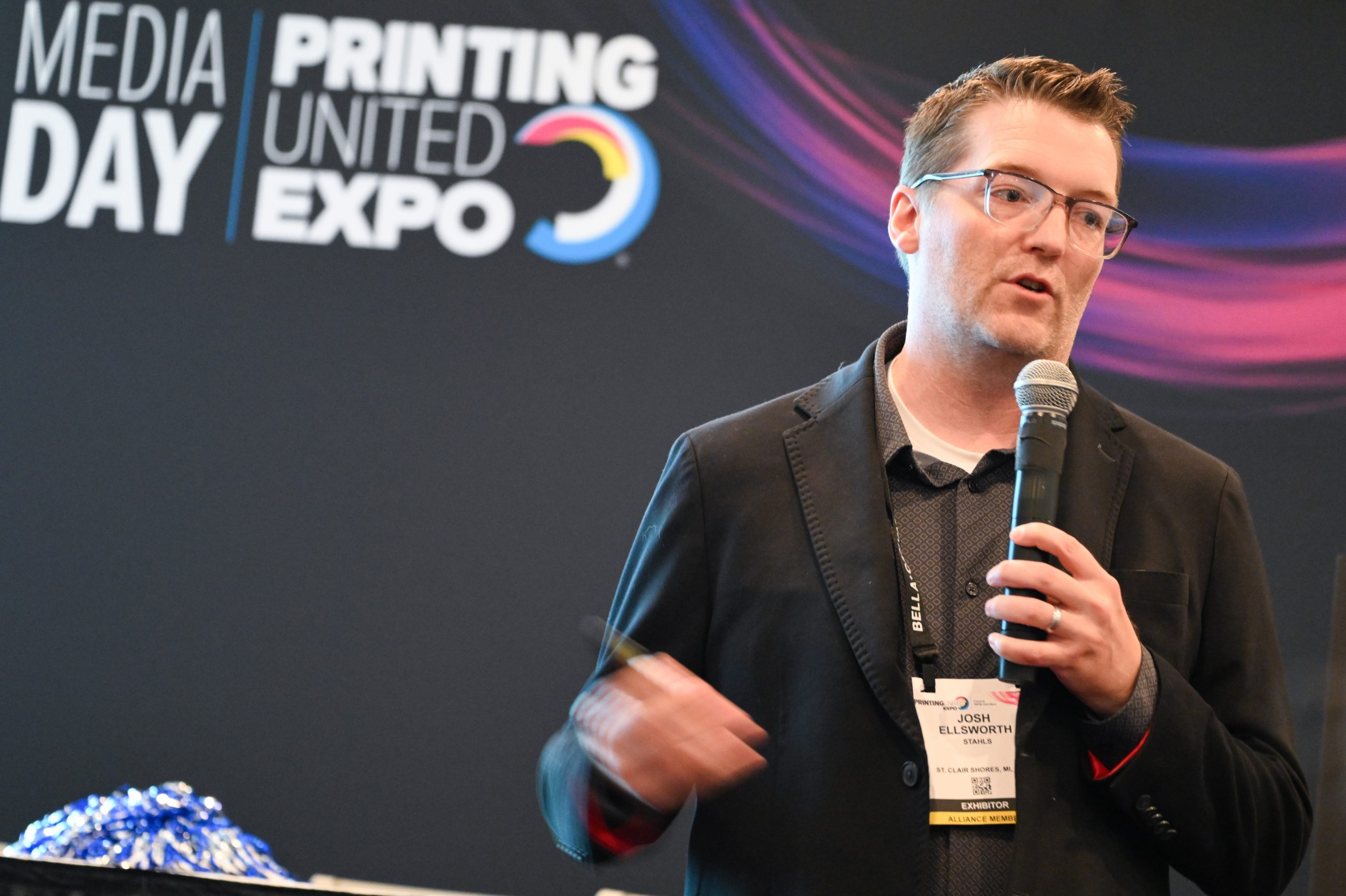
Josh Ellsworth, chief revenue officer at STAHLS', explained the company's Fulfill Engine.
The network also extends beyond STAHLS' traditional heat-printing roots, supporting UV printing, laser engraving, embroidery, screen printing, and direct-to-garment printing.
STAHLS' also highlighted its new Hotronix Carousel Heat Press, which integrates with Fulfill Engine for automated production routing. The press features automatic placement and optional automatic peeling and supports direct-to-film, screen-printed and hybrid transfers, patches, and sublimated twill.
With the auto-peeler, the press can produce up to 400 shirts per hour, compared with about 300 without it. Ellsworth said the system is best suited for runs of roughly 48 pieces or more, with about a three-minute changeover between transfer styles or job types.
For smaller shops or distributors, Fulfill Engine is a way to add scale without bringing every order in-house. A shop can continue producing work that makes sense for its own equipment while routing other products and decoration methods through the Fulfill Engine decorator network — expanding what it can sell without making the corresponding capital investment or adding specialized staff.

Ashley Roberts is Content Director of Printing Impressions.

Allee Bruce is the editor of Promo Impressions, a PRINTING United Alliance media brand.

Bob has served as editor of In-plant Impressions since October of 1994. Prior to that he served for three years as managing editor of Printing Impressions, a commercial printing publication. Mr. Neubauer is very active in the U.S. in-plant industry. He attends all the major in-plant conferences and has visited 200 in-plant operations around the world. He has given presentations to numerous in-plant groups in the U.S., Canada and Australia, including the Association of College and University Printers and the In-plant Printing and Mailing Association. He also coordinates the annual In-Print contest, co-sponsored by IPMA and In-plant Impressions.


Dan Marx, Content Director for Wide-Format Impressions, holds extensive knowledge of the graphic communications industry, resulting from his more than three decades working closely with business owners, equipment and materials developers, and thought leaders.


Elise Hacking Carr is managing editor for PRINTING United Journal, and the special projects editor.

Gabby Houck is an associate content editor for the printing & packaging group at NAPCO Media/PRINTING United Alliance.

Kalie VanDewater is senior content editor at NAPCO Media.

Toni McQuilken is the senior editor for the printing and packaging group.
 Are You Heading In the Right Direction with AI
 Preserving Institutional Knowledge | Part 3: How AI Can Help
 AI in Print: Data Readiness, Technology Alignment, and Unlocking High-Value Use Cases
 The Packaging Experience at PRINTING United Expo
 The Week that Was (8/31/26)
 Three Checks for AI Artwork Before the RIP
