


ColorArt Customer Alleges Millions in Postal Funds Disappeared, Files Suit Against JAL Equity and Eran Salu


Editor’s Note: What is reported in this article was taken from publicly available records — such as court documents and business entity formation documents — and previously published information. To further understand some of the allegations and claims, we spoke with several current and former employees under the promise of anonymity.
Following a voluntary bankruptcy filing by ColorArt – and its subsidiary Las Vegas Color Graphics – and then a subsequent emergency receivership appointment, one of ColorArt’s former customers has now filed a lawsuit against JAL Equity Corp. and Eran Salu, as an individual.
Centene Corporation v. JAL Equity Corporation and Eran Salu was filed late in December 2025 through the Supreme Court of New York County of New York. Centene Corp. — a healthcare enterprise listed as the top creditor on the ColorArt bankruptcy filing, owed $4,041,233 — alleges that it has attempted to “recover millions of dollars that, through a contractual relationship for printing services, were entrusted to ColorArt, LLC and held in escrow accounts for Centene’s benefit. Without explanation, these funds have now disappeared.”
The court document alleges that the aforementioned $4,041,233 is in dispute, and that Centene experienced a loss of $5,064,268.33 in postage deposits. The document also alleges that Centene is owed an additional $522,760.05 in “losses associated with postage, mailers, and other print inventory that are now unusable” and $360,000 in additional costs for temporary staffing and emergency backfill projects, which were necessary “to ensure continuity of service, compliance with regulatory obligations, and the uninterrupted delivery of member communications after ColorArt/Marketing.com’s abrupt failure to perform and refusal to return Centene’s funds.”
The lawsuit alleges that ColorArt enacted a “calculated campaign of delay and shifting excuses,” leading it to file for bankruptcy in 2025. It also alleges four counts against JAL Equity and Eran Salu, including breach of contract, unjust enrichment, conversion, and fraud.
Further, Centene alleges “ColorArt did not act alone. JAL Equity and its owner, Salu, exercised complete control over ColorArt, JAL Equity’s wholly owned subsidiary, and orchestrated a scheme to misappropriate Centene’s funds, refuse repayment, and shield themselves from liability.”
With this lawsuit, Centene seeks to pierce the corporate veil — a practice that is very difficult to do, according to Corporate Compliance Insights, which notes that a party intending to do so “must generally show that ‘the owners, through their domination [of the corporate entity], abused the privilege of doing business in the corporate form to perpetrate a wrong or injustice against the plaintiff such that a court in equity will intervene.”
The Details
According to the lawsuit, Centene and Cenveo entered into an agreement in February 2020, in which Cenveo would provide production and distribution of “large volumes of time-sensitive mailings and substantial prepaid balances to ensure uninterrupted service for Centene’s health plans nationwide.” In 2021, JAL Equity “quietly” built ColorArt into a national network by acquiring three Cenveo facilities in Eureka, Missouri; Amarillo, Texas; and San Antonio. Along with the acquisition of these select assets of Cenveo were the obligations of the agreement with Centene.
Under the agreement, Centene and ColorArt established prepaid escrow accounts to ensure sufficient funds would always be available to cover postage costs. The escrow accounts, as it is alleged in the lawsuit, are available “for the sole purpose of covering postage expenses” for Centene and “remained Centene’s property at all times.”
Monthly balances were apparently shared with Centene, according to the court documents. At no time was it made evident the escrow monies were being “drained or diverted,” which Centene alleges was done “under the direction of JAL and Salu.” Centene alleges JAL Equity and Salu “intended to defraud” Centene and omitted and concealed material facts, all to “buy time to divert funds.”
Another allegation made in the lawsuit is that JAL Equity, under the complete control of its owner Salu, has created a “sprawling network of dozens of other subsidiaries and affiliates” with Salu at the apex of its structure. Centene uses this to allege that the “corporate structure at issue in this case is a textbook example of domination and abuse of the corporate form,” which is in an effort to pierce the corporate veil.
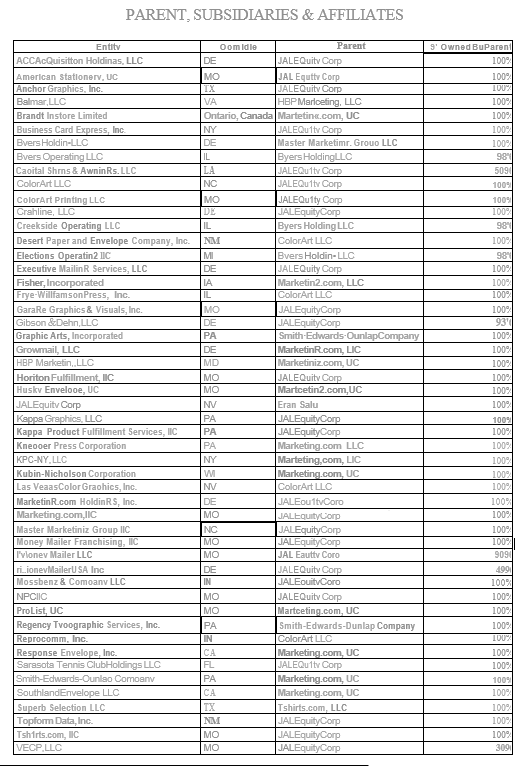
List of parent, subsidiaries, and affiliates of JAL Equity, found on page 14 of Centene Corporation v. JAL Equity Corporation and Eran Salu. | Click to enlarge.
The court document alleges — with public filings, registrations, and reports as its sources — that Eran Salu has been listed in every officer and director role of JAL Equity and that “the JAL web is a complex network of shell corporations … all ultimately owned by JAL and Salu,” as evidenced by the above image from the lawsuit.
This, Centene notes, is corroborated by the lawsuit brought by Aequum in Missouri. Centene writes that the Aequum litigation mirrors its own experience, noting it:
“ … provides further corroboration of this pattern of conduct. There, Aequum alleged that, under Salu’s direction, the Borrowers (including ColorArt and Las Vegas Color Graphics, Inc.) ‘have begun diverting funds to other businesses owned by Salu to avoid paying back Aequum’s loan.’ When confronted, Salu ‘admitted to the diversions and in the past few days has said multiple times that he would “do whatever he had to do,” including presumably stealing funds that had been pledged to and belonged to Aequum.’”
A Back and Forth on Motion to Dismiss
In response to the complaint, the defendants filed a memorandum of law in support of defendants’ motion to dismiss on March 13, stating that “because ColorArt is in active bankruptcy proceeding, Centene has no standing to bypass the automatic stay and bring a claim for breach of contract (by piercing the corporate veil) against JAL Equity and Eran Salu.”
The memorandum alleges that “any alter-ego claims belong to the bankruptcy estate,” and claims that piercing the corporate veil is an “extreme remedy,” and Centene does not provide sufficient facts.The memorandum further states that although the initial complaint from Centene alleges JAL Equity and Eran Salu “‘controlled’ ColorArt and ‘orchestrated’ a scheme to divert Centene’s funds,” the complaint does not provide facts detailing the claims.
Further, the memorandum states that the fraud, unjust enrichment, and conversion claims alleged in the Centene complaint all fail because “(1) because Centene does not allege that JAL Equity or Mr. Salu communicated with Centene, made any representations to Centene, or actively concealed anything from Centene; and (2) because Centene cannot hold JAL Equity or Mr. Salu liable for (otherwise nonactionable) representations made by others. And the unjust-enrichment and conversion claims fail because they impermissibly duplicate Centene’s breach-of-contract claim.”
In response to the claims that JAL Equity and Salu should be held accountable under alter-ego allegations, the memorandum states, “All that Centene offers to support those conclusions are allegations that JAL Equity and ColorArt shared common office space in Missouri, that various JAL Equity representatives held roles at companies in its portfolio, and that ColorArt otherwise failed to observe unspecified corporate formalities. On the last point, Centene references corporate filings associated with a different entity, Marketing.com. Centene alleges that ‘[p]ublic filings show that [Mr.] Salu is listed as the sole member of Marketing.com,’ not JAL Equity, which, Centene alleges, in fact owns Marketing.com.”
Following the defendant’s motion to dismiss, Centene filed a memorandum of law in opposition to the defendant’s motion to dismiss on March 24, stating:
“Defendants ask this Court to accept a fiction: that this case is merely a straightforward contractual dispute between Centene and ColorArt, LLC (‘ColorArt’), and that JAL and Salu are uninvolved parties who have been unfairly hauled into court only because ColorArt declared bankruptcy. In doing so, Defendants miss the forest for the trees. This action arises because Defendants, through their complete control of ColorArt, orchestrated a scheme in which millions of dollars that Centene entrusted to ColorArt were misappropriated and retained for Defendants’ benefit. Centene brings this action to hold the real decision-makers responsible.”
Directly responding to the claims by the defendants that there are not enough facts to support the alter-ego allegations, Centene wrote that “this is the quintessential case where piercing the corporate veil is justified,” noting that JAL Equity and Salu are attempting to “sidestep” the allegations by “demanding proof that can only be obtained through discovery into Defendants’ financial arrangements and organizational structure.”
Centene’s response claims that ColorArt’s bankruptcy filing “does not shield JAL and Salu from liability for their own conduct, and the automatic stay does not convert Centene’s personal claims against JAL and Salu into property of the bankruptcy estate.” It then reiterates that it “adequately pleads each of those claims based on Defendants’ control over ColorArt and their wrongful retention and misuse of Centene’s funds, with each claim grounded in independent legal duties and distinct elements.”
It reiterates its claims to justify piercing the corporate veil and alleges that it has adequately done so.
On March 30, JAL Equity and Eran Salu filed a reply memorandum of law in support of defendants’ motion to dismiss, writing, “Centene’s opposition to JAL Equity and Mr. Salu’s motion to dismiss confirms that the Complaint is a transparent effort to bypass the automatic stay, jump ahead of ColorArt’s secured creditors, and proceed directly to collect on ColorArt’s alleged contract debt from JAL Equity and Mr. Salu.”
It argues that Centene’s alter-ego theory is not unique and again rebukes the allegations in Centene’s complaint that “JAL Equity and Mr. Salu ‘dominated’ and ‘controlled’ ColorArt to the detriment of ColorArt’s ‘creditors,’ plural. Any creditor could make those allegations. Centene thus lacks standing to pursue a breach-of-contract claim on an alter-ego theory against JAL Equity and Mr. Salu.”
It notes that while Centene argued in its response that proof is obtained in the discovery stage, “New York law requires a plaintiff to allege ‘particularized facts’ at the pleading stage first. The First Department has explicitly rejected the approach that Centene takes here: plead conclusions (not facts) and argue in response to a motion to dismiss that discovery is needed to plead facts supporting those conclusions.”
It reiterates its claims from the motion to dismiss filed on March 13, and concludes “for the foregoing reasons, JAL Equity and Mr. Salu’s motion to dismiss should be granted.”
Note: This is an ongoing case and will be updated as new information becomes available.
JAL Equity and its affiliates did not respond to requests for comment ahead of publication.
Ashley Roberts is Content Director of Printing Impressions.


