


The Next Inkjet Investment May Be Beyond the Press


Production inkjet has changed the role and economics of print manufacturing, bringing digital flexibility, automation, and productivity to a broader range of applications and volumes. But as providers move more work to inkjet, the performance of the press is only one part of overall production performance.
Finishing: Production Inkjet's Next Frontier, an Alliance Insights study, examines what it takes to get more from production inkjet as volumes, applications, and production complexity increase. The research is based on surveys of 182 print providers, including 60 production inkjet users, and 207 communication buyers and influencers. The research was made possible with the support of Canon U.S.A., EMT International, Müller Martini/Hunkeler, and Tecnau.
Productivity Is Becoming a Workflow Issue
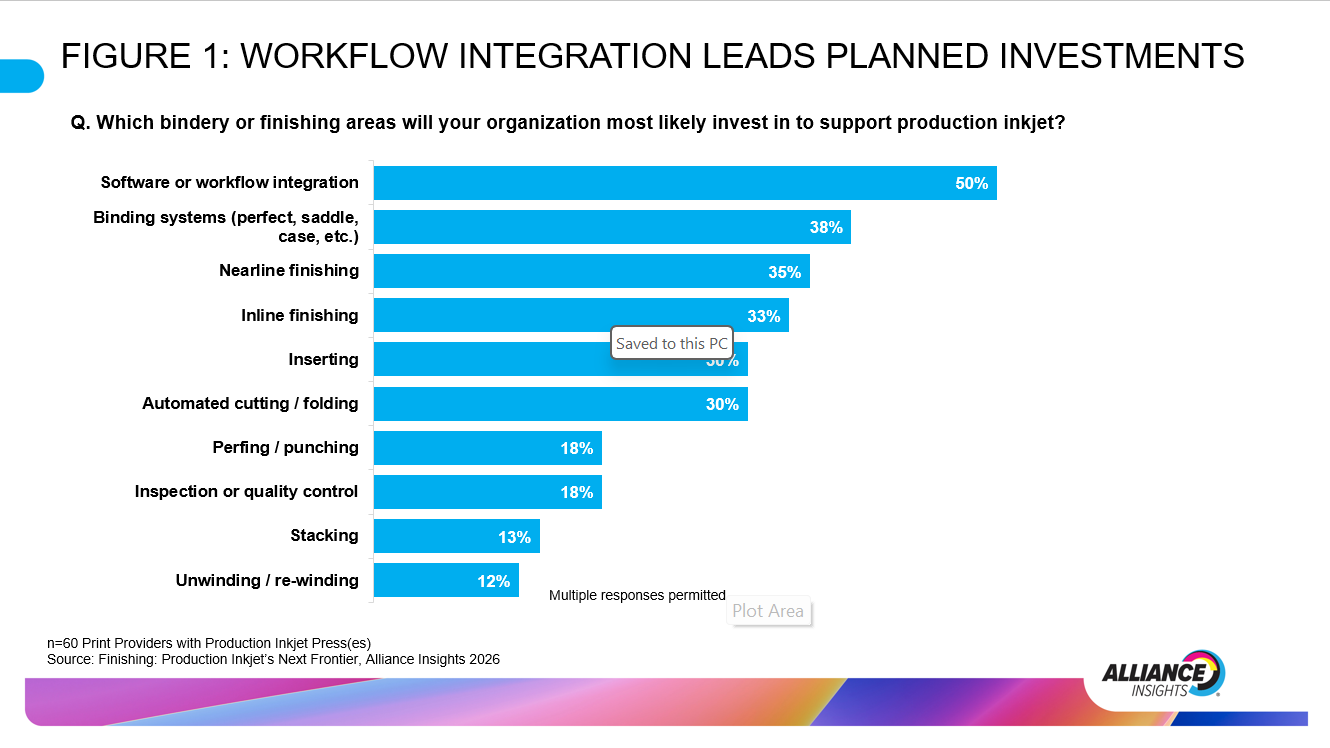
The research finds that the next productivity gains are increasingly tied to how efficiently work moves through the entire production environment, including workflow, automation, job setup, material movement, finishing, and the connections between systems. That shift is showing up in investment priorities. Software or workflow integration is the top planned investment among production inkjet users surveyed to support finishing, cited by 50% of respondents (Figure 1). Providers also plan to invest in binding systems (38%), nearline finishing (35%), inline finishing (33%), inserting (30%), and automated cutting and folding (30%).
Click to enlarge.
The findings point to a broader change in production inkjet optimization. The opportunity is no longer simply to produce pages faster, but to improve how work moves through the entire production process.
Automation at the Press Doesn't Mean an Automated Operation
One of the clearest opportunities is extending automation beyond individual devices.
Among production inkjet users surveyed, 63% say finishing setup is not fully triggered by job data, 60% report incomplete automation in the handoff between print and finishing, and 57% lack full automation in sending job-ticket data to finishing. Only 13% report fully automated feedback from finishing systems back into workflow platforms.
Manual activity also remains common in downstream production. Stacking and palletizing, inspection, folding configuration, binding setup, format changes, and job setup or makeready all retain significant levels of manual intervention.
The issue isn't simply a lack of automation technology. Seventy-one percent of production inkjet users identify integration complexity as a barrier to greater automation, second only to capital cost at 83%, while 62% cite uncertainty around ROI.
A provider can have highly automated equipment without having a highly automated operation. The opportunity is to connect systems so job data can drive downstream processes, production information can move with the work, and operators have greater visibility across the workflow.
More Applications Create More Complexity
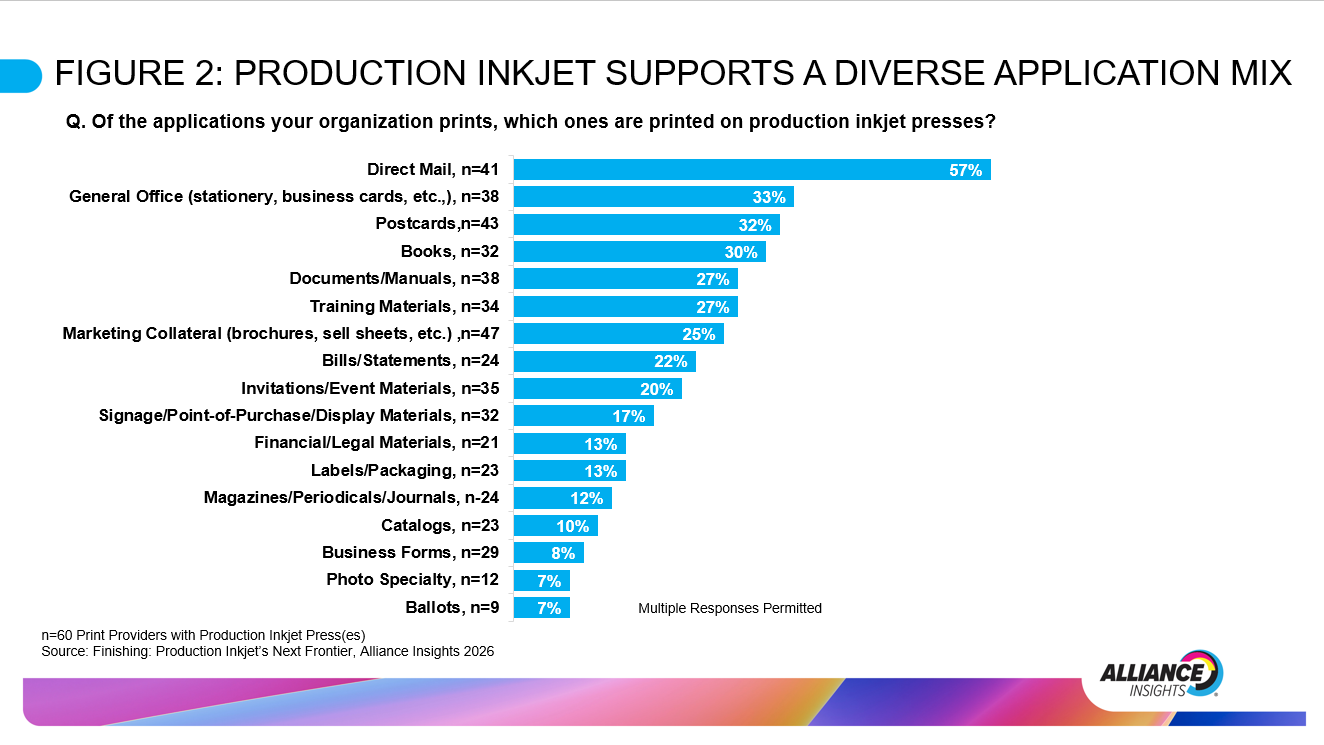
The need for a connected production environment is also being driven by what providers are asking production inkjet to do. As shown in Figure 2, survey respondents report using inkjet across applications, including direct mail, books, documents and manuals, training materials, marketing collateral, transactional work, signage and display graphics, labels and packaging, publications, and catalogs.
Click to enlarge.
That diversity is a strength, but it also creates operational complexity. Different applications bring different formats, finishing requirements, production paths, and turnaround expectations. Providers must increasingly balance speed with the flexibility to efficiently manage a varied mix of work.
Productivity and Customer Value Are Converging
Improving the production environment isn't only about efficiency. It can also help providers respond to changing customer expectations. Among communication buyers surveyed, 95% say enhanced finishing increases the effectiveness of printed materials, 88% consider finishing capabilities extremely or very important when selecting a print provider, and 70% expect demand for more complex or highly finished print products to increase over the next two to three years.
Providers therefore face a dual challenge: produce work more efficiently while supporting a more varied and sophisticated mix of applications.
Look Beyond the Press
The research suggests that realizing the next level of value from production inkjet requires a broader view of productivity. In fact, 88% of production inkjet users surveyed believe future finishing investments will deliver greater returns than faster inkjet presses, while 77% say finishing and workflow capabilities are increasingly influencing inkjet purchasing decisions.
The implication isn't that press technology matters less. It is that press performance alone doesn't determine production performance.
The next opportunity may be workflow software, system integration, automated setup, material handling, finishing equipment, greater production visibility, or a combination of these investments. The next phase of production inkjet will be defined by how effectively providers connect, automate, and optimize the entire production process.
Finishing: Production Inkjet's Next Frontier provides additional findings and analysis on production workflow, automation, integration, investment priorities, application requirements, and customer expectations. Download the full report.


