


Automation, Inkjet, and Expanding the Ecosystem

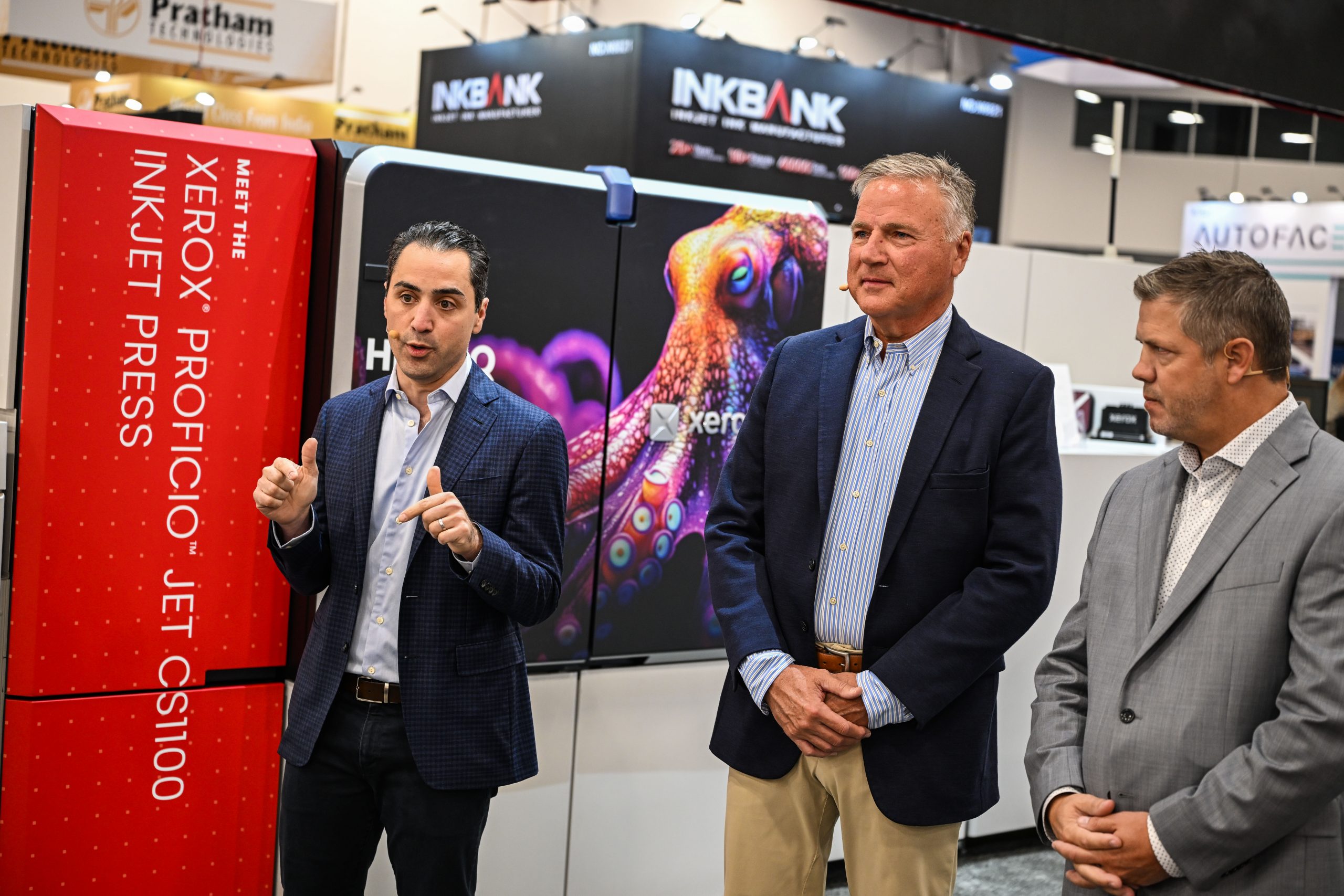
Louie Pastor, CEO of Xerox (left), along with Mike Jenoski, President and CEO, Goodway Group; and Terry Antinora, President, Global Production Print Services, Xerox, for the launch of the Proficio Jet CS1100 at PRINTING United Expo 2026.
Xerox knows it has to work on rebuilding trust after it exited the iGen space. At the recent PRINTING United Expo in Las Vegas, I had the opportunity to sit down with Louie Pastor, CEO of Xerox, to chat about where the company has come from, and where it sees the future of the printing industry heading — and how Xerox intends to position itself in that mix.
The energy at the booth this year was strong, with multiple new product launches and a good crowd. But, Pastor noted, Xerox knows it has to work on rebuilding trust after it’s exit from the iGen space.
He said, “the customers were, ‘what does that mean for us,’ right? And we committed, orally and contractually, to support and service and supply them, and ensure that [they were] running reliably and consistently while we work on the new products that are coming next. And now to have had those customers go through that journey with us, but then see what those new products actually are and how they perform and how they're differentiated — it's very rewarding.”
One of those new products is the Proficio Jet CS1100 production inkjet press, which was officially launched at Expo, along with the introduction of the first customer, Goodway Group. It joins several other presses in the new Proficio line, and helps establish the portfolio Pastor sees for the future. “One portfolio, every print opportunity,” he stressed, which was also the tagline for the entire Xerox strategy going forward.
He explained, “we want to enable our customers to capture as much of the market that's actually available to them. So focusing on the dynamics in those markets, as well as the challenges and opportunities that our customers have, and ensuring that our portfolio of offerings[meets those challenges], because it transcends hardware. It's the software, it's the supplies, it's distribution, it's service, it's everything around it. Ensuring that we're doing delivering it in a way that enables them to improve the outcomes of their business, both on the bottom line, so greater efficiency and productivity, but also to capture the market opportunities.”
That said, when he thinks about the future of the portfolio, he noted that Xerox certainly plans to broaden its offerings anywhere it makes sense to meet that mission, but it is also looking at partnerships where it makes sense.
Pastor noted, “does that mean we're going to be in every single segment and subsegment? I mean, one of the interesting things about being at a show like [PRINTING United Expo] is you get an appreciation for how many niche applications and providers there are. So, do I envision a world where Xerox has one portfolio that literally encompasses everything that's offered at a show like this? No, but I do think that over time, what you're going to see is we're going to continue to broaden out what we're doing.”
In particular, he noted that the partnership with Xeikon that was announced in September is a good example of what to expect on that front, allowing Xerox to get into the packaging and label space through that connection, and Pastor noted that there will be more to come on that front, as well as additional partnerships in the future.
A Changing Industry
When it comes to the trends Pastor is looking at, that are shaping not only the Xerox strategy today, but also where it will go in the future, one of the big ones has been the rise of high-speed inkjet displacing both offset and toner in a wide range of applications. And the quality of what is coming off those presses, he stressed, would have been impossible even 10 years ago. The technologies have evolved quickly, and Xerox has needed to evolve with it.
“Clearly one trend is a move towards inkjet based on what we can now do with at high volume, with incredible image quality, with differentiating economics,” Pastor noted. “Those are things that 10 years ago, 20 years ago [wouldn’t have been possible]. I mean, when we put the quality of the samples against what used to come out of an iGen —what still comes out of iGens today — now you're seeing it done with inkjet. Clearly that's a trend that is going to continue. In general there's still that broad-based move and opportunity to move things off of analog and offset into digital that we want to lean into, and we want to o make sure we build our portfolio out in a way that really allows us to capture some of those volumes. It's not just about us; it's about our customers.”
Thinking ahead, however, it’s about more than just press technology. When Pastor thought about what Xerox will look like 10 years from now, at PRNTING United Expo 2036, he explained, “I would start with automation. I think more than anything else, there's going to be even more automation, and it's not just about the hardware, because truly the automation comes kind of from the firmware and the software. It's the capability to do the automation, and you can see the beginning of it today in the CS1100 because we've got the self-correcting heads, and the ability to do different droplet sizes, which allow you to self-correct on any run, and making it so that every press can run continuously without any intervention from an operator. You can run multiple jobs, feed them through one after another, I think that's really the future, right? It is a fully automated ecosystem of machines where you have very little intervention from a human being, and what that can unlock in terms of productivity is unbelievable.”
The proverbial elephant in the room, of course, is AI, which goes hand-in-hand with many of the advanced automation systems coming to market across the board. AI, in many respects, is the engine of automation, and Pastor doesn’t see that changing any time soon, with more advanced tools coming to market, more advanced firmware that can interface directly with the press to automate even things like maintenance or solving minor malfunctions without needing operator interference.
But, said Pastor, “that's just the tip of the iceberg of what the opportunity is. I think the other thing where AI is going to play a major difference is there is so much prepress work, right? I need to take an image and convert it to a particular type of file that makes it so it can run on a particular type of machine. And the more you can automate that, and not just automate it for efficiency, but also leverage artificial intelligence to actually increase the quality of the ultimate output. …If you're looking to get the most out of the investment you're making into the hardware, and where you're going to invest in the hardware, you need to be thinking about the full end-to-end, and that front end with the software that allows a user on their own to create more sophisticated outputs and embellishments that actually unlock the investment you've made — that's where AI, in the next one to three years, I think, plays the biggest difference.”
That said, Pastor is still incredibly focused on the human elements, both for his own team and the printers Xerox serves, focusing on giving people the tools they need to do the job better and faster, rather than remove them from the process entirely.
And for his own team, Pastor noted that “I'm really proud of the team that put this together. And by put this together, I mean starting with the engineers and the product developers, but all the way through to the sales organization, the marketing organization, the customers, the partners who have been with us on the journey. I think there's a lot of people who deserve a lot of credit.”
- Categories:
- Business Management - Industry Trends
Toni McQuilken is the senior editor for the printing and packaging group.


