


Target Report: What Is an Image Worth?

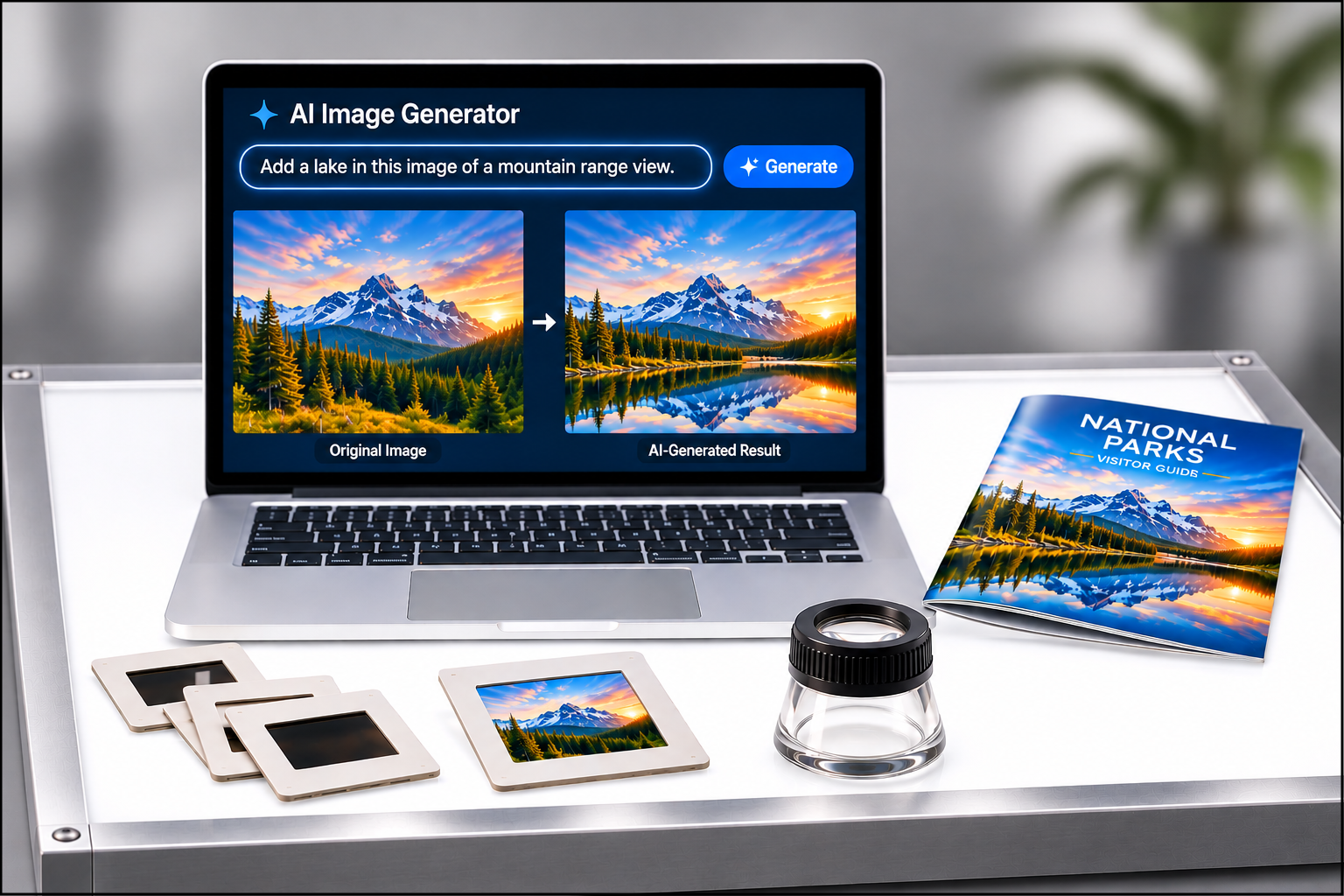 For the first fourteen years of researching, writing, and publishing The Target Report, we relied on stock photography to illustrate our monthly commentary. We would search through stock photo and image libraries, seeking an image that illustrated the central theme of that month's article. Sometimes we found exactly what we wanted. More often, we settled for something that came close or needed some additional retouching to make it work.
We purchased images as needed, paid the licensing fees, and incorporated the selected image into the monthly report and the cover of The Target Report Annual Review. Then along came generative artificial intelligence.
When writing the November 2025 The Target Report: New Consolidator Emerges, I imagined two Jenga block stacks, one solidly constructed, standing next to another tower that was wobbly and apparently ready to fall. The article compared two consolidators: one thoughtfully built over many years and another assembled willy-nilly over a short time with no apparent overarching strategy and which had just tumbled down in litigation and bankruptcy filings. I knew what I wanted but could not find a stock image that I could clearly see in my mind’s eye. I turned to ChatGPT, new to me at the time, and after several tries, I had exactly the image that I wanted.
I discovered that I could describe the concept I wanted to illustrate and have an image created specifically for the purpose. It was no longer necessary to search through existing image libraries, adjust our editorial vision to fit what was available, or pay a separate licensing fee for each image. Every image we have used since then has been generated by AI.
Our experience raises a question for companies such as Getty Images: what happens when customers can create the images they once paid to license?
Getty Images Changes the Business of Images
The company traces its origins to 1995, when Mark Getty and Jonathan Klein set out to build a business that would consolidate photographic collections and make imagery more readily available to customers worldwide. The timing was insightful and fortuitous. Photography was transitioning from an analog business, dependent on physical images, transparencies, and complicated distribution channels, to an increasingly digital business in which images could be searched, purchased, and delivered electronically.
Backed by the immense fortune of the Getty oil family, they set out to aggregate the image business by purchasing existing image libraries instead of slowly building from scratch. They recognized the impact that the internet would have on the image business, both in searches and distribution, and began digitizing images to create a centralized, searchable digital library.
Getty grew through acquisitions of photographic archives and competing agencies, assembling a vast library of creative, editorial, historical, sports, and entertainment imagery. Its customers included advertising agencies, publishers, newspapers, graphic designers, and businesses that needed visual content but lacked the resources or inclination to create every image themselves. Getty helped solve a genuine problem. It made it easier for customers to find and license images, and for photographers and archive owners to earn money from them.
The company also established a significant presence in editorial photography. Getty became an ancillary revenue source for the struggling newspaper industry, which produced many of the most meaningful photos in the library. As recently as this past October, Getty announced an agreement to distribute photographs and videos produced by the local newsrooms of Lee Enterprises, whose network encompasses 193 owned and managed media brands across 28 states.
Getty Images went public in 1996, was taken private in 2008, acquired in a secondary PE buyout in 2012, returned to the Getty family’s control in a 2018 buyout, and returned to public ownership in 2022 through a SPAC transaction that valued the business at $4.8 billion, including debt. The company generated approximately $978 million in trailing twelve-month revenue through June 2026; however, this substantial revenue was not enough to overcome its financial obligations.
Getty Images Seeks Bankruptcy Protection
Getty Images filed for Chapter 11 bankruptcy protection on October 21, 2026, entering a prepackaged financial restructuring intended to reduce its debt and return the company to private ownership.
In its bankruptcy disclosure, Getty attributed its financial distress principally to judgments and interest exceeding $200 million arising from disputes with warrant holders associated with its public listing, the collapse of its proposed merger with Shutterstock, and approximately $239 million in annual debt service. At the time of filing, the company had approximately $1.46 billion in funded debt. The bankruptcy was intended to restructure those obligations while the business continued operating.
By early October, Getty Images’ equity market capitalization had fallen to approximately $21 million, and its shares had lost about 99% of their value since the company returned to public ownership in 2022. Under the proposed restructuring, existing shares would be canceled, leaving shareholders with no recovery on those shares.
The proposed restructuring of Getty Images would transfer full ownership of the company to Getty family affiliates and Koch Equity Development upon the investment of up to $533 million. Both the Getty and Koch groups held substantial equity and debt positions. They used their stakes to control the process, orchestrate the new equity infusion, and convert debt to new equity. In addition, Koch Equity Development provided the interim financing to see the company through the bankruptcy process.
Alongside the financial pressures, generative AI presented both a competitive threat and a new market for the stock-image companies. Both Getty Images and its main competitor, Shutterstock, had immediately recognized that their collections had value as training material for AI systems. Shutterstock licensed content to developers including OpenAI and Meta.
Getty also pursued AI licensing and partnerships, while taking legal action over what it viewed as unauthorized use of its photographs, most notably against Stability AI, the company behind the Stable Diffusion image generator, a groundbreaking text-to-image model. Getty lost the key UK claim against Stability AI in November 2025, while the US case is still pending in California. Litigation costs piled on top of the other problems.
For Getty, an AI developer could be a paying customer or a defendant, depending on whether it had obtained permission to use the company’s images. Asset protection and data monetization were therefore not competing business models, but complementary efforts to get paid for the use of its collections. Yet both Getty and Shutterstock faced an uncomfortable question: could the revenue earned by supplying images to train AI systems compensate for the traditional image-licensing business those systems might eventually replace? They were finding new customers, but those customers were building tools that likely will reduce the need for their original product.
From Searching to Creating
For decades, obtaining a photograph or illustration generally required someone to create it first. An AI image generator approaches the task differently. In simplified terms, during training, it learns mathematical patterns from images and the words used to describe them. From many photographs of dogs, for example, it develops a mathematical representation of what a dog looks like—its shape, fur, ears, and possible poses. Ask for a golden retriever sitting beside a mountain lake at sunset, and the system can draw on those learned patterns to generate an image that fits the request. The customer is no longer limited to finding a photograph of a particular dog in a particular setting. Instead, the system can create a scene that no photographer ever captured.
That doesn't mean conventional photography is disappearing. There is an enormous difference between generating an imaginary scene and documenting an actual event. Editorial photography, historical archives, and authentic coverage of news and sporting events retain value precisely because the images depict something that actually happened.
The Image Business Changes
In its 2025 annual report, Getty Images noted under risk factors that “as these technologies become more accessible and capable, customers may opt for AI-generated content that bypasses traditional licensing models, impacting our revenue and market position.”
For some users, an image that is “good enough” at a lower cost may be sufficient. For others, including The Target Report, the greater attraction is control: the ability to create an image that fits the assignment rather than adapt the assignment to an available image.
For those of us old enough, we can recall when the Mac computer entered the printing industry and produced low-res typography that soon was “good enough” for most work. Critically, the Mac gave graphic designers more control over the process; quality improved, the cost advantage was compelling, and digital design programs eventually virtually eliminated the phototypesetting business.
AI Creates a Shift, Not a Demise
It would be a mistake to attribute Getty’s bankruptcy entirely to the rise of AI-generated images; however, the influence of AI was real and acknowledged by the company. AI will continue to shape how images are valued, sold, and used.
Getty's own recent results reflect the distinction. During the first six months of 2026, its creative imagery revenue declined, while editorial imagery revenue increased. Artificial intelligence is not the only factor affecting those results, but the competitive implications are apparent and likely to intensify.
Our decision to stop purchasing stock images for The Target Report was not based on cost and certainly not to save time. Developing an image that tells the story we want often takes longer than choosing a stock image. We simply found using an AI-generating tool to be a more effective way to accomplish what we wanted.
The question for stock-image companies is how many other customers are making the same choice. We still need an image that tells the story. The difference is that we can now create the image we have in mind, rather than settle for one we can find.
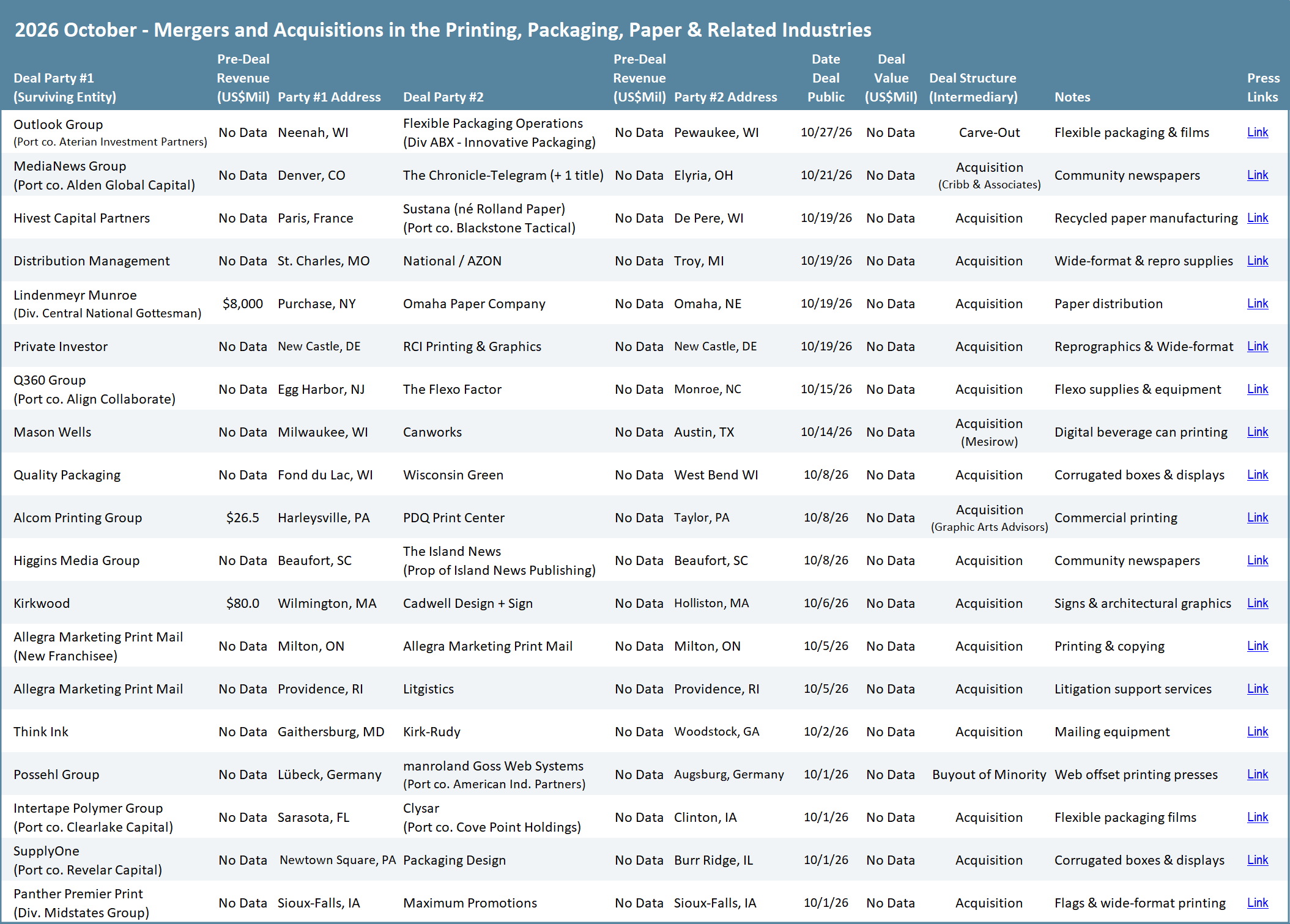
Click to enlarge.

Click to enlarge.

Click to enlarge.
View The Target Report online, complete with deal logs and source links for October 2026
For more information on Graphic Arts Advisors, visit graphicartsadvisors.com
Mark Hahn is a managing director and founder of Graphic Arts Advisors, a boutique strategic financial advisory and consulting firm focused exclusively on the printing, packaging, mailing, marketing services, brand management, and related graphic communications industries. With more than 35 years of graphic communications experience in the areas of finance, operations, sales, M&A, and general management, Hahn has served as chief financial officer, chief operating officer and other senior positions with several commercial printing companies, as well as founding and eventually selling his own printing company.The firm assists company owners and management, as well as their lenders, investors and shareholders in the following areas: mergers and acquisitions, sale of business, strategic and financial advisory, capital structure and funding, financial analysis, interim and turnaround C-level management, business valuations and serving as consulting experts. Hahn is the author of The Target Report and is regularly published and quoted in printing industry trade and management journals. Mark Hahn can be reached at (973) 588-7399 or mark@graphicartsadvisors.com


