


Target Report: Private Equity Bets Big on Digital Billboards


From Poster Panels to Electronic Displays
For more than a century, the billboard business depended on printing. From hand-painted advertising murals to multi-sheet poster panels to vinyl prints, outdoor advertising and commercial printing evolved together. Today, that relationship is beginning to unravel.
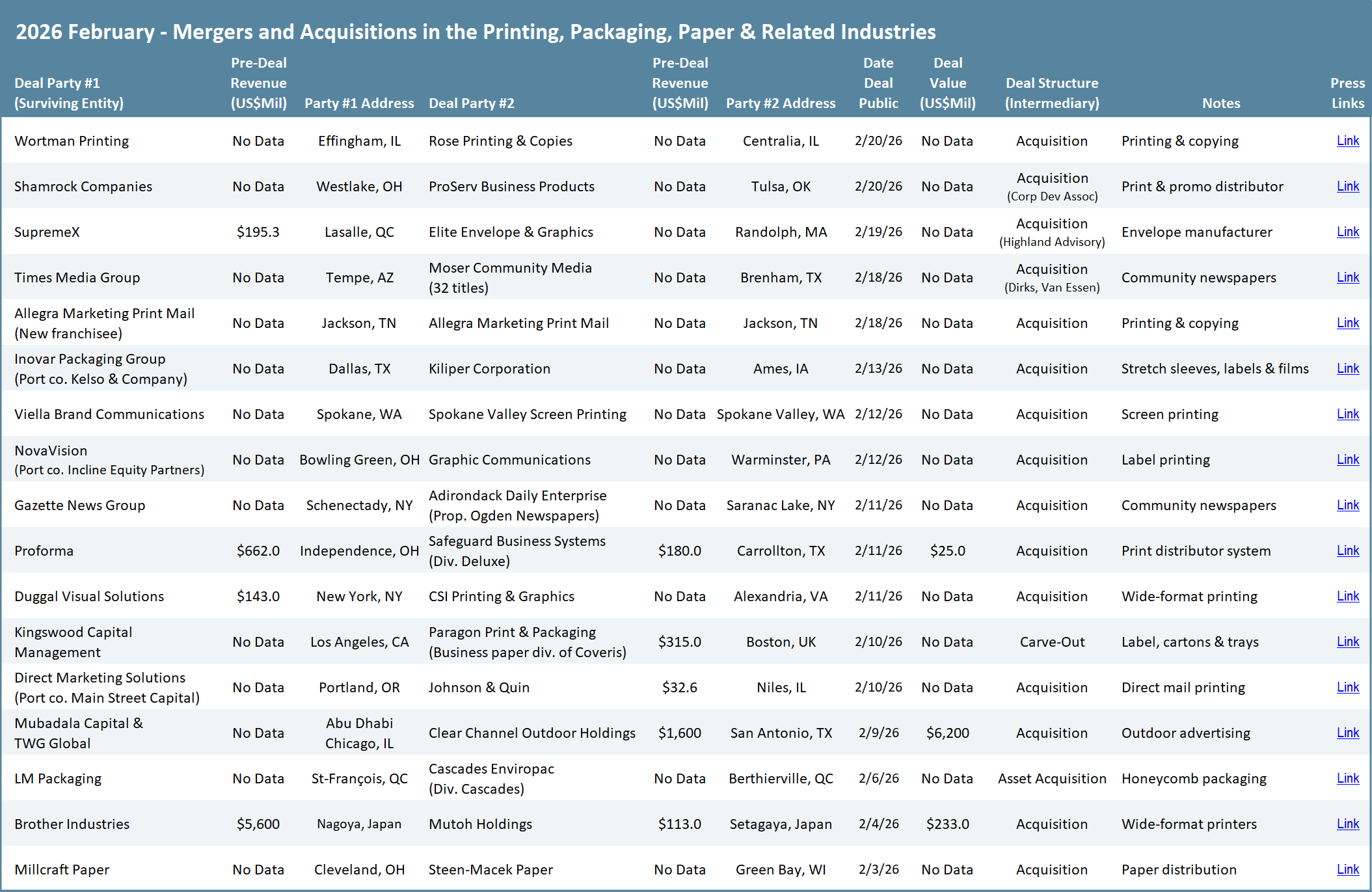
When Clear Channel Outdoor agreed in February to be acquired by Abu Dhabi-based Mubadala Capital and Chicago-based TWG Global in a $6.2 billion take-private transaction, the deal was widely framed as another step in the digital transformation of the out-of-home advertising business. The investor group highlighted Clear Channel’s network of roadside displays and airport signage as a platform for expanding electronic billboard infrastructure and data-driven advertising systems.
The combined funds’ interest in outdoor advertising is driven largely by the economics of electronic billboards. Once installed, a digital display can rotate multiple advertisements in rapid succession, dramatically increasing revenue per location while eliminating many of the logistical costs associated with traditional printed media. For operators such as Clear Channel, Lamar Advertising, and Outfront Media, converting static structures into LED billboards has become one of the industry’s primary growth strategies.
That transformation has been underway for two decades with the widespread introduction of LED displays. For the segment of the printing industry that supports outdoor advertisers, the implications are clear; every conversion of a billboard to digital technology replaces the many printed signs that would have been required over the coming years.
The Sign Painters
To understand the significance of this shift, it is worth recalling that billboard advertising itself has undergone several technological revolutions over the past century and a half.
In the early days of outdoor advertising, billboard graphics were not printed at all. Instead, they were hand-painted signs created by skilled artists who reproduced advertising imagery onto large wooden panels or painted directly onto the side of buildings. Sign painters often worked from small-scale illustrations, carefully enlarging the artwork across the billboard surface using grids or projection techniques.
Companies such as Foster & Kleiser, one of the pioneering billboard operators in the United States, helped popularize these early roadside displays, relying on teams of painters who traveled from city to city producing large advertising murals by hand. The company was the proving ground for several well-known muralists, artists, and illustrators. Most famously, the company’s artists hand-painted the iconic billboards on Los Angeles’ Sunset Strip, promoting rock-and-roll acts. (The company went through a series of name changes, sales, and acquisitions, and eventually disappeared into what is now Clear Channel Outdoor, the same aforementioned Clear Channel company.)
The 1889 Paris Exposition
In 1889, the French government sponsored the Exposition Universelle de 1889 in Paris to commemorate the centennial of the French Revolution. The fair showcased numerous technological innovations of the industrial age and introduced what would become the world’s tallest structure for more than four decades: Gustave Eiffel’s iron tower.
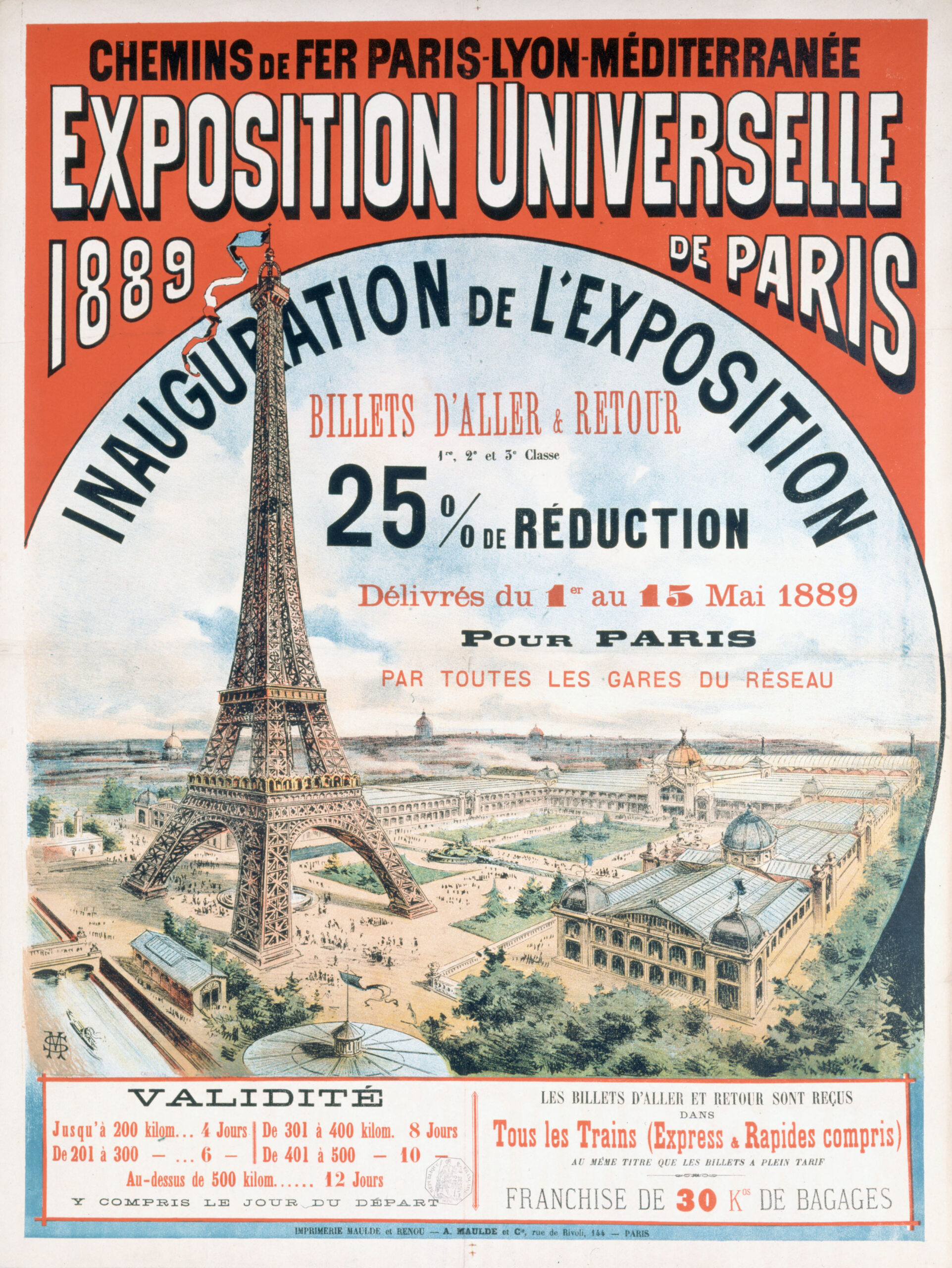
Poster promoting train to Paris fair.
Less well known, but possibly more impactful on today’s visual landscape, was the display of a large multi-sheet advertising poster at the fair by the Morgan Lithographic Company of Cleveland, Ohio. The billboard, originally composed of 24 separate printed paper sheets, formed a coherent large image when aligned and pasted together. The company, well known at the time for its colorful printed posters for the Ringling Brothers Circus, won the gold medal for its vibrant, saturated chromolithographic posters. These were produced by stone lithography, layering up to a dozen or more colors. The size of the stones limited the size of the sheet that could be printed, which led directly to the multi-sheet format for billboards.
No less important than the limitations of using stones in the printing process, the ease of transporting and installing manageable-sized sheets quickly led to the widespread use of multiple sheets to create large outdoor advertising. Eventually, the stone litho process gave way to large-format offset presses capable of producing sheets of the required size. Billboard poster sets were printed, trimmed with overlapping bleed, collated with numbered sequences, and packed for distribution. Installers, traditionally called “bill posters,” would climb ladders and scaffolds, glue and smooth the sheets to form a single billboard-size image.
Billboard Printing Becomes an Industrial Process
The introduction of mechanized large-format offset printing presses dramatically changed the process. By the early twentieth century, improvements in lithographic printing allowed billboard posters to be mass-produced on paper and assembled onto billboards in sections. This innovation enabled advertisers to distribute identical campaigns across multiple cities simultaneously, greatly expanding the reach of outdoor advertising.
Over time, the industry standardized the formats used for billboard posters. Smaller roadside displays typically used 8-sheet posters, while larger urban billboards relied on a 30-sheet format, printed in sections and assembled on site. These standardized formats allowed billboard operators to efficiently print and distribute advertising campaigns.
For most of the twentieth century, billboard advertising depended on these large-format printed posters produced in specialized printing plants and shipped nationwide for installation along highways and urban corridors. The production of these posters required some of the largest offset presses ever installed in commercial printing facilities, with sheet sizes up to 81 inches. A small group of printers developed the capability to manufacture these oversized graphics efficiently and became essential suppliers to the outdoor advertising industry.
Few companies embodied that business model better than Kubin-Nicholson of Milwaukee, whose oversized offset presses produced billboard panels that were shipped nationwide and pasted onto roadside structures. The company specialized in large-format graphics, including billboard sheet sets, transit advertising displays, and retail signage, and for decades served as a key supplier to the outdoor advertising industry. Its slogan, “Printers of the Humongous,” captured the essence of a company built around the oversized offset presses required to produce billboard posters and other large-format graphics.
For much of the twentieth century, this system worked remarkably well. The combination of large-scale printing and widespread billboard networks created a powerful national advertising medium. Printers such as Kubin-Nicholson played a crucial role in supporting that advertising system.
Wide-Format Printing Enters the Picture
The poster system that sustained billboard printing for most of the twentieth century began to erode long before the arrival of digital billboards. In practice, the decline of billboard poster printing had already begun decades earlier. Beginning in the late 1980s and accelerating through the 1990s, outdoor advertising companies increasingly replaced multi-sheet paper posters with large, printed vinyl “skins” stretched across billboard frames. Produced using screen printing and later wide-format inkjet printers, these skins eliminated the traditional thirty-sheet poster arrays that had long been printed on oversized offset presses. Installation became faster, the graphics were more durable, and the seams that once defined panelized posters disappeared.
For specialized printers that had built their businesses around billboard posters, the shift to vinyl skins marked the beginning of a steady decline in demand for large-format offset printing. Companies that specialized in offset sheets began investing in wide-format printing machines, including Kubin-Nicholson. However, as wide-format technology was deployed throughout the printing industry and many new entrants specialized in wide-format printing, supplying billboard graphics was no longer the tightly defined niche it once was. The capabilities and expensive capital equipment required to print, cut, and properly distribute printed paper sheet sets were no longer needed.
Kubin-Nicholson Shuts Down
Earlier this year, a chapter in the billboard story came to an end. Kubin-Nicholson ceased operations, and the company’s printing presses and finishing equipment were sold at auction. Among the equipment offered were oversized sheetfed offset presses and wide-format inkjet printing systems used to print billboard campaigns. The closure of Kubin-Nicholson represents more than the disappearance of a single printing company. It marks another step in the dismantling of the unique segment of the printing industry that once supported billboard poster production in North America.
When the Poster Is No Longer Needed
The technologies that once drove and enabled demand for billboard printing are giving way to a new system in which billboards are no longer printed at all. The transition will not happen overnight. Thousands of traditional billboards remain in operation across the United States, and printed posters will continue to be used in many markets for years to come. Poster panels still number in the tens of thousands across the United States, but those that remain use wide-format printed graphics rather than the traditional thirty-sheet paper posters once produced on large offset presses. The direction of the industry leaders is increasingly clear. As digital displays expand, the demand for printed billboard graphics of any type will continue to decline.
For the dedicated printing plants that once produced the massive poster arrays for the billboard industry, the transition from paper posters to vinyl skins and now to digital displays marks the quiet end of a manufacturing niche that once covered America’s highways with printed images.
Market Footnote
We have positioned the closure of Kubin-Nicholson in this Target Report within the context of the long-term changes in the large-sheet-size offset market due to the emergence and mass deployment of wide-format inkjet printers, and then further exacerbated by the increasing number of installed digital displays. These are among the Top of Formunderlying industry trends that likely contributed to this company’s decline and eventual closure. However, the final chapter of Kubin-Nicholson is more complicated. Before its closure, the company had been acquired by Marketing.com, the printing roll-up that has recently been unwinding through bankruptcy filings and a series of plant closures and equipment auctions. (See The Target Report: New Consolidator Emerges – November 2025). Recent auctions and closures in the Marketing.com family of companies, in addition to Kubin-Nicholson in Wisconsin (auction date 02-24-26), include a series of major equipment liquidations such as Knepper Press in Pennsylvania (04-16-26), Stratis Visuals in Connecticut (04-07-26), Color Art in Missouri (03-19-26), Las Vegas Color Graphics in Nevada (03-17-26), Action Printing in Wisconsin (02-26-26), Mossberg & Company in Indiana (02-19-26), HBP in Maryland (02-17-26), Brant InStore Printing in Ontario (06-25-25) and Fisher Group in Iowa (03-12-25).
Click to enlarge.
Click to enlarge.

Click to enlarge.
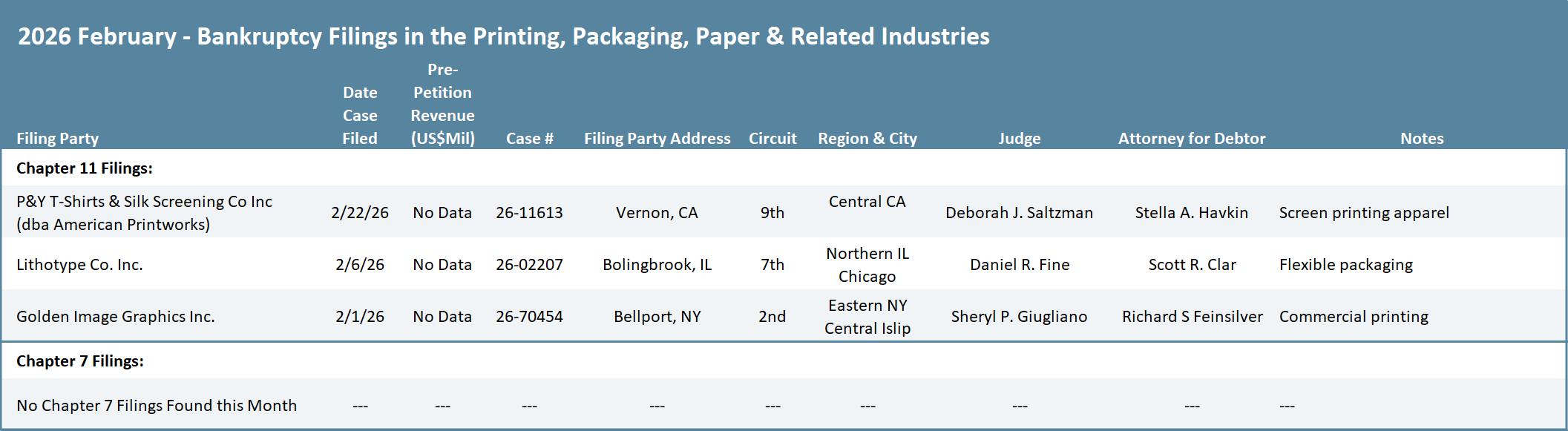
View The Target Report online, complete with deal logs and source links for February 2026.
For more information on Graphic Arts Advisors, visit graphicartsadvisors.com
Mark Hahn is a managing director and founder of Graphic Arts Advisors, a boutique strategic financial advisory and consulting firm focused exclusively on the printing, packaging, mailing, marketing services, brand management, and related graphic communications industries. With more than 35 years of graphic communications experience in the areas of finance, operations, sales, M&A, and general management, Hahn has served as chief financial officer, chief operating officer and other senior positions with several commercial printing companies, as well as founding and eventually selling his own printing company.The firm assists company owners and management, as well as their lenders, investors and shareholders in the following areas: mergers and acquisitions, sale of business, strategic and financial advisory, capital structure and funding, financial analysis, interim and turnaround C-level management, business valuations and serving as consulting experts. Hahn is the author of The Target Report and is regularly published and quoted in printing industry trade and management journals. Mark Hahn can be reached at (973) 588-7399 or mark@graphicartsadvisors.com


