


New Research: Production Inkjet’s Next Bottleneck Is Finishing

Production inkjet has evolved into a high-speed production platform, driven by faster print engines, greater sustained productivity, and a broader range of press formats. Early adoption was led primarily by continuous-feed (web) platforms, but the market has since expanded to include cutsheet devices and a growing variety of presses in different sizes and configurations. As a result, print providers are producing higher volumes across a broader mix of applications, placing greater demands on finishing operations to keep pace with increased throughput and growing application complexity.
That is the central finding of Finishing: Production Inkjet’s Next Frontier, a new survey-based report from Alliance Insights (part of PRINTING United Alliance), sponsored by Canon, EMT International, Müller Martini/Hunkeler, and Tecnau. Based on responses from 182 print providers, including 60 production inkjet adopters, and 207 communication/print buyers, the research reveals that finishing has become one of the most significant factors influencing overall production inkjet performance.
Figure 1: New Report From Alliance Insights
The Challenge Is Beyond the Press
Eighty-three percent of production inkjet operators surveyed identified finishing, not printing, as the primary constraint on throughput. The challenge extends beyond finishing equipment itself. As inkjet volumes increase, workflow coordination, systems integration, and material movement between production stages are becoming increasingly difficult to manage efficiently.
The data reflects the scale of the issue. Only 18% of production inkjet operators report that their finishing workflows fully meet operational needs. The remaining 82% operate with workflow limitations, manual workarounds, or process gaps that introduce variability, delays, and labor-intensive steps into otherwise highly automated print environments.
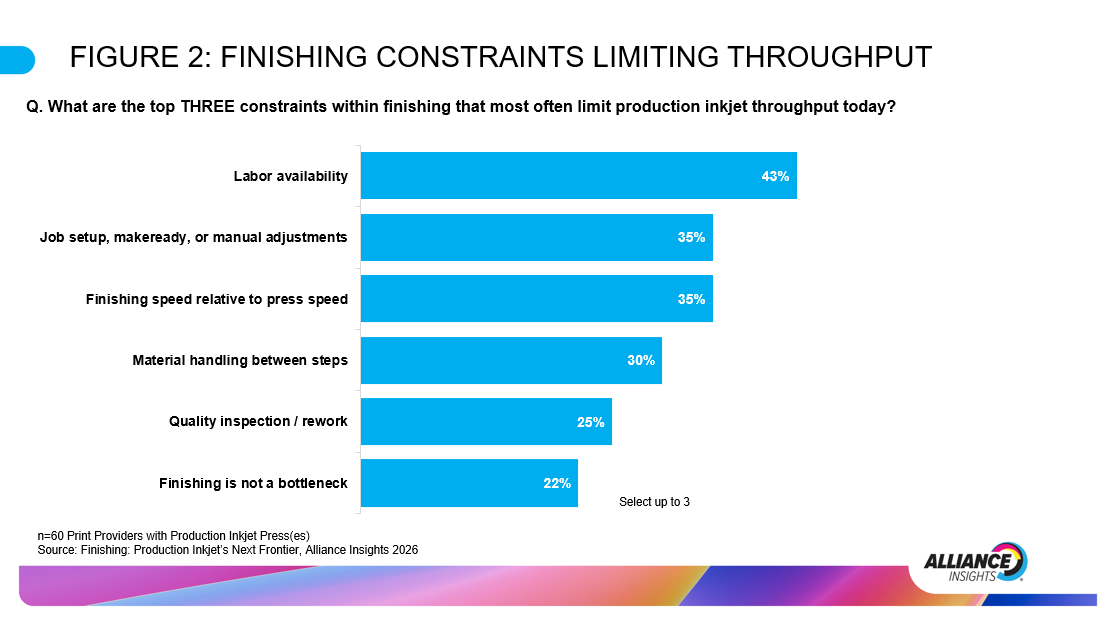
The most frequently cited finishing constraints (Figure 2) include labor availability (43%), job setup and makeready inefficiencies (35%), finishing speed relative to press speed (35%), and material handling between production steps (30%). While these are longstanding production challenges, their impact becomes more significant as job volumes and application complexity continue to grow.
Figure 2: Finishing Constraints Limiting Throughput
Click to enlarge.
The Automation Gap Between Press and Finishing
One of the study’s most notable findings is the continued disconnect between print and finishing systems, even in highly sophisticated production environments.
Across core workflow functions, including job data transfer, finishing setup triggers, and production tracking, respondents report only partial automation or no automation at all. Closed-loop visibility, where finishing systems feed performance data back into workflow platforms, is available to only 13% of surveyed providers.
At the operational level, respondents report many finishing functions remain heavily manual. Stacking and palletizing remain heavily manual for 82% of providers surveyed, followed by inspection (77%), folding configuration (72%), and binding setup (62%). Across all finishing categories surveyed, fully automated workflows accounted for only 13%.
Providers also identified significant barriers to broader automation adoption. Capital investment requirements were cited by 83% of respondents, followed by integration complexity (71%) and uncertainty regarding return on investment (62%). In addition, 53% of providers operating production inkjet presses identified available floor space as a constraint, underscoring the operational challenges associated with expanding finishing automation.
Customers Are Paying Attention
The operational implications extend directly to customer expectations and buying behavior.
Among the 207 communication buyers surveyed, 88% said finishing capabilities are extremely or very important when selecting a print provider, while 95% indicated that enhanced finishing improves the effectiveness of printed materials.
Demand for more sophisticated finishing applications is also increasing. Seventy percent of buyers expect to order more complex finished products over the next two to three years, with the strongest growth expectations coming from younger decision-makers.
When finishing performance falls short, customers notice. Thirty-one percent of buyers surveyed reported inconsistent finishing quality, 30% requested rework, and 27% identified turnaround time as a concern. These issues directly affect customer satisfaction, supplier evaluations, and long-term business relationships.
Taken together, the findings suggest that finishing is no longer a downstream production function operating independently from the press. As production inkjet volumes continue to scale, finishing performance, workflow integration, and automation maturity are increasingly shaping operational efficiency, application capabilities, and customer experience.
For print providers investing in production inkjet, the next phase of optimization will depend less on press speed alone and more on the ability to create connected, automated finishing environments capable of keeping pace with digital production demands.
Finishing: Production Inkjet’s Next Frontier provides additional data, analysis, and strategic context around workflow integration, automation gaps, investment priorities, and buyer expectations. Download the full report.


