


Johnson & Quin: Preserving 150 Years of Excellence

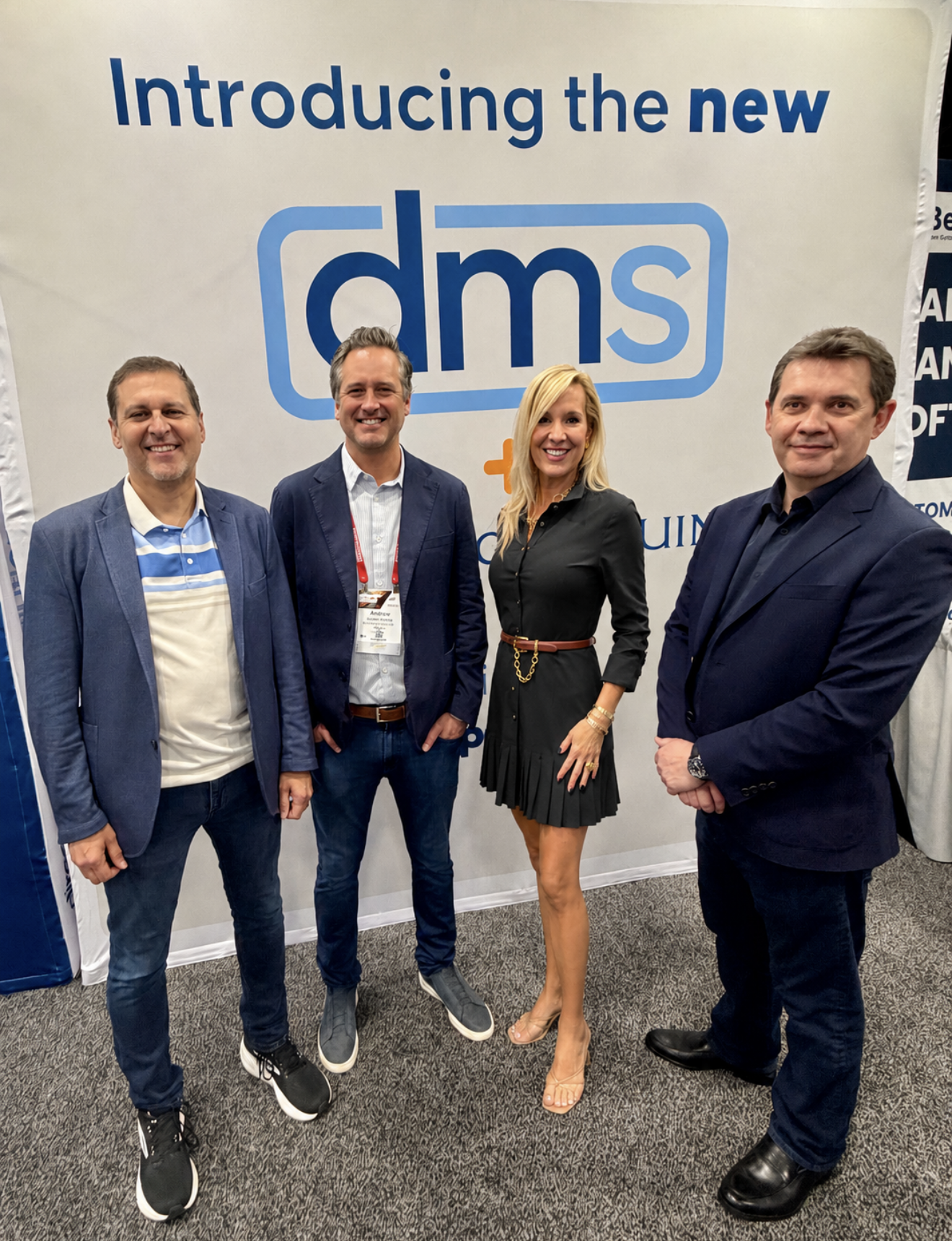
Now part of the same company, from left, Bob Arkema, Andrew Henkel, Wendy Stratton, and Luke Teboul, stand together.
| Credit: DMS
It is not every day you find a business that has been successful for 150 years. However, Johnson & Quin (J&Q) is beating those odds.
The Niles, Illinois-based direct mail specialist has certainly come a long way since its founding in 1876. Beginning in Chicago as “Blank Book Manufacturers and Book Binders,” J&Q officially got its name in 1896 when Thomas Stephen Quin joined the company.
Now, 150 years later, Johnson & Quin is a powerhouse in direct mail — with close to 200 employees and a strong reputation for excelling at high volume, complex projects that require personalized and variable data printing.
The Keys to Longevity
What has helped J&Q thrive for so long? Andrew Henkel, president of J&Q, says it’s the company’s ability to tailor its capabilities to the ever-changing needs of the industry.
“I think that one of the biggest things was our ability to adapt, so going from traditional print into highly targeted marketing and production services. We got into that in the late 1970s and just adapting to that and moving in that direction certainly helped us differentiate from just a traditional commercial printer,” Henkel says.
Henkel also says that J&Q has had a knack for investing in the right equipment at the right time, and that has been another key component to the company’s success.
“For example, with color inkjet, we waited until the cost was at a place where we could switch our clients over without increasing costs,” he says. “But it was just adding value. So, we waited to a point where it was really a no-brainer for us to invest in and for our clients to move over to that.”
Bob Arkema, executive vice president of J&Q, echoes a similar sentiment, saying that J&Q has always had a knack for investing and developing at just the right time and not a minute too soon or too late.
“We have had all kinds of different innovations along the way. We were one of the first companies that had an electronic way to match personalized names to each other,” he explains. “We developed that in-house. We’ve always kind of tried to focus on what was going to be the next new thing, and not doing it too soon, but yet, being an early adapter.”
Keeping It in The Family
It’s also worth noting that J&Q is a family run business — let’s break down some of the history.
1960 → Robert I. Henkel joined the J&Q management team and was instrumental in adding new capabilities in offset printing. Robert also brought a renewed focus on niche markets, especially the telecommunications industry.
1977 → David R. Henkel, who today is CEO, joined his father at J&Q in a sales and marketing capacity. He was initially assigned the task of developing capabilities within the specialty printing categories. It was David, who led the charge into direct mail.
2006 → David Henkel’s son, Andrew Henkel, joined the company in a sales role and was responsible for selling direct mail and integrated marketing services before moving up to president of the company.
For how the business and family have been able to thrive for so long, [Andrew] Henkel says it boils down to the simple fact that they have always agreed with each other on the direction they want to take the business.
“Find a family that agrees in many ways,” Henkel jokes. “But really, we were very lucky, and in the times that we disagreed on situations, especially on bigger decisions, I think we were both willing to listen and we got more people involved. This has never been a company that has been just centered around ownership, we really try to empower our management team. We respect their opinions, and it’s very rare that we will just overrule the general consensus,” Henkel says.
Arkema also agrees with Henkel’s sentiment and explains that while not every family-run business is run on the whim of the owners, some unfortunately are. That is not the case with J&Q, and he can confidently say that after working for the company for 22 years.
“They really did take everybody’s input, and everybody definitely did contribute to all the decisions and everything the company did,” Arkema says. “A lot of times, family-owned businesses are not run like that, they’re run very much like, ‘Gee, what kind of mood is the owner in today?’ We are not run like that. So, I think that’s been part of the success.”
Meeting at the Intersection of Experience and Innovation
One of the more exciting headlines to come out this year for J&Q is that it was acquired in February by Direct Marketing Solutions (DMS), a nationally recognized provider of integrated direct marketing services.
Luke Teboul, CEO of DMS, says the combination of the two companies made sense considering the aligned values.
“We always conduct ourselves ethically and with integrity,” he says. “We saw that in the entire team that we met during due diligence with Johnson & Quin, [they’re] just fantastic people. They wanted to take care of their clients, but they also wanted to take care of their employees to an equal level, and that was really important to us.”
Teboul jokes that DMS has always been competing with J&Q from afar because it already has a well-established reputation for doing a great job with exceptional quality.
But when it came down to it, the decision to merge was both regional and for the simple fact that it would benefit both companies’ customers.
“We’d looked at a number of acquisition targets down the center of the country, so for us, it was a conscious decision to try and expand into the Midwest,” Teboul says. “Then when we [went] under the hood, so to speak, and we really learned how complementary the service offerings were and even the equipment. And we didn’t do the acquisition because of equipment; that’s the easy part to get. We had very similar capabilities, but we also had some other services that each of us offered that could bring benefits to both sets of customers. That was the major plus.”
And while the acquisition wasn’t technology-based, Henkel explains that DMS has several presses that will allow J&Q to offer more self-mailers and postcards. Currently, the majority of its mailings are envelope packages.
“And then probably more significant than that is their additional services,” Henkel says. “So, with creative, a robust strategy team, and digital and data services, they’re nice for diversification and cross selling with our current accounts.”
As part of the transition, Andrew Henkel will become president of DMS, while David Henkel will join the DMS Board of Directors, ensuring continuity and a strong connection to Johnson & Quin’s heritage.
Preserving Heritage Among the Acquisition
Speaking of heritage, when a company has a 150-year legacy — it’s wise to preserve it, and Teboul assures that is the case.
“We did the acquisition because we liked the team, and we’ve learned so much from the team already,” he says. “And I’d like to think it’s vice versa. We’ve got this really good collaborative approach where we’re already like a new family, where we can challenge each other’s ideas and we can learn from different processes and procedures.”
Wendy Stratton, vice president of sales and marketing at DMS, says that through it all, the most important thing is that the combined entities are going to maintain their “client-first approach.”
“I think our goal is to keep it client first,” she says. “We are client centered. That’s why both of us have a long-standing history with our current client base. They have been here for decades, and we have very little turnover, and I think that speaks to our dedication to their business, understanding their business, and trying to really be an extension of that. But as we grow, not losing sight of that.”
- Categories:
- Business Management - Operations
Gabby Houck is an associate content editor for the printing & packaging group at NAPCO Media/PRINTING United Alliance.
 Inside swissQprint America's Bold Investment
 The Most Dangerous Phrase in Business
 The Graphic Group Celebrates 30 Years in Business
 Carla Johanns on Hunting, Hustling, and Being Kind to Yourself Along the Way
 You Did Not Plateau. Your Business Model Did.
 What Does Your PRINTING United Alliance Membership Really Support?
