


The ‘Brain Hack’ Behind Embellished Print

Embellished print is engineered to tap into a human’s emotions. Eric Vessels, chief experience officer at Taktiful, explains they affect people on a deep level.
“Digital embellishments are a brain hack,” he says. “[They] create an emotional reaction in us that is hard to beat. Once you touch someone emotionally and deeply and [there is a] psychological factor, the behavioral economics of it is just hard to beat.”
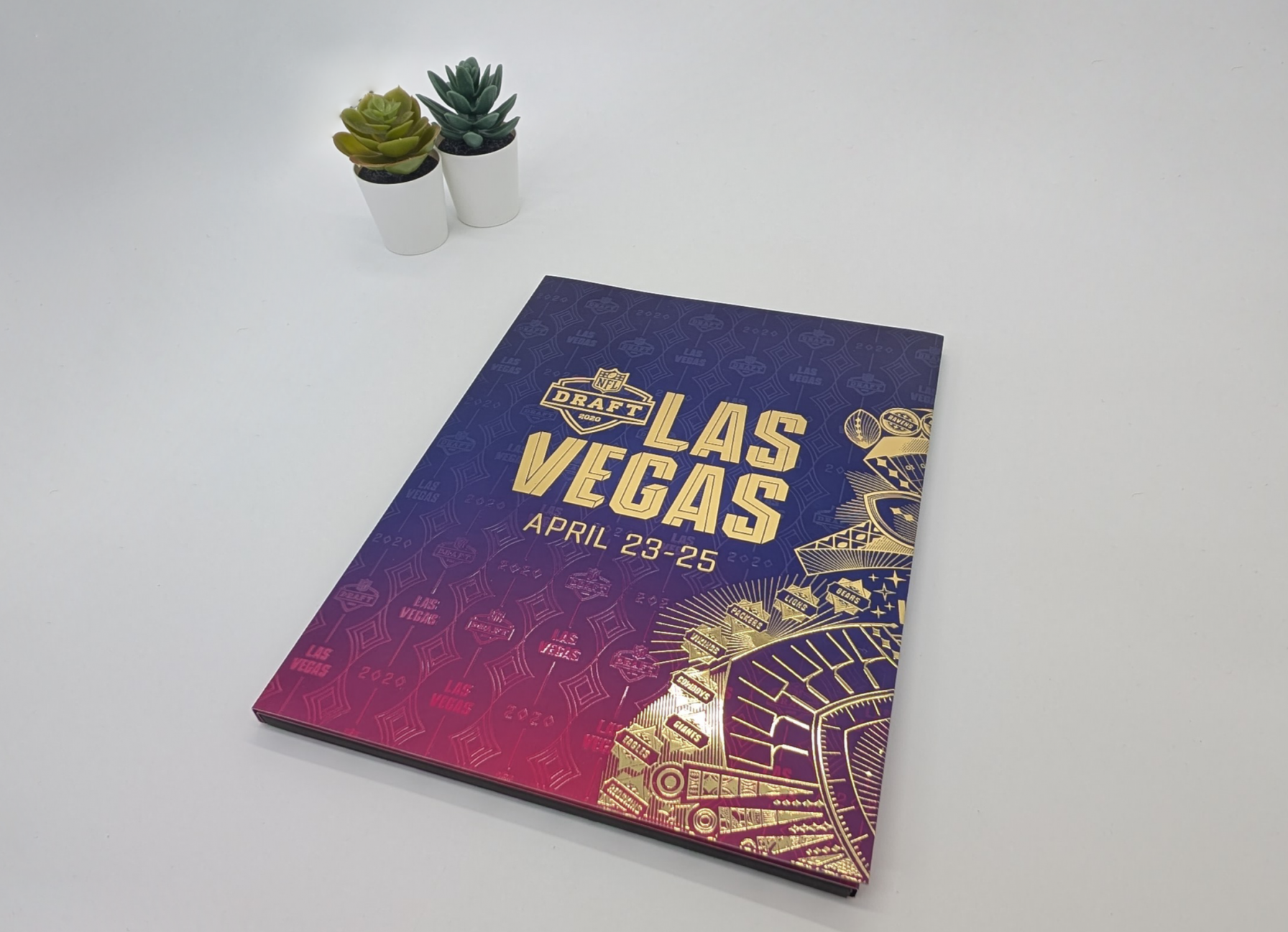
Raised foil and varnish were used on this NFL draft mail piece, which included a LCD screen inside with a custom video message. | Credit: bigDAWGS
Embellishments, both digital and analog, are constantly evolving and adapting to stand out and meet customer needs. That’s why Printing Impressions spoke with three embellishment experts — Vessels; Eddie Davin, CEO and innovator at Toronto, Ontario-based bigDAWGS; and Jeff Alexander, CEO of Lindon, Utah-based Alexander’s Print Advantage — to find out what the trends are and how they recommend approaching embellished print. We identified seven tips, tricks, and pieces of advice based on those conversations.
1| Personalization is still the core value driver.
In effective marketing, personalization has moved from an exception to an expectation. Davin points out that AI has made digital marketing even easier than it was in the past. An email can be personalized with several data points almost instantly, making digital communications less likely to stand out in an already crowded inbox. This, coupled with digital fatigue, presents the perfect opportunity for personalized embellishments to make an impact.
Davin suggests pairing a direct mail recipient’s name in raised holographic foil with other data points.
“I think that’s the next-level embellishment 2.0, and those who have invested now in digital embellishment equipment … they are ahead of the game because digital is the only way to connect to a database and run a variable campaign,” Davin says. “I see this as where the industry is going. If I get a piece with my name on it, I would never throw that out.”
2| Digital embellishment has democratized the space but the window of advantage won’t be open forever.
While digital embellishments are still relatively novel, Vessels makes the case that because digital equipment is becoming more accessible, at some point that will no longer be the case.
“We’re in the freaking gold rush era of this,” he says, and because it’s not in every shop yet, it’s still an area of value.
3| Don’t embellish everything.
One of the pieces of advice all three experts shared is the importance of being discerning about where embellishments will add value. Vessels points out that when technology is new, the inclination is to “slap it on everything,” such as what happened with QR codes, but it’s important to remember that not everything is “worthy” of an embellishment.
Sometimes an embellishment can even detract from an overall design. Alexander explains that while his company has the ability to offer embellishments anywhere a designer wants to add value, the team offers consultation services to guide them to the most effective use of embellishments.

Alexander's Print Advantage works with designers to ensure that the embellishments match the message of the printed piece. | Credit: Alexander's Print Advantage
“There are certain fonts that don’t look right, especially at certain sizes,” he says. “It’s usually size more than anything else that’s the determining factor there. And we’ll consult with them on the design because sometimes the designer might have one idea in mind, but we know it won’t really translate well to a foil design.”
Both Alexander and Davin note that it’s important to work with the customer to decide if an embellishment will fit with the overall piece before moving forward.
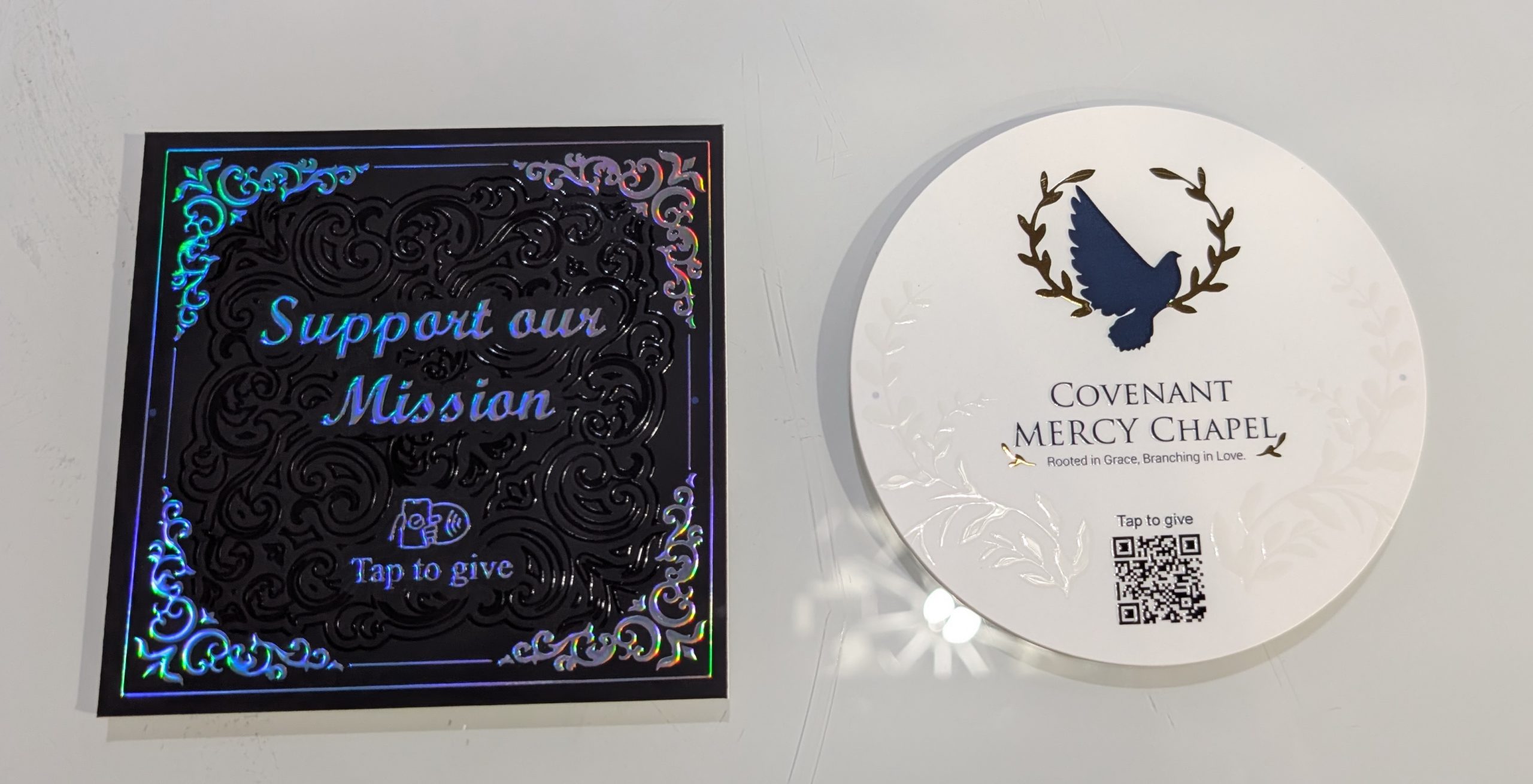
To prevent “quishing” (QR phishing), bigDAWGS recommends using NFC technology. This church offering card was redesigned (on the left) with detailed embellishments and NFC technology to be more secure. | Credit: bigDAWGS
4| Show, don’t tell.
Although Vessels says people are “tired of hearing it,” the concept of “show don’t tell” is effective. Giving customers the opportunity to physically experience an embellished piece increases the chances that they will buy into it.
“All you have to do is put this type of printed output in the hands of folks,” he says. “And now we have awesome 3D visualizers. … That’s another way to actually show and not tell because people can sort of see on the screen without investing a lot in printed output.”
Alexander’s Print Advantage uses this strategy, as well. Alexander explains that when the company first started offering embellishments, it would have open houses and invite designers.
“We would invite them to send us a design before they came so that we could produce it and show it to them, and then talk about how they could change it so that it might work better with foil and varnish,” he says. “We would always have a lot of sample books so that they could get ideas of what will really work. [It also] gets them thinking about their different customers and how they could apply the effects of embellishments.”
5| Take it one step further and try a ‘VIP portion of the run’ tactic.
Vessels describes a specific sales technique: embellish part of a print run to be used strategically. This can help to prove the embellishment’s value before a customer fully commits. He gives the example of giving a customer 100 embellished business cards in a run of 1,000 CMYK business cards. At a trade show, when the customer pulls out that stack of cards and they want to make a deeper impression, they will be more inclined to reach for the embellished card.
“You’ve done two things,” he says. “You’ve gotten them to break that barrier of embellishing. Here’s the second thing that’s going to happen: the next time that person orders, they're probably going to order 500 embellished and 500 regular because when they see the reaction from the people that they’re giving those cards to, they’ll order 500 embellished.”
6| A tactile experience creates an emotional connection, driving memory and price tolerance.
It’s true that embellishments still bring up the concern of cost for some buyers of print, but Vessels says the tactile nature of embellishments “short circuits price concerns” because it typically creates a strong emotional response.
Similarly, Davin says that experiences illicit emotions.
“It creates that experience and that experience creates that emotion,” he says. “That emotion creates impact and it reinforces a memory.”

This wedding invitation and wedding book cover were produced with delicate embellished features. | Credit: Alexander’s Print Advantage

Alexander also points to this as an important piece of the puzzle.
“When people get an embellished piece of print, they feel it and they hold on to it,” he says. “If it’s a marketing piece, they remember it more than maybe another, just because of how it looks but also how it feels.”
One thing to note though is that it’s important to match the embellishment to the emotion of the message. bigDAWGS not only does physical embellishments, it does a lot of printed pieces that include both physical and audio embellishments, another element that needs to be considered early.
“Sometimes [a customer will] create some sort of card design and then add a random sound, but it doesn’t tell a story,” Davin says. “It should be planned from the beginning. What emotion and message are you trying to convey, and how can they both come together?”
Davin shares two examples that show how a printed piece paired with sound can create two totally different emotions, based on the messaging.
In one focused on colon health, an amusing and colorful character is paired with a voice actor advocating for colonoscopies. The effect is one intended to grab the recipients’ attention and keep it. While the messaging is for a serious topic, it’s done in a playful way that disarms the audience and normalizes a sometimes taboo topic.
In another, more sobering example, messaging about domestic violence is paired with a real 911 call. The design and colors are simple and match the tone of the message.
7| Pair embellishment with digital connectivity (NFC over QR).
Digital connectivity not only works as a way to move people from a printed piece to a digital location, it can be considered as a value-added layer of security. Davin notes that while everyone is familiar with QR codes and how to use them, when presented with the choice to scan a QR code and tap an NFC, people tend to interact with the NFC because of its seamless integration and trustworthiness. There is a scam, he explains, called “quishing” (QR Phishing), where scammers place fake QR code stickers on top of others, something NFC inhibits. Pair that layer of security with embellishments, such as a raised foil, and Davin says you’ve got a piece that will make an impact.
Embellishments, in general, are a great way to reinforce credibility in print. Davin points out that when someone receives a piece of direct mail and it is embellished, it immediately gives the piece legitimacy.
“Printed marketing takes time and effort,” he says. “That time and effort is a trust signal. Going even a step further, though, digital embellishments take time, effort, and money. … Since it costs time and money to the customer, it’s value. To the customer, this piece is actually valuable. To them, it doesn’t matter if they realize what embellishments are on it. With foil [for example], it’s such a high quality piece that they know this company spent money on this direct mail piece.”
- Categories:
- Finishing - Digital Enhancement
Ashley Roberts is Content Director of Printing Impressions.


