


Route 66: Celebrating with Stamps


“Get your kicks on Route 66.” Nat King Cole’s iconic song is one that has endured through the ages. Even those of us born after the heyday of the famous route not only have nostalgia for a less complicated time, but can also probably sing the entire song from memory right now. I’m not sorry I just got it stuck in your head for the next week.
Route 66 was and remains a national iconic symbol of freedom, promise, open roads, and limitless possibilities. And to celebrate the 100th anniversary of the legendary highway, the United States Postal Service released a set of eight commemorative Forever Stamps celebrating everything Route 66 represents.
Lisa Bobb-Semple, director of stamps at the USPS, sat down to chat with us about the release of these stamps — and the printing process behind official stamps, which are still offset printed. In this case, she notes, “a lot of times we try to commemorate anniversaries through our stamp program. With it being the 100th anniversary of Route 66, that was kind of the idea there.”
How that came to be is an interesting window into how any commemorative stamp is produced. Bobb-Semple explains, “There's a group called the Citizen Stamps Advisory Committee (CSAC). They are appointed by the Post Master General, and they are from multiple disciplines. We have people on the CSAC that have a historical background, a creative arts background, a sports background, a medical background, philanthropic backgrounds, etc. We really try to find people who have different backgrounds to lend their knowledge into the discussion.”
Every quarter, she explains, the CSAC meets to take a look at subjects that might be worth commemorating — anniversaries, events, historical figures, etc. There are, she explains, usually thousands of topics that are sifted through to find the right fit for a stamp.
“It’s a pretty difficult process. They're having vigorous debates around the why, the why not?,” Bobb-Semple says. “Is this the best of America? Why is it? What's the positive? What's the negative?”
Key anniversaries are one of the things that can help a subject rise to the top of the list, such as 50th or, as in the case of Route 66, the 100th. Most of the time, this process can start years in advance, so the committee isn’t just looking at what’s going on right now, but trying to take the pulse of where the country will be several years down the road.
“We really try to celebrate sort of what's the best of America, what's iconic,” she explains. “We try to have a mix of different topics. Route 66 touches so many people's lives, {and is part of] the fabric of America. So we just really thought this was a perfect topic to commemorate given the 100th anniversary. That's how this stamp came about.”
Creating a Memorable Stamp
Unlike a lot of print, a stamp doesn’t have a lot of square footage to tell its story. So the process of creating an eye-catching and memorable stamp starts with art directors, who will spend sometimes months trying different designs and ideas until they find what resonates and works in that form. And then, of course, it has to go through legal teams to ensure the final project is vetted and ready for production, before the Postmaster General then signs off on the run.
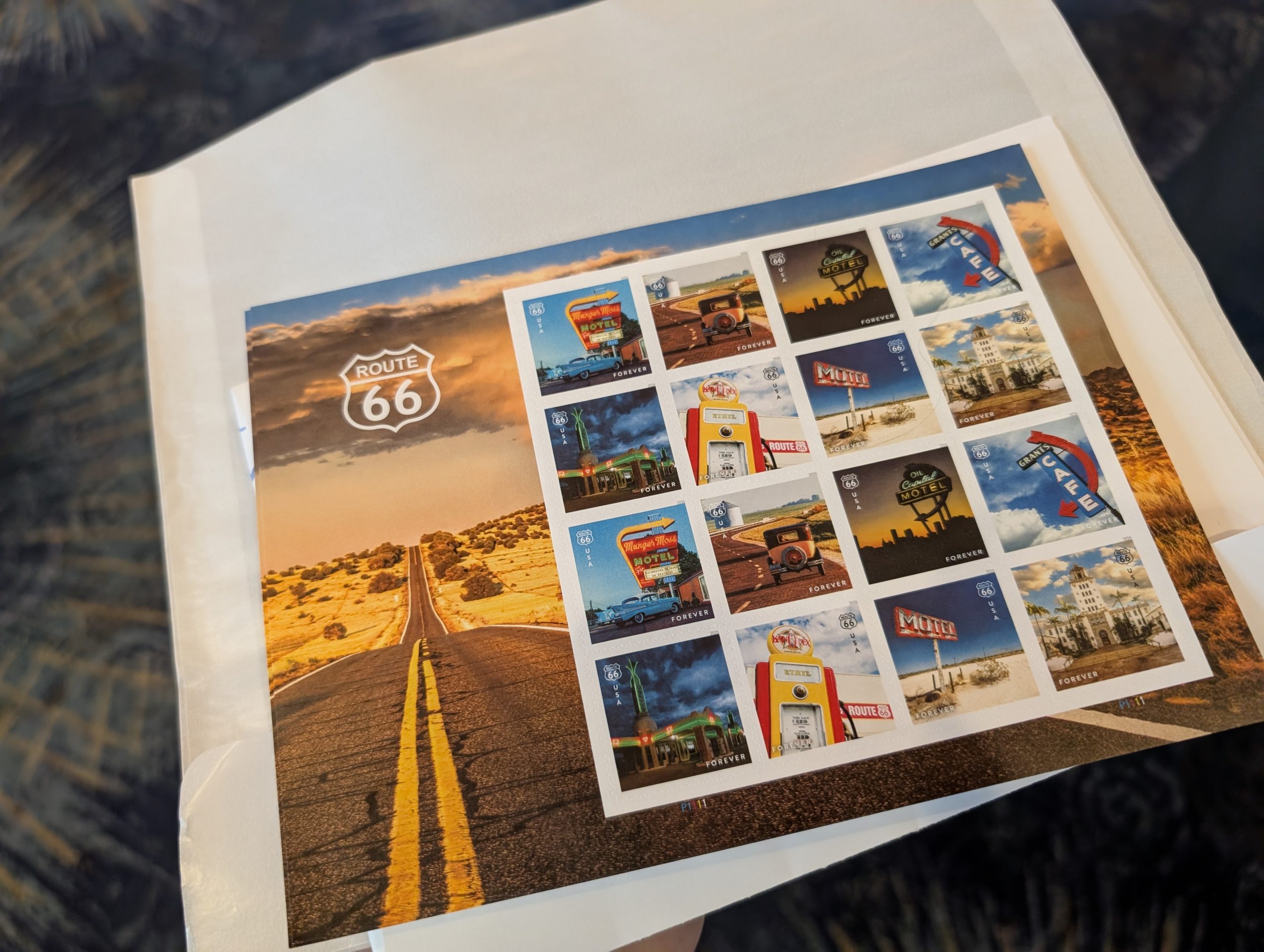
The Route 66 stamp sheet.
In the case of Route 66, the USPS connected with photographer David J. Schwartz, who provided the iconic images that truly captured the essence of what the highway means to people. From there, Greg Breeding, an art director for USPS, then designed the eight individual stamps, as well as the commemorative pain of 16 that can be purchased for display. The idea was to have one stamp to represent each of the eight states Route 66 travels through — Missouri, Illinois, Oklahoma, Arizona, New Mexico, Texas, Kansas, and California.
Bobb-Semple notes that the goal was to figure out what history they wanted to highlight, and what images would be the most iconic in representing the essence of Route 66. She also stresses, “We want to be able to show the entire route, if you will. You couldn't really have the stamps, but only have them geared to one or two of the states. You really wanted to show the full breadth.”
She continues, “[Breeding] really worked with the research group on determining those locations, those images, and working with [Schwartz] on the full breadth of pictures he had to be able to tell that story.” She also notes that Schwartz never imagined his images would end up on stamps, as the USPS worked with him to use photos he had taken in the past to document Route 66.
Part of the challenge Breeding faced as well was taking full-size images of larger-than-life locations and condensing them down into a design that works both as a large commemorative version, but just as well when it’s postage-stamp sized, without losing any of the detail, emotion, color, or impact. And then do that eight times, while ensuring that each one works together as a set, but also has its own personality and represents its state well. It was a balancing act that Bobb-Semple notes was bit more tricky than for some other sets the USPS has produced, but the results speak for themselves.
The USPS doesn’t track the exact popularity of any individual stamp set, and what most people likely don’t realize, is that every stamp in a run like this is printed once — and only once. Bobb-Semple explains that they try to estimate how popular they think a given design will be, and print enough sheets to be able to sell them for around a year, to a year and half. They are kept in a central storage location, and as local post offices run low, they are restocked until the run is gone. For some designs, that run might last longer than the expected year and half, and for others, it might go faster — so if you want to secure the Route 66 stamps, you’ll want to head to your local post office sooner rather than later to ensure they still have them.
Only once in recent memory does Bobb-Semple note a stamp design has been given a second print run, and it was for an anniversary, where the public was invited to vote on one of the 25 most popular designs to bring back as a limited run. It was a Mr. Rogers stamp that won, was brought out of the vault, and given a second print run, which debuted at the World Stamp Show earlier this year. Other popular stamps that have sold out quickly include the Betty White stamp released last year that went quickly, and the Elvis stamp from 1993. It’s impossible to know where in the spectrum Route 66 will fall, but given its universal popularity, it will likely be another one that goes faster than expected.
Route 66 continues to capture our imaginations, even decades after the height of its popularity. And on the 100th anniversary, it’s a great time to stop and celebrate everything that made such a lasing and iconic impression. The USPS commemorative Route 66 stamps are just one piece of that celebration, but it captures the best of the memory in a small, portable piece of art.
Toni McQuilken is the senior editor for the printing and packaging group.


