CONNECT 2026 Sessions Stress It's Time to Invest and Evolve
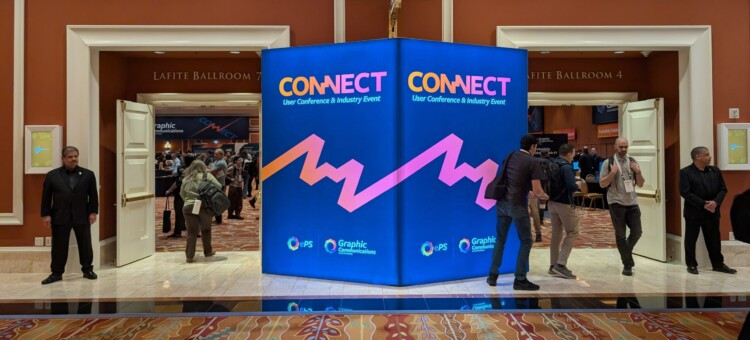
“We're going to focus on a number of things that will add value to you as our customers.”
Brent Pietrzak, CEO of CAI Software, made that note about the company’s strategy for the future during the opening session of the 26th CONNECT event this week in Las Vegas, Nevada. The agenda delivered on that promise on day one of the event, as Nathan Safran, vice president of Research at Alliance Insights, took the stage shortly after Pietrzak. Safran offered attendees a look at key challenges ahead of 2026 and how industry leaders are responding.
He shared that among print service providers (PSPs) surveyed, the key concerns were increasing sales, maintaining profitability, economic business conditions, rising labor costs, rising substrate costs, and the effects of tariffs on costs, supply chains, and workflow. He then identified four specific ways PSPs are addressing these challenges, with 71% focused on productivity and finding ways to improve efficiency; 70% focused on controlling costs; 69% focused on automation, reducing steps, and streamlining processes; and 52% capturing higher-value, more profitable sales.
When it comes to productivity, he noted that rising input and substrate costs, along with ongoing labor constraints, wage pressure, margin compression, and customer demand for faster turnarounds are all drivers pushing the “productivity imperative.” There is an opportunity, however, to improve workflows, reduce process friction, and increase throughput without additional overhead or labor. One way to prioritize those factors is through investment, and while he noted that some PSPs might become overly cautious in times of uncertainty, it’s important to continue investing and to align those capital investments with operational efficiency goals. Across commercial printing, graphic and sign printers, and label and packaging printers, AI and business intelligence systems ranked at or near the top of investment plans for 2026.
“The way that we think about it is, it's a good time to invest,” he said. “You’re investing in equipment that gives you greater automation and greater productivity. You're addressing your whole line, you’re addressing finishing, and the whole stretch of your software to identify where you can improve so that you can make yourself more competitive, so that you can separate from the competition, so that you can get into new areas of business.”
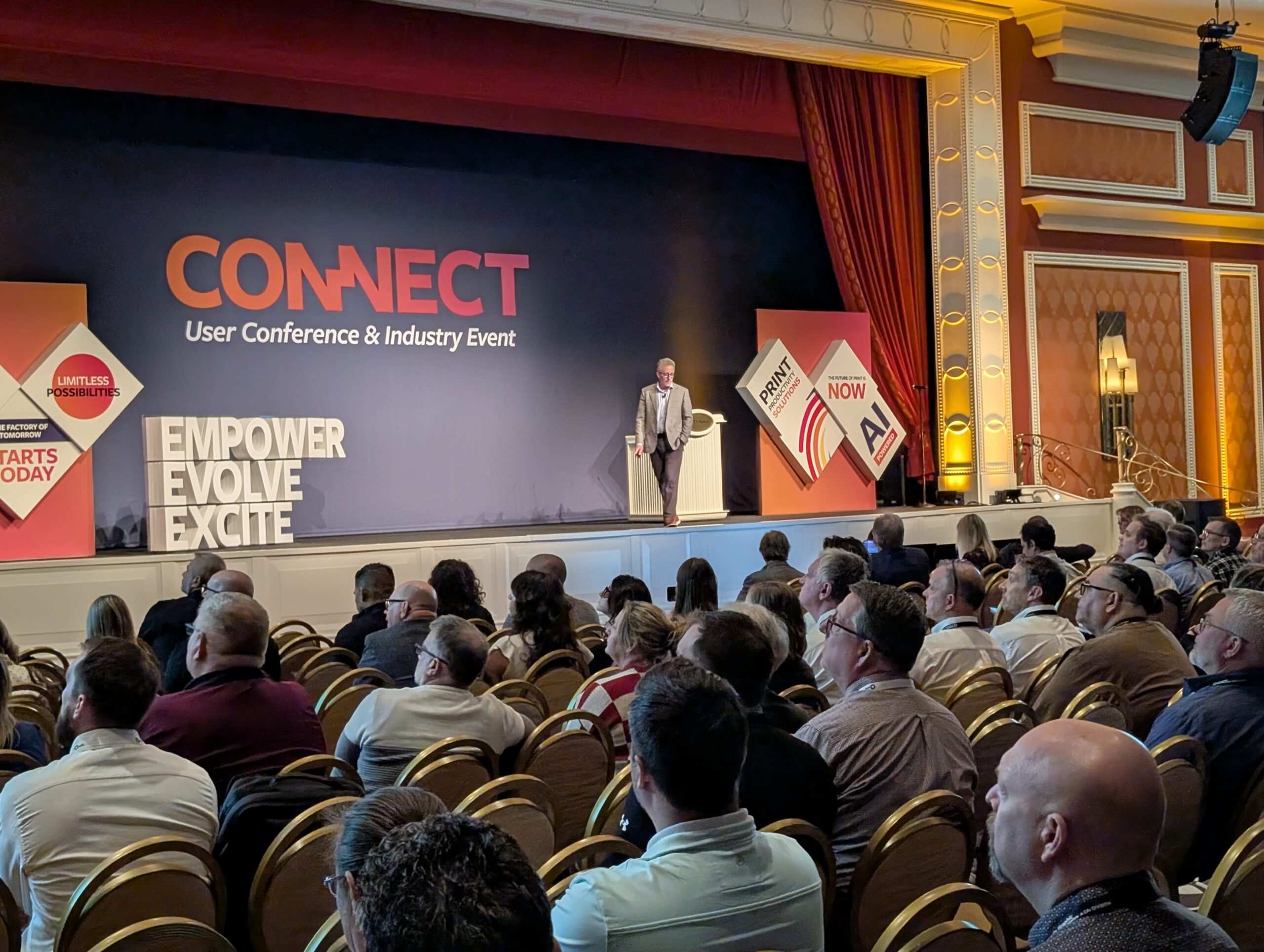
Nathan Safran, vice president of research at Alliance Insights, gave the opening keynote session at CONNECT 2026.
To address the cost-control mandate, Safran noted that PSPs report trying to “find and plug leaks” and to keep an eye on expenses.
“How do you turn automation into a competitive advantage?” Safran posed. “Treat it as a survival strategy, not as a nice-to-have.”
While automation is the focus of industry research, education, and events, Safran reported that 67% of respondents in one of Alliance Insights’ surveys said they are minimally or not automated at all. When the team looks at it year over year, the level of automation in the industry is making slow progress, Safran said, but there is room for improvement.
“The good news is, 57% of you told us that you’re seeking automation features on equipment or workflow,” he said.
When looking at the companies that are looking to capture higher-value and more profitable sales, Safran noted convergence, or PSPs diversifying into multiple segments, is a growing trend. Looking at the change from 2018 to 2025, PSPs in three segments increased by 185%, and those in four segments increased by 860%.
“I give you folks kudos,” Safran said. “It's not easy to expand into other services. But it shows that as an industry, you're not sitting back and waiting for things to happen. You're being proactive about going out there and saying, ‘How can I grow my business?’ ‘How can I become more resilient?’ ‘How can I increase money?’”
Safran concluded his session by noting that many companies are also moving toward intelligent marketing services.
“It all starts with intelligent automation, reducing touches and then value-added growth, maybe a shift from commodity print to integrated, higher margin solutions,” he said. “Aiming toward becoming a technology company that does print and adding more value, and becoming stickier and stickier with your clients.”
Actionable Insights with AI
Steve Metcalf, founder, CEO, and chief AI officer of IMAGINE AI LIVE, took to the mainstage on the first night of the event, in his session “What is Your AI Agent Strategy.” Perhaps the single biggest thread he talked about is the rise of what he termed “digital humans,” using AI agents to complete tasks as you would a human employee.
AI, he stressed, is shifting from a chatbot mentality to one where you can simply assign a task to an AI agent, which will then go out and do all the work, from research to design to final completion — and, in many cases, will actually recruit other agents for specific tasks as needed.
He did, however, stress that, just like human employees, AI agents need to be taught what you want and how you want it done. This is accomplished through skills, which can be created from scratch or sourced from thousands of people who create hundreds of thousands of skills that can be downloaded and adapted to fit the specific tasks required.
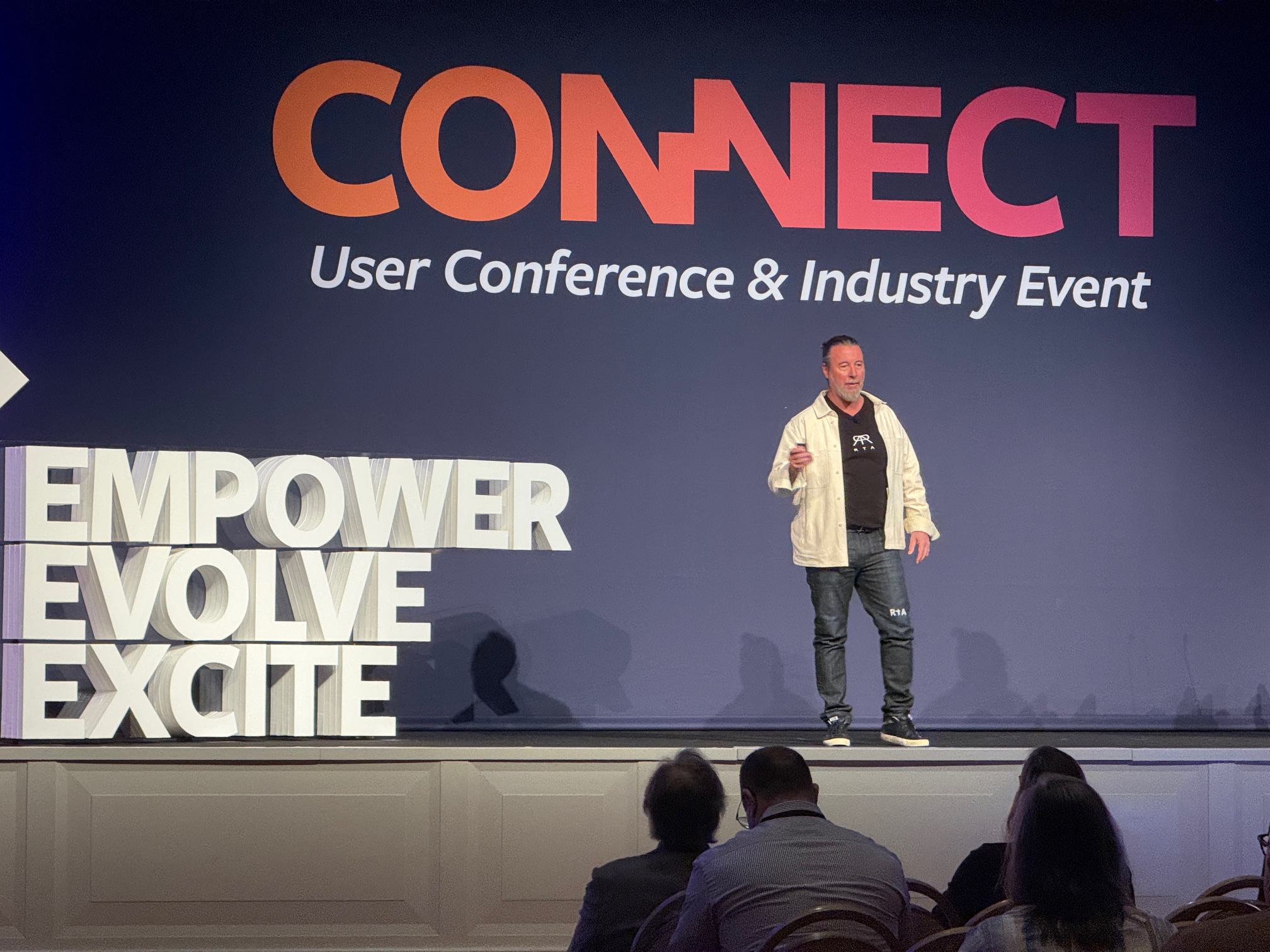
Steve Metcalf, founder, CEO, and chief AI officer of IMAGINE AI LIVE, took the stage to share the state of AI.
He also noted that, just as human employees can make mistakes, AI agents can still hallucinate or get it wrong, so a human still needs to be the final stop before anything AI-produced is used. Although he did note that having a second AI agent fact-checking the first can be one way to begin automating that process as well.
He stressed that those who aren’t exploring how to use AI and these agents now will quickly find themselves left behind by the competition in the near future. That said, he notes that the print industry is “perfect for AI. You have to be pretty fearless to get into print, but here we all are.”
Part of what is driving the evolution of AI is the cost structure coming down, making it more feasible for more people to explore even the most advanced tools. Fierce competition has the top few AI companies striving to bring down costs and prove they are the most attractive option for long-term investment. At the same time, countless smaller AI companies are chipping away at the top dogs, creating even more downward pressure on pricing, even as the “AI arms race” continues at full speed to improve what these systems can do and how quickly they do it.
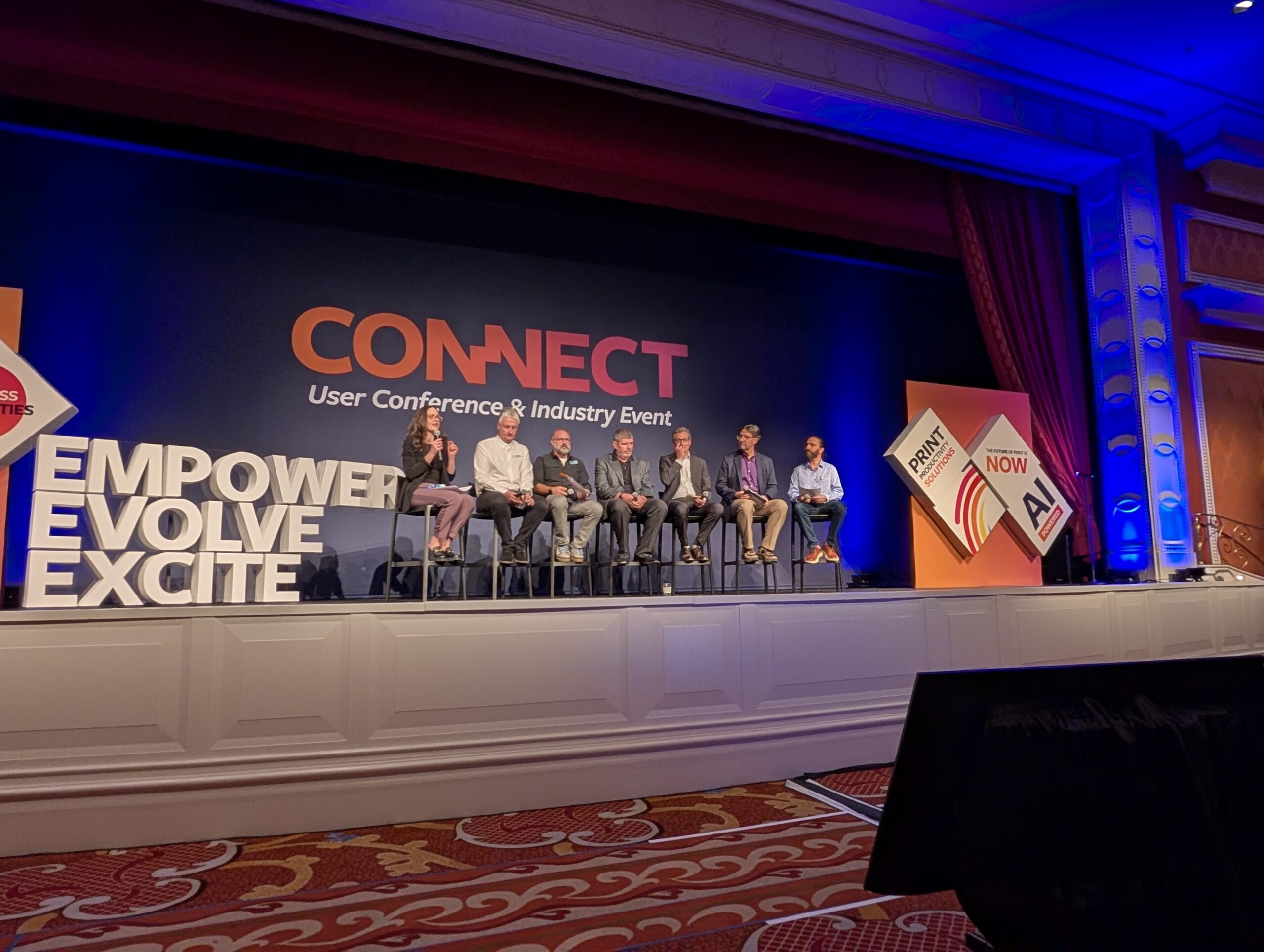
(From left) Ashley Roberts, content director of Printing Impressions, moderated an AI-focused campfire chat with Paul Cook, customer success manager, Graphic Communications; Thomas Dahbura, president, Hub Labels; Dennis Kramer, chief architect, ePS; Erik Peters, worldwide marketing manager, ECO3; Bob Raus, category manager, PRINTOS Workflow, HP; and JohnHenry Ruggieri, president, Sundance USA.
Rounding out the major discussions on AI on the mainstage was a panel session moderated by Ashley Roberts, content director at Printing Impressions, titled “Implementing AI in the Real World.” She was joined by six panelists:
- Paul Cook, customer success manager, Graphic Communications
- Thomas Dahbura, president, Hub Labels (Hagerstown, Maryland)
- Dennis Kramer, chief architect, ePS
- Erik Peters, worldwide marketing manager, ECO3
- Bob Raus, category manager, PRINTOS Workflow, HP
- JohnHenry Ruggieri, president, Sundance USA (Orlando, Florida)
All six offered valuable insights into the dos and don’ts of implementing and using AI in print production environments, but a few themes stood out.
First, there is a lot of data in today’s business environment, and it can be downright overwhelming to try to parse it all, much less turn it into a usable form. This is where AI can shine, the panel stressed, helping to pull together disparate pieces and identify specific actions that can be taken right now.
Because both the data and the pace of AI evolution are so vast, the panel recommended picking just one or two of what they called “low-hanging fruit” — the tasks that are easy to automate and bring AI into the mix. Commit to just one or two things, but don’t just sit it out and wait — there is a small window of opportunity where printers can stay ahead or fall behind, and that window is getting smaller every day. It isn’t necessary to solve everything, or automate everything, or integrate AI everywhere — just pick a place to start and keep moving forward.
That said, the panel also noted that printers need to be realistic about AI implementation. They noted that it is impossible to use AI to gain real insights into the business if the foundations aren’t in place. And without some automation and integration, AI is next to useless. Shops need to start by embracing automation wherever possible and ensuring the data is clean and solid. “Garbage in, garbage out,” the panel quoted.
Finally, the panel discussed how to overcome the inherent fear many people have about AI, whether it's security risks or the fear that AI will take their jobs. It is critical to stress that AI is a tool to automate routine tasks, such as data entry or report generation, so people have more time to focus on what matters, like interacting with customers.
Instead of trying to force the issue, show skeptics how it can help improve their daily workload. Another idea the panel floated was to make it part of weekly or monthly team meetings, where people share which AI tools they’re using and the results. Demystify AI and help demonstrate the real-world uses, and skeptics will learn to embrace the tools.

Ashley Roberts is Content Director of Printing Impressions.

Toni McQuilken is the senior editor for the printing and packaging group.