


Why Quantum-Resistant Printing is the New Gold Standard


The Quantum Leap in Document Security
As someone in the print industry, the phrase "data breach" has taken on a terrifying new dimension. For decades, the commercial printing industry viewed security through the lens of physical access: badge readers, locked trays, and "pull printing" to ensure a document wasn't snatched off the exit tray.
However, as of this year, the threat has migrated from the physical tray to the quantum “realm.” With the official release of enterprise hardware like the HP LaserJet Enterprise 5000 and 6000 series, the industry has reached a tipping point. Quantum-Resistant Printing (QRP) is no longer a niche requirement for defense contractors, it is a standard clause in almost every high-value commercial RFP (Request for Proposal).
What is Quantum-Resistant Printing?
Quantum-Resistant Printing is the integration of Post-Quantum Cryptography (PQC) into the entire lifecycle of a print job, from the moment a user hits "Print" on their workstation to the moment the ink hits the paper.
To define it simply: It is a security framework that replaces traditional encryption methods (like RSA and Elliptic Curve Cryptography) with new mathematical algorithms that are "mathematically hard" even for a quantum computer to solve.
While classical computers might take trillions of years to crack an RSA-2048 key, a sufficiently powerful quantum computer using Shor’s Algorithm could theoretically do it in hours. Quantum-resistant printing ensures that even if a quantum computer is used to intercept and analyze print data, the information remains gibberish.
Why Our 'Old Math' is Breaking When It Comes to Security
To understand why the commercial print industry is pivoting, we have to look at the math. Current encryption relies on the difficulty of factoring large prime numbers. In simple terms:
- Classical Security - Finding the two prime factors of a massive number is hard for a standard computer.
- The Quantum Threat - Quantum computers use "qubits" and superposition. They don't just guess numbers; they use quantum interference to find the answer almost instantly.
Post-Quantum Cryptography (PQC)
Now, we have moved toward Lattice-based Cryptography. Instead of factoring numbers, this tech relies on finding the shortest vector in a high-dimensional grid (lattice). This is a problem that remains exponentially difficult for both classical and quantum computers.
By following the NIST FIPS 203 and 204 standards, modern printers now use these lattice-based digital signatures to verify their firmware and encrypt the data "tunnel" between the server and the printer.
The 'Harvest Now, Decrypt Later' (HNDL) Crisis
The most pressing reason the commercial print industry should care isn't a threat that exists today, but a threat that is being built right now. This is known as "Harvest Now, Decrypt Later" (HNDL).
Cyber-adversaries are currently intercepting and storing massive amounts of encrypted data, including sensitive print streams from law firms, hospitals, and financial institutions. They cannot read this data yet. However, they are banking on the fact that in 5 to 10 years, quantum computing power will be accessible enough to decrypt these "harvested" files.
If a commercial printer handles a 20-year land deed or a 10-year clinical trial document today using 2024-era encryption, that document is effectively a "time bomb" of data exposure. Quantum-resistant printing "future-proofs" the data, ensuring it remains secure for decades.
Why the Commercial Print Industry Should Care
For a commercial print shop, "trust" is the most valuable product on the floor. This year, the industry is seeing a shift in liability and client expectations:
1. Liability and Compliance
Insurance companies have begun denying coverage for data breaches if the provider cannot prove they used "Quantum-Resilient" standards for sensitive sectors. If you are a printer for a healthcare provider, and a HIPAA-protected document is intercepted today and decrypted in 2030, the legal liability could trace back to the print provider's lack of PQC-compliant infrastructure.
2. Competitive Advantage in RFPs
Major banks and government agencies now include a "Quantum-Safe Architecture" section in their procurement documents. Print shops that upgraded to HP’s PQC-enabled hardware or similar enterprise solutions are winning contracts over those still running legacy 2022-era fleets.
3. Data Sovereignty
As printing becomes more decentralized and "print-on-demand" networks grow, data often crosses international borders. Quantum-resistant protocols ensure that data sovereignty is maintained even when jobs are routed through third-party cloud servers.
Core Pillars of the Modern Quantum Print Tech Stack
The transition to quantum-safe printing isn't just a software update; it’s a holistic hardware and software overhaul.
PQC in Firmware (The Brain)
Printers are essentially high-powered computers. If a hacker replaces a printer's firmware with a malicious version, they have total control. Modern printers use ASIC-level PQC implementations. This means the "handshake" that verifies the firmware is genuine is protected by lattice-based signatures that a quantum computer cannot spoof.
Quantum Random Number Generators (QRNG)
Traditional computers use "pseudo-random" numbers, which follow a predictable pattern if you have enough computing power. This year, high-end printers integrate QRNG chips. These use the inherent randomness of subatomic particles to create encryption keys that are truly, 100% unpredictable. This makes the "Pull Printing" release code virtually impossible to guess.
Secure Remote Print Transmission
For remote workers or branch offices, data travels over the open internet. Legacy VPNs are vulnerable to quantum "man-in-the-middle" attacks. The new standard uses Quantum-Resistant TLS (Transport Layer Security), creating an uncrackable tunnel from the user’s device to the printer’s internal storage.
Real-World Quantum-Resistant Printing Use Cases
- Legal Industry - Law firms printing discovery documents or trade secret litigation materials now require "End-to-End PQC" to maintain attorney-client privilege against future quantum decryption.
- Pharmaceuticals - During the printing of drug patent applications or clinical trial results, the data is encrypted using QRNG-generated keys to ensure the intellectual property remains secret for its 20-year lifespan.
- Government/Defense - Military-grade printers now ship with "Zero-Trust" quantum modules that wipe the hardware's memory using quantum-safe protocols after every job.
The Role of AI and Computing Power
We live in a world where AI-driven brute-force attacks are becoming common. AI can analyze patterns in encrypted traffic to find vulnerabilities in traditional RSA implementations. When you combine the pattern-recognition of AI with the raw processing power of emerging quantum processors, traditional security doesn't just "fail", it evaporates.
Big companies with sensitive data have made quantum-resistance the standard because they realize that AI is the "accelerant" for decryption. To counter an AI-driven quantum attack, you need math that doesn't rely on patterns or simple prime factors. You need the structural complexity of PQC.
Adjacent Industries Leading the Charge
The printing industry isn't alone in this transition. By looking at adjacent sectors, we can see the roadmap for the future of print:
- Financial Services - Banks were the first to adopt Quantum Key Distribution (QKD) for inter-branch transfers. Printers in these banks are now "nodes" in this quantum-secure network.
- Telecommunications - 6G networks, currently in early testing, are being built with quantum-resistant backbones. Print-as-a-Service (PaaS) providers are leveraging these 6G networks to offer "Quantum-Cloud Printing."
- Automotive - Over-the-air (OTA) updates for autonomous vehicles now use PQC to prevent "quantum hijacking." Printers use similar logic to protect their own cloud-based updates.
Legacy vs. Quantum-Resistant: A Comparison
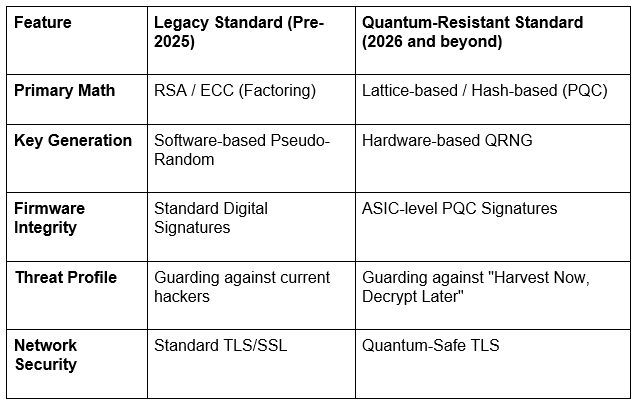
Click to enlarge.
The New "Normal" for Commercial Print Security
As we move deeper into the future, the distinction between "regular printing" and "secure printing" is fading. In a world of ubiquitous AI and looming quantum threats, Quantum-Resistant Printing is simply "Printing."
For commercial printers, the message is clear: The hardware you buy today will likely be in service for the next 5 to 7 years. If that hardware does not have PQC built into its silicon, like the new HP LaserJet Enterprise 5000/6000 series, you are investing in obsolete technology that may become a liability before it is even fully depreciated.
Protecting the printed page is no longer just about who is standing at the machine; it’s about ensuring that the data behind the page is safe from the most powerful computers ever built. The quantum era has arrived, and for the commercial print industry, the only way forward is through the lattice.
The preceding content was provided by a contributor unaffiliated with Printing Impressions. The views expressed within may not directly reflect the thoughts or opinions of the staff of Printing Impressions. Artificial Intelligence may have been used in part to create or edit this content.
- Categories:
- Data Management
Alyssa Summers is the CEO of Pryntbase, a marketing service and solutions provider for full service print companies. She brings a deep background in digital strategy and a proven track record in agency and industry leadership. Alyssa has helped hundreds of print businesses drive visibility, leads, and sales through smart use of technology and marketing automation. Known for her practical approach and deep industry insight, she is a digital marketing thought leader focused on helping printers thrive in the digital age. You can reach her at alyssa@pryntbase.com.


