


Where AI and Art Intersect: Print’s Role in the Next Creative Era
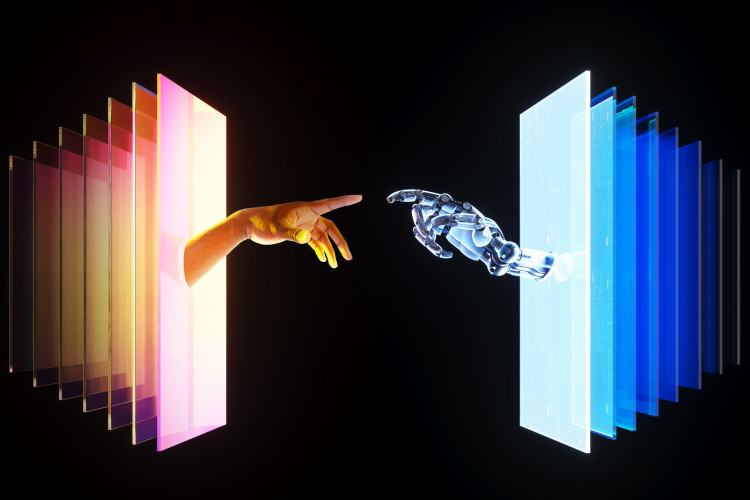

As artificial intelligence (AI) becomes more embedded in creative workflows, the printing industry is being forced to reexamine its role in the creation of art. While AI promises speed, scale, and efficiency, its advantages raise deeper questions about authorship, authenticity, and value.
This intersection of human creativity and machine intelligence is exactly where Sensaria's Jen Corbett, director of art, and Chris Young, executive vice president, find themselves. In their PRINTING United Expo session, they address how art and AI are reshaping our visual culture.
“We beg to ask the question … can AI make art that actually matters?” Corbett asks. “And that is the real question here, because historically, real art is a reflection of human emotion, connectivity, memory, and rebellion.”
So, how can a computer make meaning out of a form that is uniquely, and profoundly, human? Perhaps the key is to understand its place within the industry. “What gives art its value isn’t just what’s on the canvas,” Young says. “It’s a process, the story, the humanity behind it. Every product we create is for someone’s story, their journey, their home, their business, their brand, their identity, their meaning.”
AI doesn’t serve as the creator; it serves as the accelerator. “Technology is always going to evolve, but the humanity remains the medium here, and that’s our advantage,” Corbett says.
Where Creativity Meets Responsibility
As AI ushers in a potentially new art movement, one looming concern is how to use the technology ethically and legally. This is where companies like Sensaria are leading the way for responsible image generation.
Corbett notes that the most controversial issue is not typically the art itself, but rather, the training sets. For industry professionals just starting out, they’re most likely using open source platforms that scrape the internet for images without permission or attribution, ultimately leading to copyright issues.
“We’re seeing two paths emerge in the AI world,” Corbett says. “One being that open source, where it’s fast and flexible, but built from scraped imagery. The other is closed or licensed data sets, [it] trains on proprietary libraries where the rights are clear.”
For print service providers, the distinction is vital.
“This isn’t just a creative issue,” Young says. “It’s a supply chain issue. It’s about knowing your inputs like you would with ink certifications or even paper sourcing.”
When sourced responsibly, AI-generated art not only becomes safe, it becomes valuable. Artists are compensated, brands are protected, and consumers find meaning. This is the junction where AI becomes a tool for print.
From Automation to Authorship
With clear boundaries around data and sourcing, the conversation around AI in art can shift from “what” to “how.” Both Corbett and Young emphasize that AI does not operate alone, but rather, it responds to direction. “AI doesn’t decide, it only suggests,” says Young. The quality, relevance, and meaning are ultimately defined by the human guiding the process.
For artists, this means utilizing prompting as a creative skill. For printers, the responsibility extends beyond printing reproductions, but instead, ensuring that what reaches the press aligns with customers’ story, brand, or identity.
“I would say that key takeaway is AI can give us scale, but humans give us significance,” Young says. “It's not about who can produce the fastest — sometimes it is — but it's also who can produce the most meaning, and that's the business we're in. That's why humans still matter, because machines can make, and as a reminder, only people can move.”
- Categories:
- Artificial Intelligence (AI)
Jessie Farrigan is the production editor for the Printing & Packaging Group at NAPCO Media.


