Business Management - Industry Trends

Electronic Paper — Paper Route
January 1, 2007

THERE WAS a time not long ago (2005) when scarcely a week would go by without there being news of some new development in the growing “electronic paper” market. Perhaps “market” is the wrong word to use, as almost all the news that came out comprised solely of technology demonstrations, announcements of strategic partnerships, and prototype media and devices—none of which were available commercially. As a result, there was no real “market” to speak of. Still, the news was always exciting and sent the gadgets and gizmos crowd swooning with anticipation. And then, silence. What happened? It’s possible to interpret all
Hot Markets for 2007 — Prepare for Growth
January 1, 2007

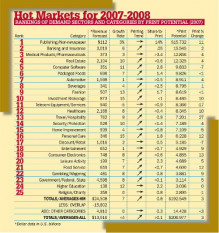
DON’T BELIEVE the pundits. The U.S. economy will expand, not contract, in 2007-2008, and to an annual growth rate of nearly 4 percent in GDP. This will reverse the downward adjusted 3.2 percent in 2006 and 2005. Our industry should makeready to run forward at near the GDP rate. The reason: print growth is tied to the “knowledge economy,” which is not calculated into GDP while government, an outlay, is. Research and development, if treated as a capital investment rather than as an intermediate expense, boosts GDP by 3 percent and the national savings rate by more than 2 percent. The U.S. accounts

Remarkable Changes of Emphasis Revealed at Printed Electronics USA 2006
December 14, 2006

PHOENIX—12/14/06—Here come the products. The annual IDTechEx event, Printed Electronics USA, took place in Phoenix, Arizona in December 2006 and it was larger than ever before, with over 300 delegates attending. IDTechEx prioritises the commercialisation of this technology in this conference series, which takes place annually in the US, UK and Japan. The term Printed Electronics rather than the old technically-led term Organic Electronics was apposite because, these days, the best devices increasingly involve both organic and inorganic patterning in the same device. But what really matters is do they work and can they benefit society? This year’s event was very different from

Pricing Competition Comes from All Sides
December 14, 2006

Among the more interesting issues in the printing industry is the constant, decades-old complaints about market pricing of print and its supposed roots in industry overcapacity. While those that topic will not be discussed here, it is essential to remember that the print medium exists in a larger communications marketplace, and now competes with more alternatives than ever for the same amount of budget dollars, and sometimes less. Recent reports from the Bureau of Labor Statistics show how prices have changed in these areas. The Consumer Price Index of inflation for the past two years has increased by 7.7% in total. Commercial printing prices have

Direct Mail Spending Positioned for 6.8% Average Annual Growth Through 2009
December 14, 2006

NEW YORK CITY—Decenber 14, 2006—Despite rising postal rates, higher raw materials costs and the advent of numerous alternative channels, marketers continue to seek out the return on investment benefits of direct mail—spending $60.6 billion on the channel in 2006—according to a white paper released today by Winterberry Group, a leading strategic consulting firm serving the marketing industry. The white paper, entitled Vertical Market Trends in Direct Mail and the Impact on Production Service Providers 2006, is the New York-based consulting firm’s third annual study of the direct mail production sector. Based upon feedback provided through hundreds of interviews with executives from throughout the direct mail

Passive RFID Label Prices and Volumes in a Vicious Circle
December 13, 2006

NEW YORK CITY—December 13, 2006—The market for passive radio frequency identification (RFID) labels — particularly UHF labels — has not yet grown as stakeholders in the industry had hoped. According to a new study from ABI Research, the reason these core components of RFID tags have failed to achieve their expected potential is the relationship between prices, volumes, and the business case for RFID. In a classic “vicious circle” dynamic, production costs for UHF labels (hence for Gen 2 passive labels) are still at levels tending to inhibit the high-volume deployments that would provide economies of scale. Research analyst Robert Foppiani says, “At current

RFID in 2006: A Story of Extremes
December 6, 2006

As we enter 2007, many RFID suppliers are licking their wounds, while for others, RFID business is booming. As IDTechEx interview solution providers and users across the RFID industry for the new report “RFID Forecasts, Players & Opportunities 2007-2017” to be released in January, Raghu Das, CEO, summarizes some of the findings. The volumes that never came At the beginning of 2006, there was much optimism in the retail mandate sector. RFID tag production capacities had been put in place and Gen 2 was delivering superior performance than previous versions. However, arguably the pallet/case market for RFID tags became the nearest thing to

October Printing Shipments Up +$259 Million; Six Consecutive Months of Increased Shipments
December 6, 2006

Printing shipments in October were up a strong +$259 million on a current dollar basis, and up +$155 on an inflation-adjusted basis. While current dollar shipments have been up for six months, real printing shipments have been up for three consecutive months. This was the biggest monthly comparison since July 2004’s real shipments were +$206 million compared to those of July 2003. For the year, real shipments are now slightly better than last year; it had been negative until this report. The strength of the increase may be attributable to highly contentious local political races around the country. Print was considered more effective than new

Content-Rich Annual Conference Explores ‘21st Century Economics’
December 1, 2006

NPES members attending the 2006 Annual Conference in Ponte Vedra Beach, Florida last month were treated to a business-intensive agenda featuring more speakers and ultra-current content than any previous event has afforded. With guidance from the Association’s Programs and Meetings Committee – Bruce Goodwin, John Stewart, Steve Fullerton, and Elinor Midlik – the Conference program was designed to engage members in lively dialogue with an array of industry leaders assessing and driving new business models of print. The program was enhanced by outstanding representation from the printing company community. An interactive printer panel discussion, featuring three executives assembled and moderated by NAPL’s Joe Truncale,

RFID Exotica ­— A Ubiquitous Enabling Technology
November 9, 2006

By Dr Peter Harrop At IDTechEx, when we teach Radio Frequency Identification RFID, we talk of it being a ubiquitous enabling technology like the wheel or paper. Some people consider that to be rather far fetched. After all, wheels extend from prayer wheels, steering wheels and wheels of fortune to aircraft wheels and microscopic wheels in Micro Electro Mechanical Systems MEMS. They are everywhere, as is paper because that appears as anything from art to toilet paper, packaging, books and origami. However, RFID is now used from Bulgaria to Namibia, from Azerbaijan to Vietnam and Antarctica. It is a life to death experience because it is