Business Management - Industry Trends

Printed Electronics — On Track to a Major Industry
February 14, 2007

CAMBRIDGE , UK—Feb 14, 2007—Nowadays, the term printed electronics is taken to include thin film electronics that will become printable. Most of the potential for printed electronics lies in what Toppan Forms calls Smart Media Products (SMP) which will be intelligent and mass producible yet often customisable as well. They will usually be used at the human interface or connected to networks and embedded ubiquitously into the environment. All this means that printed electronics will largely create new markets, such as tape around pipelines to detect leaks and impending leaks and signal that there is a problem. After all, leaks still occur in the
New PRIMIR Study on Small Commercial and Quick Printers
February 13, 2007

RESTON,VA—02/13/07—A new Print Industries Market Information and Research Organization (PRIMIR) study, Small Commercial and Quick Printer: 2006-2011 investigates the nature of quick printers (franchise and independent) and small commercial printers (less than 20 employees) in today’s marketplace. In addition to understanding the market dynamics and future trends, this study provides insight into the competitive landscape of this market and identifies selling opportunities and strategies for serving this unique industry segment. According to J Zarwan Partners and Sherburne & Associates, who conducted the research for PRIMIR, “the average small commercial or quick printer has 5.5 employees and does $583,000 in annual sales. With

Why Telling Businesspeople to “Embrace Change” is Meaningless
February 8, 2007

Go to an industry seminar, a trade show, or read a trendy business book, and you’ll undoubtedly hear something like “you have to embrace change to be successful.” How trite. How simple. How misguided. How lucrative, if you’re on the speaking circuit. Its corollary is “change or die.” The advice does little to improve businesses or improve businesspeople. We will die whether we change or innovate or not. We’re sorry to break the news to you this way, but it was the only free newsletter we were sending you at the time. When you choose to embrace something, it also means that you can

Printed Electronics vs. Silicon—Getting the Priorities Right
February 8, 2007

Although the capabilities of complex silicon chips increase at a rapid pace, there is little or no reduction in cost of the simplest silicon chips. These have stuck at about five cents for decades. The cost of a chip factory and the cost of research to improve chip production is rising exponentially so there is no reason to believe that the simplest chips will get significantly cheaper in future. An added concern is that these chips are the ones that make little profit so they are the first to be rationed and suffer price hikes when there is a chip famine i.e. when demand

New PRIMIR Study Spotlights Inkjet Market Potential
February 8, 2007

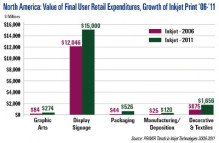
Many companies, small and large, are investing in inkjet technology R&D to develop systems for graphic arts, packaging, and other markets. To gauge the upside potential of this technology, PRIMIR commissioned I.T. Strategies of Hanover, MA, to produce a study focusing on Trends in Inkjet Technologies 2006-2011. The study, which has been released exclusively to the members of PRIMIR, targeted five key markets including Display Signage, Graphic Arts, Packaging, Decorative/Textiles, and Manufacturing/Deposition. According to I.T. Strategies, there is no doubt that inkjet technology will play a major role in these markets, driven by the process advantages it will offer, and its ability

Gift Cards: A Booming Niche in the Marketplace
February 8, 2007

When it comes to gift purchases these days, more and more people are paying with plastic – and not just the credit card variety. The National Retail Federation reports that consumers bought some $25 billion worth of gift cards over the recent holiday season. Printers have been taking notice of this growing opportunity in the marketplace. At OnTime Mailings in Chelsea, MA, a specialist in card embossing, President Richard Connolly says, “In the year 2000, we did fewer than 10 million cards, but for 2006 we’ll do approximately 100 million.” By any measure, gift cards are a booming business, one that could attract printers’

Printed Electronics - the Giants Get Involved
January 31, 2007

Printed electronics often involves simple things such as printed conductive patterns to counter the pollution, unreliability, bulk, weight and cost of wires, solder and etched patterns. The US Army plans to use printed electronics to reduce the weight of a warfighter’s pack by two thirds and give him smart clothing that generates electricity, heats him, cools him, monitors vital signs, acts as a long range antenna and so on. Printed electronics is mainly about reducing cost but it also involves printed lasers, photodiode arrays and many other sophisticated structures some of which perform better and are more fault tolerant than traditional alternatives. Most commonly,

Printed Electronics – the Missing Fragments
January 25, 2007

CAMBRIDGE, UK—01/25/07—Nowadays, the term printed electronics is taken to include printed electrics and even thin film devices that are likely to be printed in due course. Anything less risks missing the big picture, the subject is moving on so rapidly. Of the different components that are becoming printable, Organic Light Emitting Diodes (OLEDs) are very important. This is because they are set to replace many of today’s electronic displays with something more economical and with better performance. They will do the same with much of today’s lighting as well. In both cases, the change will be accelerated by the advent of cost-effective flexible displays

What Will 2007 Hold for Printing Shipments?
January 18, 2007

The recent bullish rise in industry shipments has changed the outlook in our different forecasting models for 2007 and 2008. Forecasting is sometimes viewed as guesswork or a black art, but there are numerous tools that forecasters use, and we use as many as we can find. Through the years, we have found that the use of statistical models helps to focus the discussion and immersion in anecdotal accounts are used to enrich prognostications. Every day, we review forecasts, and sometimes we joke there are often more forecasts than there are real data. There is one aspect of forecasts that continually befuddles us: the “consensus

Industry Consolidation: Not as Simple as it Looks
January 11, 2007

Cadmus was bought by Cenveo. Cenveo chased Banta, and then R.R. Donnelley outbid them. Donnelley then bought Von Hoffman. Cenveo is a product of mergers. Donnelley is becoming one as well. There’s more to come. The fact that mergers and acquisitions exist in the printing business should not be a surprise: they have been going on for decades. The 1980s had their “greying of the industry” wave, as owners sold because their grown children had careers of their own, many deciding that printing was not for them. The 1990s had a growing stock market and Wall Street analysts who saw commercial printing as a