


Mark Smith
June 1, 2012
Characterizing drupa 2012 as another inkjet show is too limiting to capture the broader digital printing focus of the developments announced. Nanographic Printing, liquid-toner presses and hybrid offset-inkjet configurations where every bit as prominent, and the B2 format dominated the product introductions.
December 1, 2011
Looking ahead to 2012, it seems as if the commercial printing industry, the country as a whole and even the global economy have been cast in a sequel to the Bill Murray movie that nobody wanted to see made—Groundhog Year. The first draft of the script for the coming year reads much like it did for the past two years.

October 1, 2011
Wide- and grand-format printers really stood out around the show floor, with the size of some devices giving them the impression of being the new “heavy iron” in the industry. Even the new crop of inkjet presses for high-volume page production was overshadowed a bit by their wider brethren, as fewer vendors elected to bring machines to Chicago.

March 28, 2011
The On Demand Conference and Exposition in Washington, DC, felt more like a conference with an exhibit hall, rather than a trade show with an education track. Much of the show floor had the feel of the tabletop displays at Seybold Conferences.

March 1, 2011
Differences in the inkjet imaging systems now being employed can have an impact—to varying degrees and relative to each other—on head cost, failure rate and cleaning/maintenance requirements; substrate flexibility; print resolution; color saturation; print width; and more. It doesn't quite rise to the level of an apples to oranges comparison, but the technology has very distinct flavors.
February 1, 2011
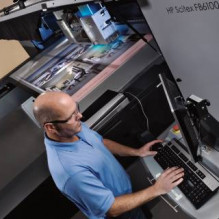
Hybrid print production, or the integration of digital and offset printing, can take multiple forms and be defined in different ways. Examples include digital imprinting of preprinted offset shells, running inkjet heads in-line with a web offset press or binding line, and building a common workflow for processing files output to a digital press and computer-to-plate system. (Includes Web-only sidebar and bonus video content.)
December 1, 2010
With the dawning of 2011 on the horizon, the business outlook had already turned brighter, even before the outcome of the November elections buoyed the spirits of the business community. "The bias of the U.S. economy is that it wants to grow," observes Ron Davis, Ph.D., and Printing Industries of America's (PIA) chief economist and vice president.

October 1, 2010
Drupa 2008 has claim to the label, but calling this the Inkjet Graph Expo was even more apt because the technology accounted for much of the printing equipment running on the show floor. That's, of course, factoring in the large number of wide- and superwide/grand-format inkjet printers on display.
April 1, 2010
JDF's potential is yet to be realized, but there is another pathway for integrating MIS and production—shop floor data collection and direct machine interfaces (DMIs).
February 1, 2010
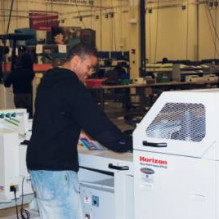
Mimeo.com went from being a business model on paper to an online print provider with more than 450 employees and nearly 300,000 square feet of manufacturing space spread across three strategically located production facilities.
