


So, You Plan to Buy a Flatbed…


The following article was originally published by In-plant Impressions. To read more of their content, subscribe to their newsletter, IPI E-News.
Flatbed printing has grown more than any other service at in-plants. While 29% had flatbed printers in 2024, 45% run them today, according to IPI research.
And no doubt that number will grow even more after this year’s PRINTING United Expo.
With so many flatbeds on display at the Las Vegas show, picking the right one can be a daunting task. Managers who have already done this have some good advice.
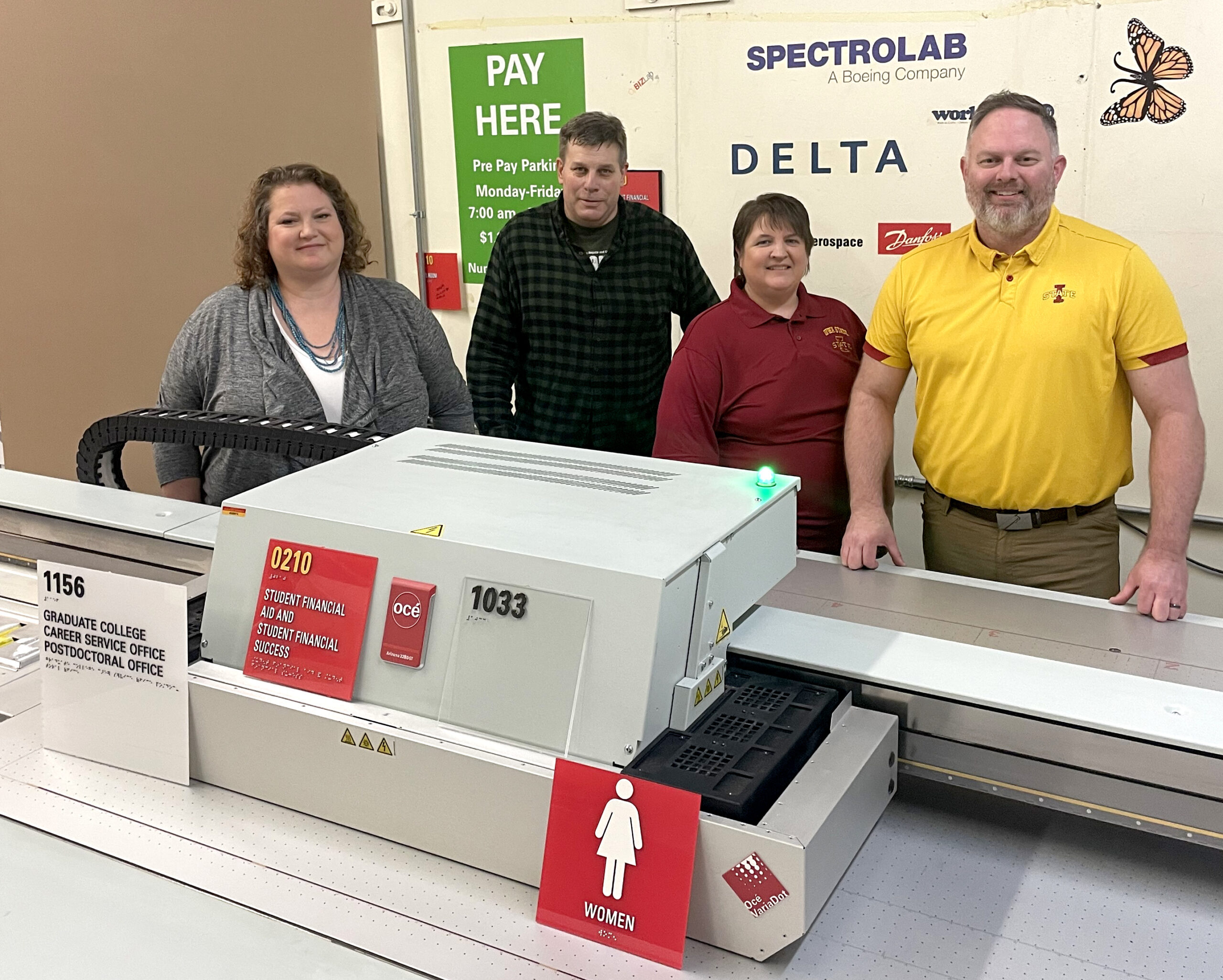
Staff of Iowa State University Printing Services stand with samples of ADA-compliant signage and the Canon Arizona 2280 GT flatbed printer that produced it. From left: Erin Thompson, Dan Holland, Elaine Broome Cheaney, and Nathan Thole. | Credit: Iowa State University
“Quality is rarely a concern anymore, so don’t get dazzled by the pretty samples,” notes Nathan Thole, director of Iowa State University Printing Services, whose shop added a Canon Arizona 2280 GT flatbed printer a few years ago and never looked back.
Before going to the Expo, Thole and his team did a lot of research.
“We employed a thorough evaluation, considering ROI, industry trends, specific capabilities, vendor support and reputation, peer input, demonstrations, etc.,” he reflects. “Because we were looking for a solution that could specifically support ADA-compliant sign production, we were able to justify a sole-source purchase from Canon USA.”
World Bank Group’s Printing & Multimedia Services operation just purchased an Epson V7000 flatbed UV, and is awaiting delivery to its Landover, Maryland production facility.
“Quality and features were the most important things when deciding which machine to buy,” explains Adam Broadfoot, senior program manager. “We wanted something with the ability to add spot and gloss varnishes, and have top notch color capabilities to meet our clients’ needs.”

The World Bank Group's Colex cutter and EFI 16H Pro hybrid flatbed printer.
While the in-plant already had a 65” EFI Pro16H hybrid UV wide-format press, it needed a flatbed that could print on boards up to 48x96”.
“This printer will allow us to create jigs on our Colex and UV print more items at once than our current capacity,” Broadfoot says. “We opted for the Epson due to positive past experiences.”
And while the in-plant didn’t make the final purchase decision at PRINTING United Expo last year, Wes Troup, Business Solutions Associate for the World Bank’s Printing and Interactive Media teams, says the Expo certainly factored heavily into the process.
“Mainly, being at the Expo gave us direct access to multiple vendors and print platforms in close proximity which made it a bit easier to compare capabilities and footprint,” Troup says.
Tips for Evaluating Flatbeds
As you walk the Expo floor this year, whether you’re just starting an exploratory journey, or you’ve been doing the research for months and you’re ready to make the final decision, there are a few things to consider.
Know What You Need
With every vendor and piece of equipment running, samples flying, and everyone excited to be at the Expo, it can be easy to get caught up in the moment. Before ever stepping foot on the floor, take the time to make a list — mental or otherwise — of what your in-plant is actually lacking. What are your specific pain points? What features are critical for you?
“Have a good understanding of your operation and the gaps that need to be filled prior to going,” Troup stresses. “When attending demos, take the time to ask the reps about how the machine fills your specific needs. Don’t be shy about diving into the capabilities that matter most to you. There’s a lot going on at Expo, but it pays to spend as much time as possible understanding the equipment that really interests you. Also, think about how your program will evolve, and if your potential machine can grow/upgrade along with your growth.”
Have Questions Ready to Go
It is easier to compare models when you have a common base to start. Having a list of questions prepared to ask every vendor you are talking to will allow you to make direct “apples to apples” comparisons of the equipment.
Thole breaks down a few questions he would ask if he were buying again at this year’s Expo based on what he has experienced with his own press. “What are actual print speeds in various modes, and how does that affect my product lines? Is there a limitation to the type of media I can print on? How durable is the ink technology and does it need special ventilation?”
He adds that he would ask a few more general questions as well, including, “What makes your device better than the rest? What does support look like, for me, if I were to make a purchase? How long has this model been out, and how much longer do you anticipate it being supported?”
To File or Not to File, That is the Question
Whether or not to bring your own files to the show floor to see how each piece of equipment handles examples of your specific work is debated. Thole notes that he wouldn’t bring them to the show floor, but would likely ask for specific samples on specific media options later. “This hasn’t always worked well in my experience,” he notes. “I would do that outside of the show, so the vendor has a chance to do it right, and on the media you want. There isn’t always time for this, and vendors sometimes seem to be annoyed by this, at the shows.”
On the other hand, Broadfoot is a big proponent of bringing files to the Expo floor. “On the show floors you can see your actual files being printed without tweaking them in advance,” he says. “It's not a dealbreaker, but the hope is that the color and quality are close to your expectations, even if some adjustments are required.”
Troup splits the difference, noting, “It can be difficult to get some OEM’s to print your specific files in the moment during the show. I do certainly recommend having them print your files on a substrate of your choosing, though. If possible, seek out a representative from the OEM or distributor prior to the show and ask for a demo. If they agree, you will be able to provide files with instructions on the substrate in advance so the process is much smoother on the show floor. If you don’t have time to prearrange a demo, ask the vendors when is a good time for them to do a demo with just your files. You might have to stay a little late or arrive a little early the next day, but most will try to accommodate you.”
Don’t Ignore Red Flags
While today’s equipment is fairly good, that doesn’t mean every flatbed press will work in every in-plant. Here are some red flags to keep an eye out for as you walk the floor:
- Don’t just look at cost — the cheapest option might actually cost you more in the long run if it’s not the right fit or doesn’t have the right options.
- Look beyond the cost of the press itself. Media, inks, support — all of those can vary and can make a difference when it comes to the actual ROI of a machine.
- Don’t forget to factor in hidden costs (starting to notice a theme?). Some flatbed presses require ventilation, for example, and the cost of preparing a facility to accommodate that can tip the scales in major way.
- Be careful with aging technology. Not only will it be more likely to be phased out sooner and supported for shorter periods of time after your purchase, it will also likely end up costing more in the long run. Newer technologies might cost more up front, but they often bring upgrades and efficiencies that reduce the total cost of ownership over time.
- Don’t overlook geography. Especially when it comes to the support network, having technicians within a few hours of your in-plant can mean getting a problem solved same-day, versus working with a company that has to fly someone in and having a press down for days or weeks. That is a hidden cost in time and productivity that can add up fast.
As you plan your PRINTING United Expo visit, hopefully these tips will help you get the most out of your three days on the floor.
“I would just advise anyone to do thorough research and always send multiple files for samples,” Broadfoot says. “We do this for production presses, copiers, and wide-format equipment as a matter of practice simply because it allows us to see our files — printed — so we can compare them to our current output and the output of comparable machines. Our wide-format and promo item product lines have absolutely exploded over the last few years, and many lessons have been learned during the process.”
Start making your list and checking it twice. PRINTING United Expo is coming up fast, Sept. 23-25 in Las Vegas, and for every in-plant even considering equipment purchases in the next 12 months, it will be the one event you don’t want to miss.
- Categories:
- Digital Printing-Wide Format - Flatbed
Toni McQuilken is the senior editor for the printing and packaging group.


