Lean Into Waste Reduction: A Q&A with a Lean Six Sigma Master Black Belt
Are you looking to reduce waste and improve efficiency in your printing operation? John Compton, principal at Compton & Associates LLC, a Lean Six Sigma Master Black Belt (MBB), and senior member of the American Society for Quality, shares his wisdom with printers ready to embrace lean manufacturing.
A professor emeritus at Rochester Institute of Technology (RIT), Compton is a respected consultant, trainer, and author dedicated to improving people, processes, and profits in the printing industry. He’s held several leadership roles in quality and organizational development and spent 15-plus years as the conference consultant to PRINTING United Alliance’s Continuous Improvement Conference.
In this Q&A, Compton shares the benefits of adopting lean strategies for print service providers (PSPs), the most effective methods to implement, key metrics to measure, and advice for those just getting started.
PI: How can lean manufacturing principles benefit PSPs?
JC: Lean was born from a study of the Toyota Production System (TPS), a system recognized worldwide as a highly successful management and production method. While Toyota used its TPS for the manufacture of automobiles, the basic principles have been shown to successfully apply to nearly every type of production activity. A wide variety of companies in the printing industry are practicing some form of lean and continuous improvement.
Basically, lean is about creating the most value for the customer while minimizing resources, time, energy, and effort. A lean approach is about:
- Understanding what’s really going on at the place where value is created, called the Gemba, which is often the shop floor, but also includes sales, customer service, shipping, etc.
- Improving the processes by which products and services are created and delivered.
- Developing and empowering people through problem-solving and coaching.
- Developing leaders and an effective management system.
Commercial printers face identical conditions. They have a need to provide maximum value to customers using minimum resources. It’s not surprising that many commercial printers have chosen to learn about and implement lean practices. The challenge is to take enough time to learn the thinking behind the approach to more effectively practice and benefit from it.
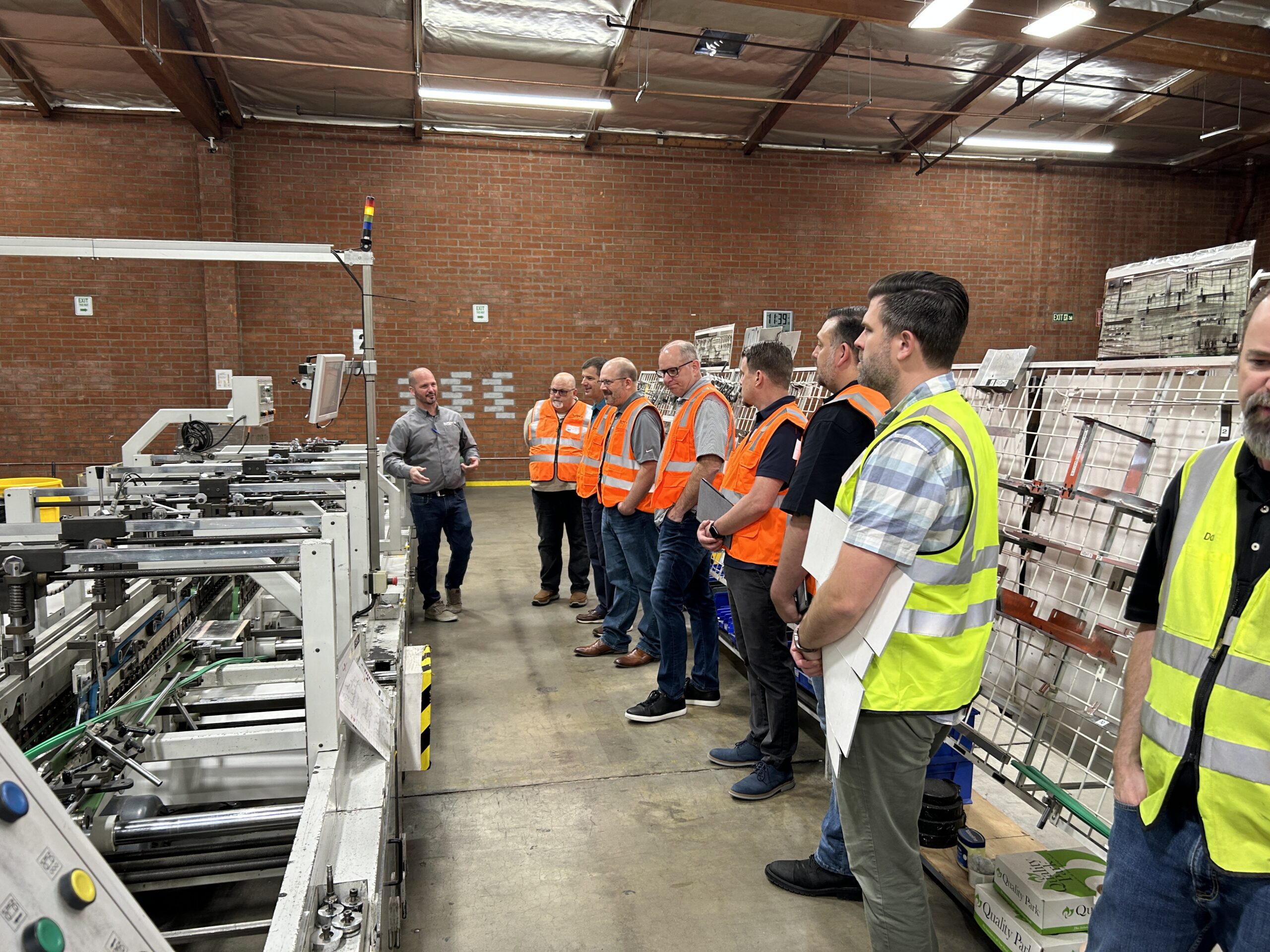
Michael Bouquet explains Los Angeles, California-based Superior Litho’s lean operations to his fellow OPEX/Lean peer group members. | Credit: John Compton
PI: Why should waste reduction matter for PSPs, both in its environmental impact and its business case?
JC: All work performed at a commercial printer (or any type of printer) is done through a series of processes. A process is a set of steps with an input and an output. There are processes for order entry, scheduling, file verification, platemaking, presswork, finishing, and shipping just to name a few. Typically, there are hundreds of such processes in place. Many go unseen or unstudied because they are taken for granted as the way we always do things. Lean teaches us that all processes are loaded with waste and that there are seven types of waste always present.
Transportation: Transporting product between processes is a cost incursion that adds no value to the product. Excessive transportation and handling can cause damage and offer an opportunity for quality to deteriorate. Material handlers must be used to transport the materials, resulting in another organizational cost that adds no customer value.
Inventory: Any raw material stock and work-in-process more than the requirements necessary to produce product as the internal and external customers need it. Excess inventory tends to hide problems on the shop floor, which must be identified and resolved to improve operating performance. Excess inventory also increases lead times, consumes productive floor space, delays the identification of problems, and inhibits communication. Every piece of inventory you hold has a physical cost tied to it. Unnecessary inventory that accumulates before or after a process indicates that smooth flow is not being achieved.
Motion: This waste is related to ergonomics and is seen in all instances of bending, stretching, walking, lifting, and reaching. These are also health and safety issues. Jobs with excessive motion should be analyzed and redesigned for improvement with the involvement of the operators.
Waiting: Whenever goods are not moving or being processed, the waste of waiting occurs. Typically, as much as 90% of a product’s life in traditional batch-and-queue shops (most printing companies) will be spent waiting to be processed. Much of a product’s lead time is tied up in waiting for the next operation because material flow is poor, production runs are too long, and distances between work centers are too great.
Overprocessing: Any effort in production or communication that does not add value to a product or service. Overprocessing waste includes overly tight specifications, unnecessary handling and inspections, excessive information, and process bottlenecks, as well as redundant reviews and approvals. This all adds cost and time, but no value.
Overproduction: Making more product earlier or faster than what is required by the next process downstream, leading to excess inventory. It’s viewed as perhaps the worst of the wastes as it leads to many others.
Defects: Defects are produced when the product fails to conform to customer requirements. This leads to costs associated with increased inspection and sorting, reruns, scrap, and customer credits, among others.
Commercial printers should be greatly concerned with all these wastes, not just physical paper waste. Many studies have shown that only about 20% of the work being performed at commercial printers is value added, while the remaining 80% of the work is adding no value from the customer’s perspective. These costs and time being shouldered by any printer not focused on reducing the seven wastes are quite large.
PI: How have you seen lean principles successfully tailored to meet the unique challenges of print production environments?
JC: The tailoring occurs at the very beginning of the application. Printers are unlike mass manufacturing companies in that they typically do not produce the same product (i.e., widgets) repeatedly and sell it to many different customers. These companies focus on achieving flow of product through reduced batch size, standard work activities organized into cells with no interruptions. However, printers serve a variety of customers producing a variety of products weekly, monthly, or quarterly. In this fashion, they think of themselves as a type of “custom” producer — and in many respects, they are.
However, like all other manufacturing companies, printers have processes that are repeatedly used to produce the product. Yes, the products change, but the processes remain fundamentally the same, and all those processes are loaded with waste and inefficiency. The focus that makes the greatest sense is on the seven wastes — their presence and reduction.
The lean method most frequently used by printers is 5S (sort, set in order, shine, standardize, and sustain). The primary objective of 5S is to create a clean, orderly environment — an environment where there is a place for everything, and everything is in its place. 5S exposes some of the most visible examples of the seven wastes. It also helps establish the framework and discipline required to successfully pursue other continuous improvement initiatives. It reduces searching, waiting, walking, and other time-wasting activities. While it’s most commonly practiced on the shop floor, the thinking and practice apply to all work areas.
The challenge here is that for many printers, lean begins and ends with 5S. If it’s implemented as a tool without a deeper understanding of lean thinking and principles, the benefits are very limited.
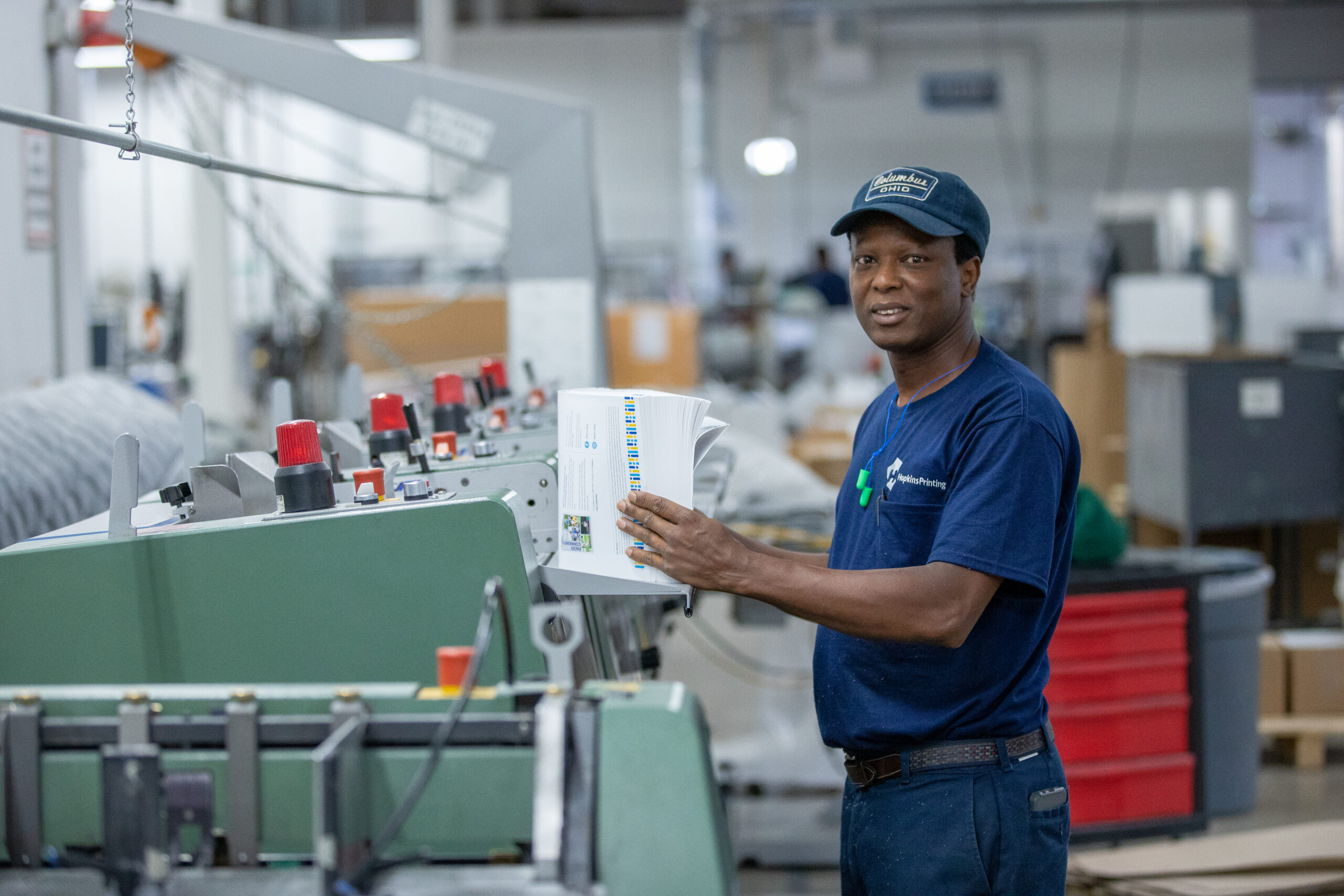
Hopkins Printing uses lean principles and strategies to tackle its most common wastes: inventory, motion, overprocessing, and wasted human potential. | Credit: Hopkins Printing
PI: What types of lean manufacturing methods can be most effectively adapted for the printing industry and waste reduction?
JC: Here’s the problem: Many printers starting a continuous improvement initiative are drawn to the tools and methods that they believe can be quickly implemented to bring improvement. Unfortunately, without a solid understanding of the thinking and principles behind lean practices, the use of the tools alone yields limited returns and is often short lived.
The reality is all the tools and methods of lean can apply to print production processes once you understand the purpose of lean and the thinking that guides it. I have worked with many printers over the years who have applied nearly all the lean methods but only after they understood the problem to be solved, what was needed for success, and then selected the method most appropriate for the type of improvement being sought did they see significant results.
There are many lean methods for reducing the seven wastes. 5S, makeready reduction, visual workplace, point-of-use storage, and many others, but to select the right one first requires an understanding of the problem to be solved.
PI: What metrics can help printers track waste reduction progress credibly?
JC: The use of physical waste measures is widespread and typically includes makeready waste, run waste, and rejected product, among others, with each valued in different ways.
In my experience, measures of paper waste currently being used are fine. But the measures alone do nothing to improve processes. The challenge is to undertake specific process improvement actions that are focused on reducing it. This requires an understanding of lean principles and methods as well as the involvement of employees who work in the process. Awareness of physical waste does not reduce it; specific actions taken on the processes that produce it are necessary.
While focusing on physical waste is important, many printers fail to take action on the other six wastes that plague all processes, and create cost and add time. In those cases, measures of time (process time, cycle time, lead time, etc.) are often used. Time is quite easy to measure and is specific to a particular process, and therefore a useful measure for improvement.
PI: What advice do you have for PSPs beginning to implement lean strategies?
JC: Take time to learn the principles that underlie lean, and recognize that it is much more than a set of tools and methods. Implementing a tool like 5S without understanding the thinking that supports it will never provide lasting returns.
Learn about and develop a deep understanding of the seven wastes of lean. These wastes are everywhere in your business, slowing down and encumbering your people and processes. They make all work activities harder to perform, more likely to generate mistakes, slower to complete, and more costly to carry out. The goal of lean practices is to make work easier, better, faster, and less expensive. Once you understand these wastes, teach them to everyone in your company and seek their help in reducing them.
The wastes are everywhere. You can’t do it without them.
I recommend you read these books to get solid insight into the thinking and practice of lean: “2 Second Lean” by Paul Akers, and “Lean Made Simple” by Ryan Tierney.
Finally, I suggest you visit companies that have transformed to a lean way of working to see what is required by all management levels to be successful with it.