


Inkjet Powers Mayo Clinic’s Mission to Put Patients First


The following article was originally published by In-plant Impressions. To read more of their content, subscribe to their newsletter, IPI E-News.
Few technologies have transformed print production quite like inkjet, and Mayo Clinic’s in-plant shows just how dramatic the impact can be.
“We used to have three production machines that ran our secure print work, two shifts a day. It took us all day and all night to produce the statements on those three devices,” recalls Bret Johnson, manager of the Print Production Unit at Mayo Clinic, in Rochester, MN. Then his 49-employee in-plant added a continuous-feed inkjet press in 2021 and everything changed.
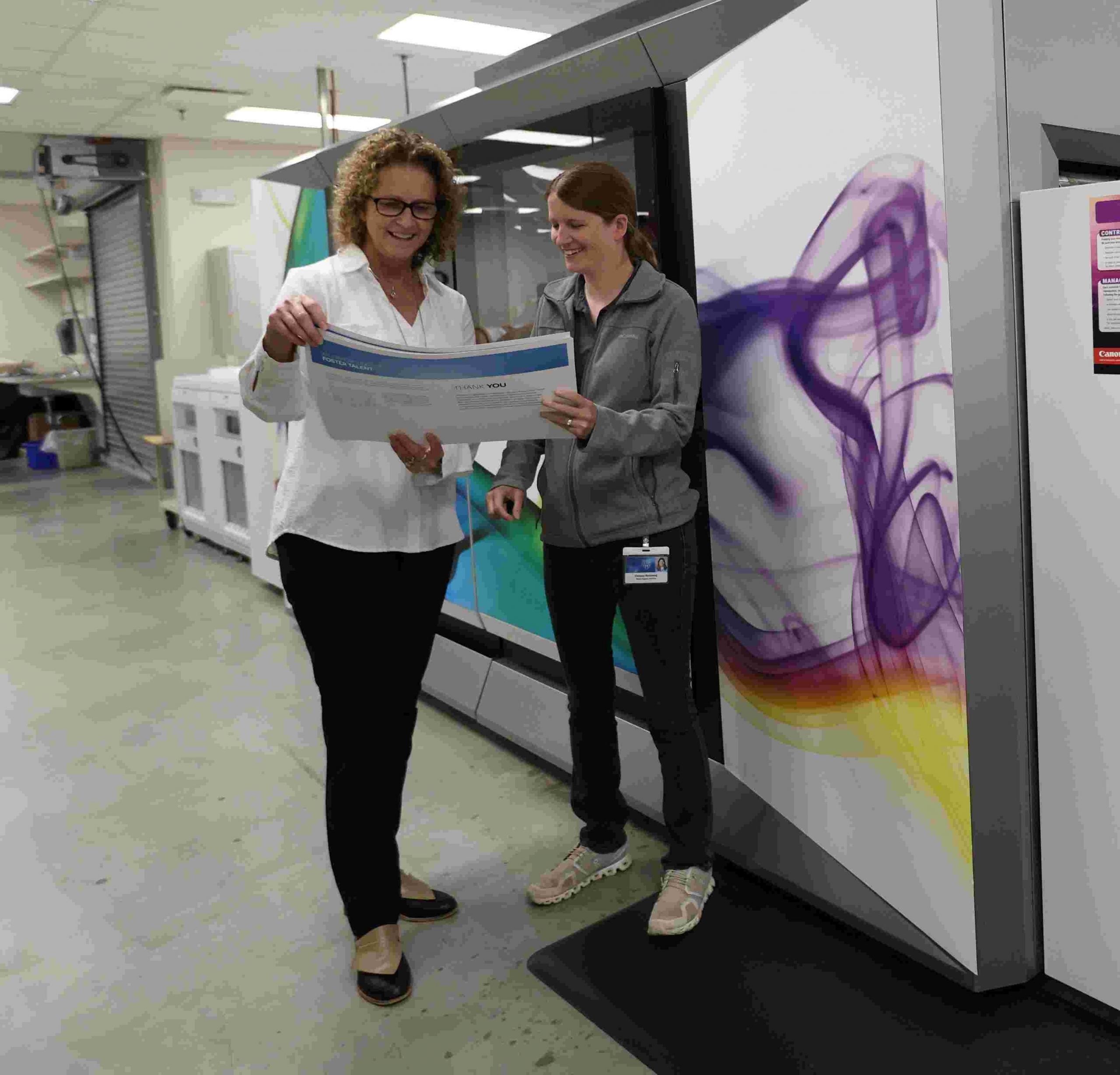
Supervisor Donna Macht (left) and Chelsey Holmberg review output from the in-plant’s cut-sheet inkjet press.
“Now we do that in about six hours … on the night shift,” he says — freeing the day shift to work on other projects that bring value to the world-renowned medical center.
For instance, the time saved through inkjet efficiency enabled his team to develop a 54-page saddle-stitched booklet to replace the folders stuffed with brochures and loose materials Mayo nurses once spent valuable time assembling.
“This saves many, many hours of nursing time, which then can be put back into patient care,” Johnson points out. And that, ultimately, is the mission of Mayo Clinic.
A Legacy of Care
Regarded as one of the world’s leading medical institutions, Mayo Clinic is a nonprofit academic medical center founded in 1864 and built around integrated patient care, research, and education. With major campuses in Rochester, MN; Phoenix; and Jacksonville, FL, Mayo Clinic employs approximately 76,000 people and serves about 1.3 million patients from more than 130 countries each year.
Its international reputation is rooted in its ability to attract patients with serious and complex conditions, while advancing medicine through research, education, and a collaborative model of care.
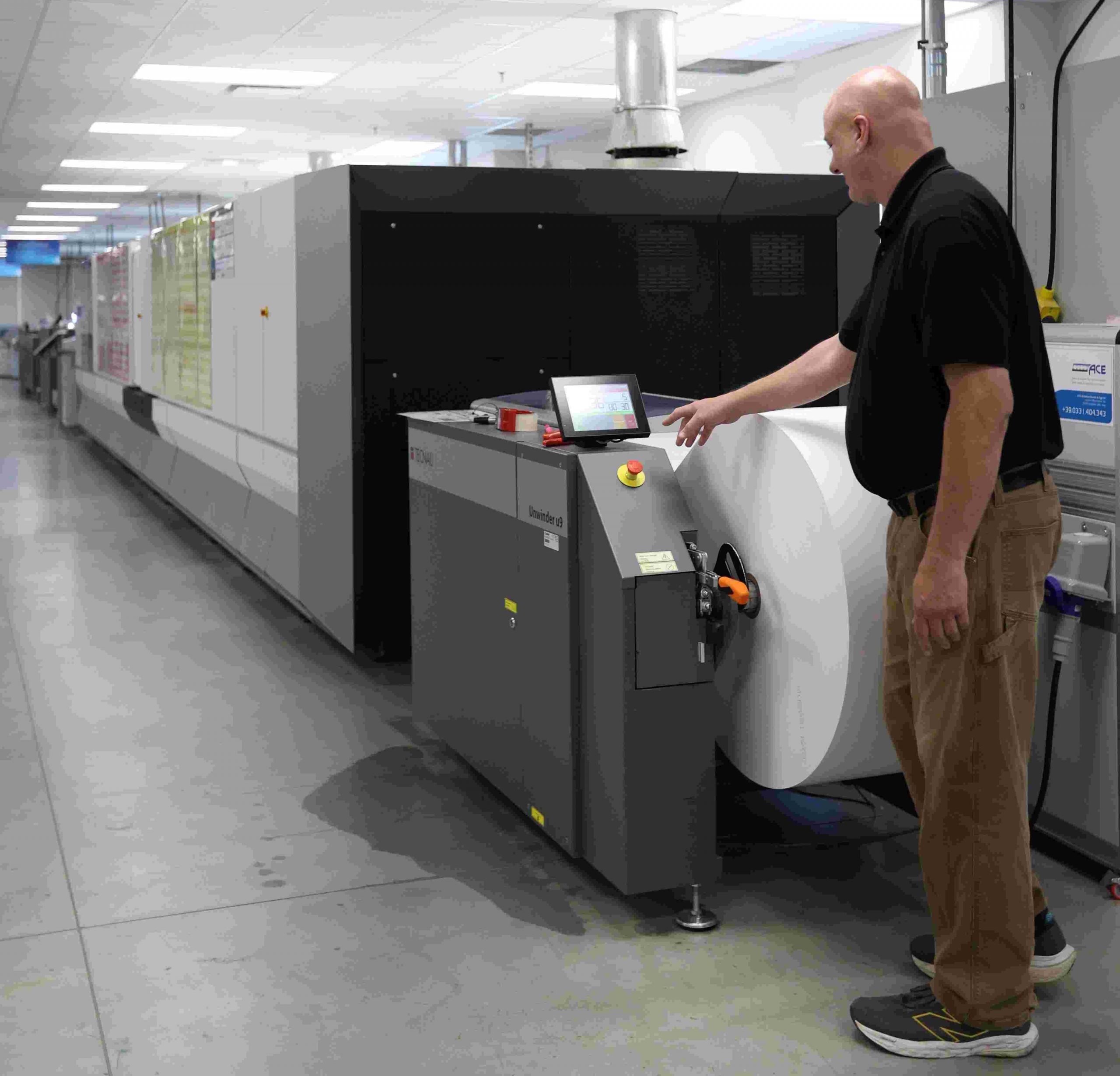
Tony Row checks the paper roll information on Mayo Clinic’s roll-fed inkjet press.
Johnson joined Mayo Clinic in 2008 after two decades as a field service technician for Xerox. Guided by that experience, he moved the in-plant away from offset and, after attending the Inkjet Summit several times, steered the operation into production inkjet. The continuous-feed inkjet press was quickly followed by a cut-sheet inkjet press in 2022, and additional inkjet capabilities are on the horizon. Johnson was back at the Inkjet Summit this year, researching a replacement for two black-and-white toner presses the shop keeps as backups.
“It definitely will be inkjet over toner,” he asserts. “The cost and the speed just makes it the right decision.”
Johnson’s confidence in inkjet stems from years of dealing with the constant maintenance demands of his shop’s former toner presses.
“I used to have three technicians here every day of the month, pretty much, when I had 10 digital devices,” he says. “Now I’ll see the inkjet [service] guys a couple times a month.”
The phenomenal uptime of the inkjet presses has greatly enhanced the in-plant’s productivity. The shop now produces almost 80,000 jobs per year totaling about 90 million pages. The in-plant still outsources 2,400 or so jobs each year, and Johnson says he could add a shift and take on a portion of this work, “but we also want to have a robust commercial environment around us that’s there to support us if we need them.”
Beating the Shell Game
One of the biggest benefits of inkjet, Johnson notes, was the elimination of preprinted shells.
“I was able to get rid of 40 preprinted shells that we were swapping in and out of trays,” he told his peers while participating in a panel discussion at this year’s Inkjet Summit.
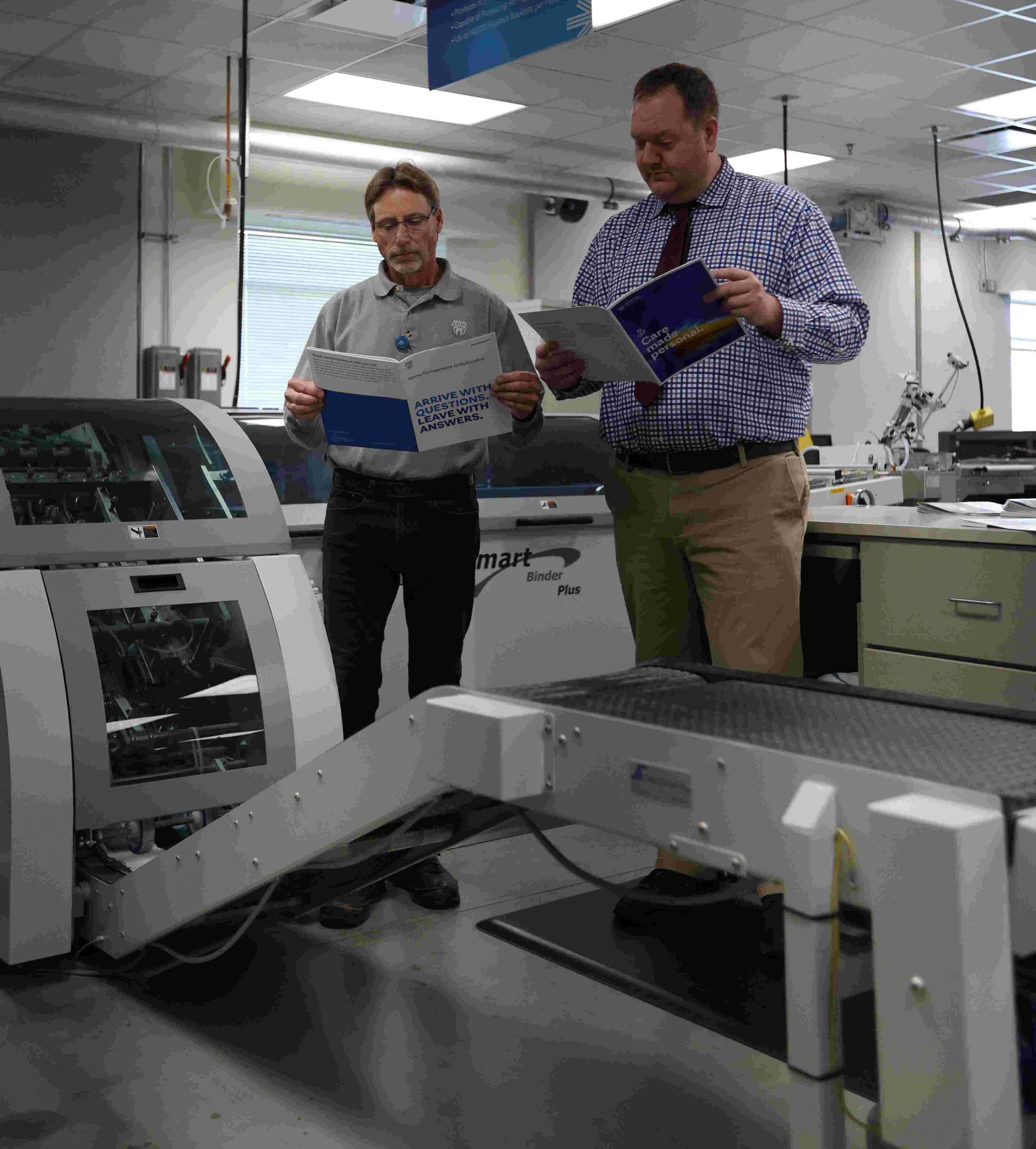
Will Pearson (left) and Supervisor Mike Glasrud review the quality of some recently produced booklets.
These were printed by outside printers, stored in a forms warehouse, and shipped on request to the in-plant to be overprinted with toner. In addition to all the manual labor involved, he says, “It led to lots of opportunities for errors.”
Switching to inkjet allowed the in-plant to transition Mayo’s patient education materials to a saddle-stitched book with a self cover.
“Now we run most of our patient education materials more like a magazine,” he says. “It allowed our patient education colleagues to go from the ability to only have a color shell and black internals, to producing the whole thing in-line, full color, every page, for a cost that’s less than what we were paying for black overprints.”
The in-plant also eliminated pre-perforated shells for transactional work and now prints them in color on the continuous-feed inkjet press, perfing them with the in-line dynamic perforating system.
The Perks of In-line Finishing
Though many inkjet users prefer using near-line finishing equipment, not wanting to slow the press by anchoring it to in-line equipment, Johnson is confident Mayo’s inline configuration was the right decision due to service level agreements mandating 24-hour turnaround.
“It doesn’t do me any good to have rolls of printed product that need to be out within the next six hours if my finishing line is down,” he says. “So, if I can’t get it all the way out, then we switch it to a sheetfed environment and run it sheetfed so that we can get the work done.”
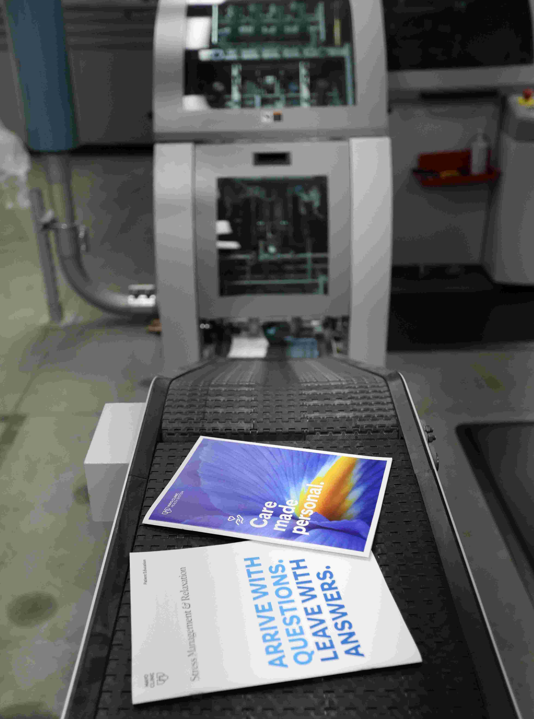
Personalized care booklets printed by the in-plant.
But generally, the continuous-feed inkjet press enables the shop to complete its 24-hour turnaround work in closer to 16 hours, he says.
The speed and costs savings of inkjet don’t mean the in-plant has sacrificed quality, Johnson stresses. The quality the shop gets from its inkjet presses is excellent, he contends.
“Quality is not even a factor anymore,” he says, noting that the in-plant has won several In-Print awards in recent years for pieces printed with inkjet.
Wide-Format Mastery
Inkjet is also crucial in another area of the in-plant: its wide-format printing division. The shop uses one flatbed and four roll-to-roll printers, along with an automated flatbed cutter, to produce wallpaper, murals, window graphics, museum displays, and more. Often the shop uses wide-format to transform patient spaces to make them more inviting and welcoming, with messaging focused on healing. One recovery room hallway was decorated with a wildlife theme, featuring a range of birds and animals native to southern Minnesota. Employee-facing graphics include messaging focused on Mayo Clinic’s organizational mission, vision, and values. The shop has also printed a lot of clear acrylic pieces to recognize doners, Johnson says.
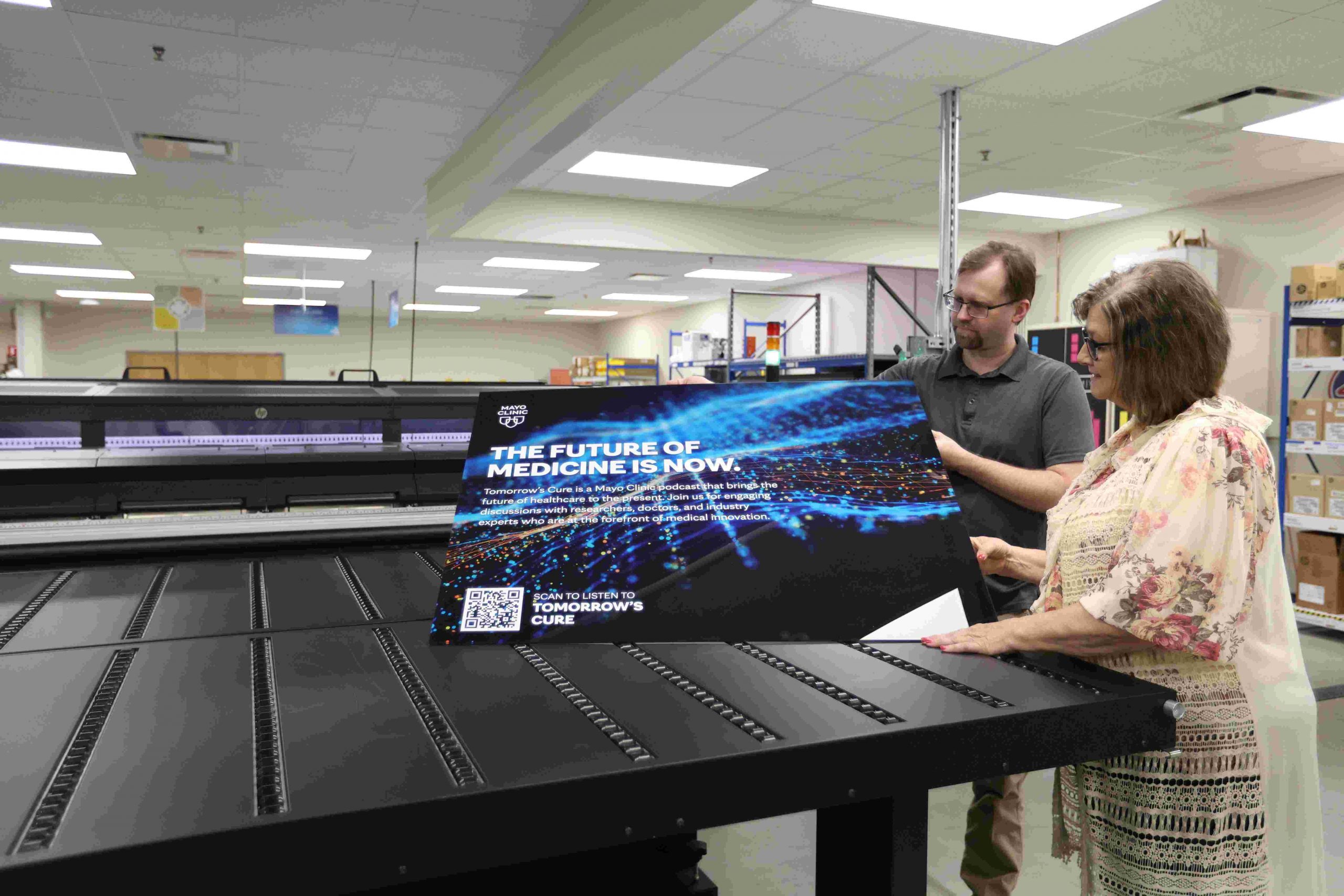
Standing with the in-plant’s flatbed latex printer, Jarrod Kintzi (left) and Supervisor Rebecca Thompson analyze a reverse printed acrylic display piece.
Doing wide-format projects like these in-house not only saves money, it’s faster than sending the work outside. The in-plant can get a file, print it, and ship it within 24 hours, without incurring rush fees. This is especially important for the scientific posters the shop prints for doctors to take to conferences, which often have tight 24-hour turnaround demands.
Johnson notes that an upcoming $6.4 billion expansion to Mayo Clinic’s Rochester campus over the next four years will create lots of signage printing opportunities for the in-plant.
One job the in-plant has moved off its roll-to-roll printers is labels, which it now prints on a small inkjet label printer. It used to take three hours to print 1,000 4x7" medical or warning labels, laminate them, and cut them.
“Now we do those 1,000 labels in 15 minutes on the small direct inkjet label printer with pre die-cut labels,” he says. “It’s so much faster and efficient for really short-run labels.”
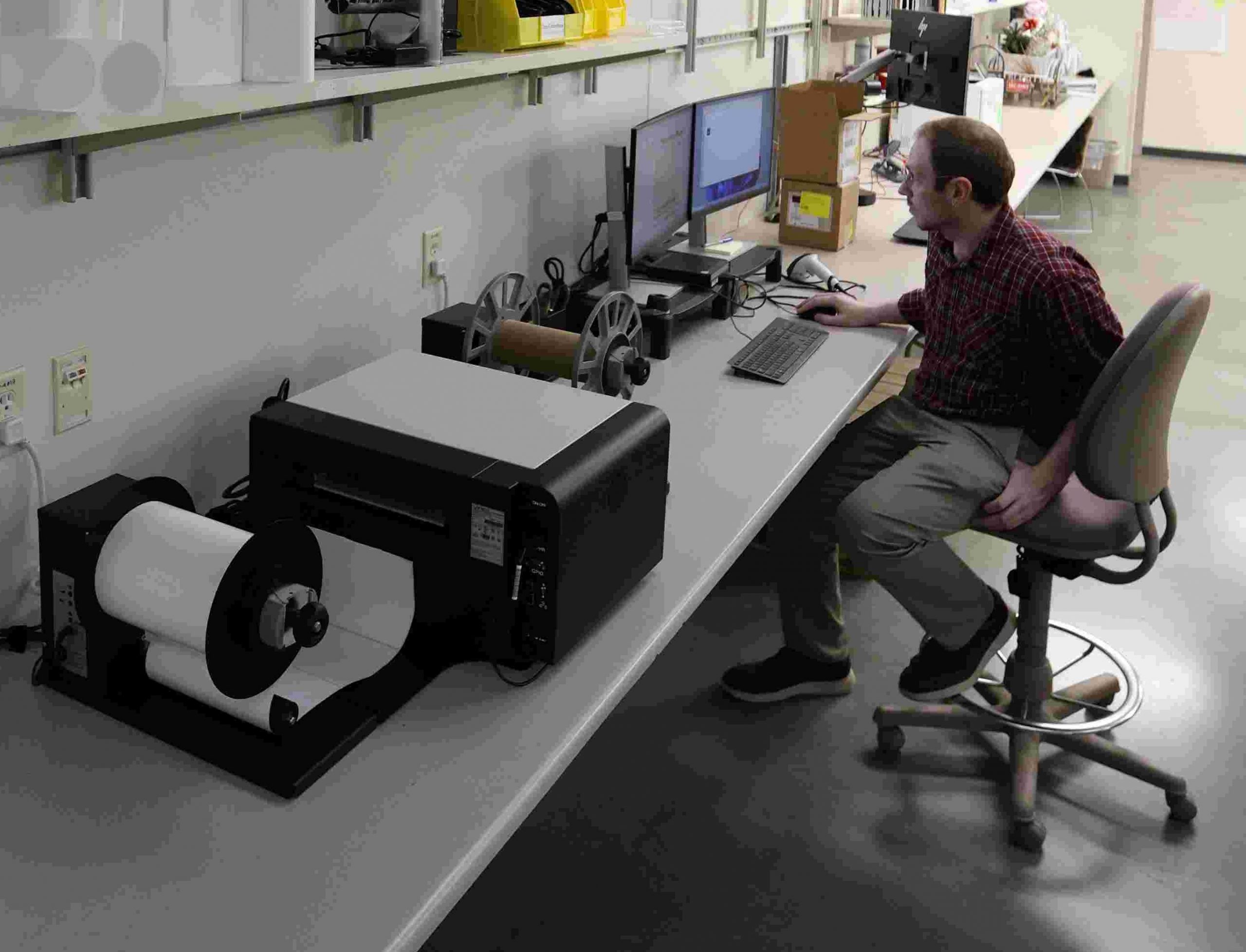 Johnson plans to look for other time-saving technologies again this year at PRINTING United Expo, taking place Sept. 23-25 in Las Vegas.
“I am wanting to move into the ability to do quick-turn braille for signage for ADA compliance,” he says. “That’s a big opportunity for us.”
He will also be on the lookout for front-end automation at the Expo. Johnson credits his upper management at Mayo for supporting the in-plant’s modernization efforts.
“We are very fortunate to be well supported from our parent company in getting equipment and keeping up with technology,” he says. “We’ve been successful in keeping ourselves on the front edge and not falling behind and then trying to catch up.”
‘Phenomenal’ Supervisors
With a $10.2 budget, Mayo Clinic’s Print Production Unit is the 14th largest in-plant in the country, according to In-plant Impressions’ annual ranking. It also has some of the best leaders in the business, Johnson says.
“The supervisors that I have below me are phenomenal. And that’s what makes the difference for me, is their involvement and their abilities and their … caring,” he praises.
He and his three supervisors show that caring for their team members in a variety of ways, including by planning and funding an annual two-hour “Holidazzle” party each December, with food, games, and prizes. To aid in the merriment, Johnson even dressed up as an “Elf on the Shelf” one year.
One highlight of the event is a contest in which each work area receives a cardboard box and supplies such as duct tape, then has to transform it all into a specific object — like a snowman or a Christmas delivery truck.
“It allows them to be really creative,” Johnson says. “It promotes a lot of team building,”
He and the supervisors also host summer parties with food, cornhole competitions, and a dunk tank with managers in the hot seat, which raises money for charity.
“I can confidently say that I feel I have the best supervisor staff at Mayo Clinic,” Johnson praises. “They’re compassionate leaders, they’re intelligent, and they care about the mission, which is the needs of the patient come first.”
Bob has served as editor of In-plant Impressions since October of 1994. Prior to that he served for three years as managing editor of Printing Impressions, a commercial printing publication. Mr. Neubauer is very active in the U.S. in-plant industry. He attends all the major in-plant conferences and has visited 200 in-plant operations around the world. He has given presentations to numerous in-plant groups in the U.S., Canada and Australia, including the Association of College and University Printers and the In-plant Printing and Mailing Association. He also coordinates the annual In-Print contest, co-sponsored by IPMA and In-plant Impressions.
 In-plant Panel at Inkjet Summit Details Why Inkjet Works So Well
 Mayo Clinic In-plant, Solimar Systems Win the Xplor Application of the Year Award
 Sponsor Content
Allen Printing Partnered with DPS for its Inkjet
Sponsor Content
Allen Printing Partnered with DPS for its Inkjet
 EFI and Agfa’s DPS Business to Form Inkjet Company
 Sponsor Content
Canon Highlights Inkjet and Toner Technology
Sponsor Content
Canon Highlights Inkjet and Toner Technology
 Sponsor Content
Canon Gives a Preview of Its Booth at the Expo
Sponsor Content
Canon Gives a Preview of Its Booth at the Expo
