


Hatteras Drives Growth with Three Strategic Investments


As Bill Duerr sees it, basking in past success is a luxury no commercial printer can afford.
“You grow in this business, or you die,” Duerr, president of Hatteras, a Tinton Falls, New Jersey-based commercial printer, remarks.
So instead of luxuriating in his family-owned company’s successful expansion into wide-format, packaging, fulfillment, warehousing, and other businesses, Duerr has made three major equipment acquisitions designed to speed throughput, bring in more work, and better serve customers.

Ryan DeVesty, senior director, digital print operations, leads a plant tour for Hatteras sales and customer service team members to show them the new equipment. | Credit: Hatteras
Over the past few months, the $75 million, 270-employee company has added an HP PageWide Advantage 2200 web press, a Harris & Bruno ZRX digital embellishment system, and a Durst P5 350/HS Double 4 hybrid wide-format printer. Each machine hit the ground running, immediately taking on work and relieving bottlenecks.
The HP PageWide Advantage 2200 has provided some welcome relief for Hatteras’ three HP Indigo digital presses, which were at maximum capacity printing a growing volume of data-driven direct mail pieces.
“We needed the ability to scale quickly and increase our capacity because of our tight service level agreement,” Duerr explains.
Hatteras installed the A2200 with an in-line Harris & Bruno tower coater and a customized near-line roll finishing solution from VITS International to convert rolls into postcards, self mailers, posters, and documents. This combination has eliminated steps and increased turnaround times.
“Now we basically print and coat all in-line on the A2200, and then we just go to the VITS, load a roll, and we’re finished,” Duerr says. “That opened up capacity again in the Indigo department to handle more of the short-run, quick-turnaround jobs or more variable data [work].”
That efficiency is translating directly into cost savings for Hatteras.
“We’re buying material more efficiently now on a roll,” he reports. “There’s less waste. There’s less handling through the shop because we’re not moving it across three pieces of equipment every day.”
Though the A2200 has only been in operation for a couple of months, Duerr sees the opportunity to move some offset jobs over to it, and also to produce highly versioned retail signage and packaging work.
“I think there’s lots of possibilities, but we’re really just getting started,” he says.
To further differentiate its offerings, Hatteras also installed the industry’s first Harris & Bruno ZRX digital embellishment press, enabling it to produce high-impact embellishments that add visual and tactile appeal to packaging, marketing collateral, store signage, and direct mail.
“We can flood coat, we can do a spot gloss raised UV, and we can do foil all on one machine,” Duerr says — all in just one pass.
The ZRX can embellish both digital and offset work, adding effects to uncoated stocks without the need for lamination.
“It’s our mission to elevate brand experiences with the power of print. And that means being able to do things that are going to help our clients’ work stand out,” he explains. “Embellishment just adds a level of engagement to the printed piece that is not as cost prohibitive as it has been previously.”
Hatteras used the machine’s xMatte feature, which creates raised matte textures with the look and feel of an embossed finish, to add texture to the image of a turtle’s shell on one project. “It’s really cool,”
Duerr says.
He was drawn to Harris & Bruno because, like Hatteras, it’s a family-owned company that manufactures in the U.S. He worked closely with the Harris & Bruno team during implementation and was very impressed.
The third new acquisition, the Durst P5 350/HS Double 4 (D4) hybrid wide-format printer, brings a much-needed speed boost to Hatteras’ wide-format printing operation. Though the company already has a Durst P5 350, this more advanced version can print rolls and boards at three to four times the speed, Duerr says, with the same level of quality.
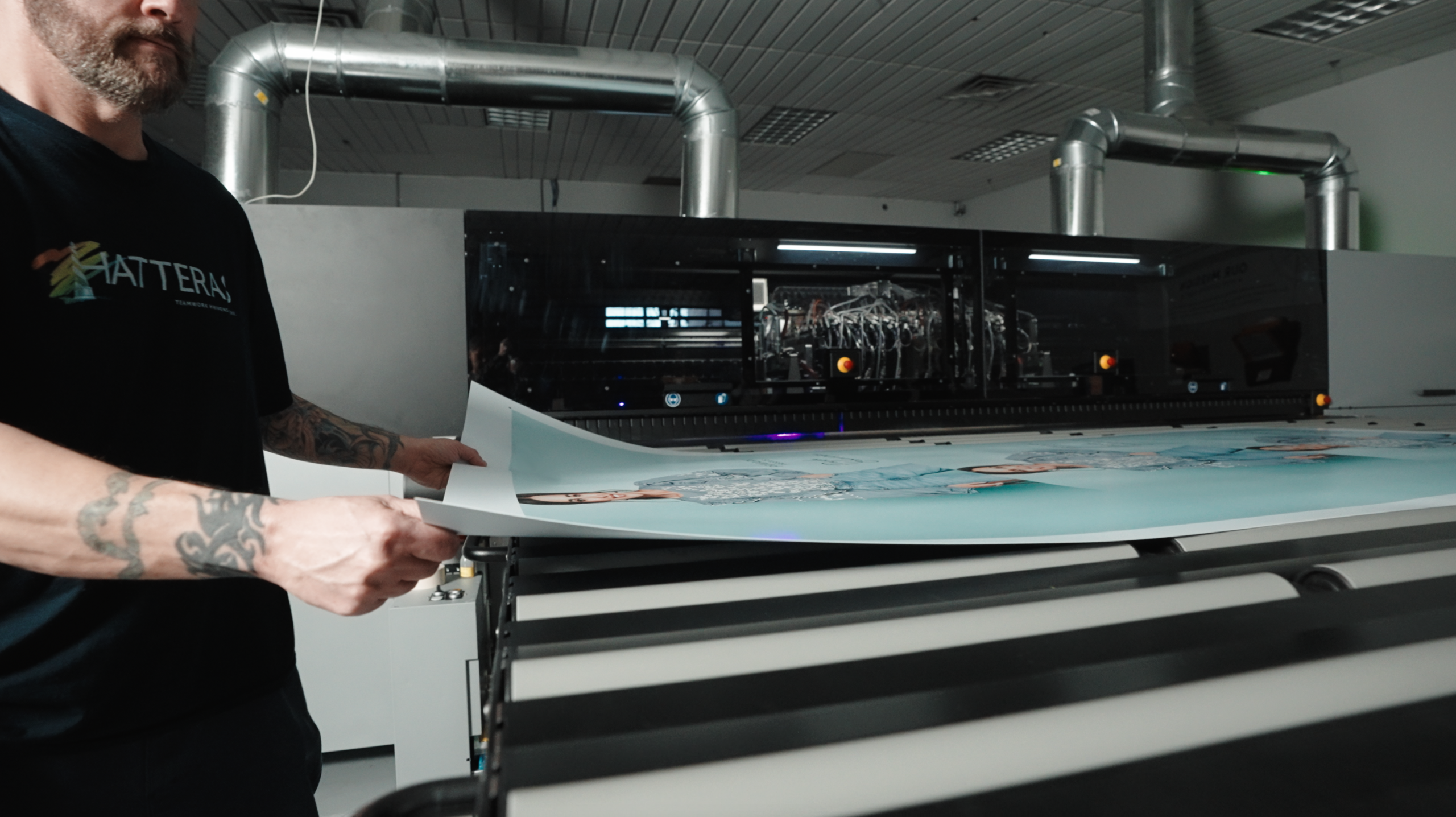
A Hatteras operator pulls a printed sheet from the new Durst P5 350/HS Double 4 hybrid wide-format printer, which can print rolls and boards at three to four times the speed of the company’s other Durst wide-format printer. | Credit: Hatteras
“One of the trends that I see in the industry is there’s a lot more time spent on the front end conceptualizing … and the more time you spend there, the more time you lose in manufacturing,” he notes. “Speed to market without sacrificing the quality is critical. So for us to be able to hit ‘go’ and have the material off the machine a lot quicker is critical to us.”
Because Hatteras’ wide-format department is driven heavily by retail, he says, it has to deal with drastic peaks and valleys in volume.
“So we need the equipment that can support that,” he says. The Durst P5 350/HS D4 has exceeded expectations.
“I think the Durst equipment is phenomenal. It’s extremely reliable. It’s well built. They’re extremely responsive with their service,” he lauds. “The way I’ve looked at it, offset for me, Heidelberg’s the gold standard. Digital, HP is the gold standard. Large-format, Durst is the gold standard. And that’s how I want to build each of these areas of the company.”
Investing in these three new machines, he says, has not only increased efficiency, decreased turnaround times, and opened new business opportunities, it has demonstrated the company’s commitment to continually earning its place with both employees and clients.
“It breathes life into the company, and it shows your team, ‘we’re committed to this and we believe in this,’ and it shows your customers, ‘we’re committed to you and we believe in you and we’re trying to get better,’” he says. “Because we’re only as good as our last job in the commercial printing business. Nothing’s guaranteed. You have to constantly justify your existence.”
- Categories:
- Business Management - Operations
Bob has served as editor of In-plant Impressions since October of 1994. Prior to that he served for three years as managing editor of Printing Impressions, a commercial printing publication. Mr. Neubauer is very active in the U.S. in-plant industry. He attends all the major in-plant conferences and has visited 200 in-plant operations around the world. He has given presentations to numerous in-plant groups in the U.S., Canada and Australia, including the Association of College and University Printers and the In-plant Printing and Mailing Association. He also coordinates the annual In-Print contest, co-sponsored by IPMA and In-plant Impressions.


