


Get Better or Fall Behind


"In the printing industry, you now either get better or fall behind. There is no longer a third option.” That bold statement can be found in the 2026 State of the Industry report — the annual report produced by PRINTING United Alliance and sponsored by Canon U.S.A, which looks at actual business conditions based on responses from a regular panel of industry players.
What is driving that sentiment is the fact that the report found the top 20% of companies by revenue grew an astounding 15.4%. While the bottom 15%? Well, they contracted by 19.6%. Those making investments in their futures — including equipment, software, workflow, automation, AI, and more — are seeing business not just maintain but continue to expand and grow. Those who are taking a “wait and see” approach? Well, they are starting to find it harder to compete, win business, and secure jobs.
“The Fourth Industrial Revolution, powered by AI, big data, and the internet of things, is spreading across our industry,” stresses Andy Paparozzi, chief economist for PRINTING United Alliance, and one of the authors of the report. “There is no waiting it out. The revolution will reward companies that are innovative, agile, receptive to change, and prepared to move ahead with investments in equipment, software, workforce development, and diversification despite upheaval and uncertainty. Companies that aren’t — no matter how established or successful in the past — will be left behind.
Growth by Design
One of the growth companies is Specialty Print Communications, which was 44 on this year’s Printing Impressions 300 (PI300) list of the top printing companies by sales in the United States and Canada, up from 56 last year, with revenue growth of 20%. Adam LeFebvre, the Niles, IL-based company’s president, notes that kind of growth doesn’t happen by accident.
“I believe our continued commitment to customer, innovation, and dedication to providing exceptional service allows us to succeed where some others are not. It also helps that we are firmly committed to continuing to invest in our equipment and our people,” he explains.
Another company that hasn’t put the brakes on investment and is seeing the rewards is Hanover Park, IL-based ER2 Image Group. The company’s vice president and partner, Gary Schellerer, notes, “We’ve continued investing in our workflows, technology, and communication systems to support larger opportunities while maintaining the responsiveness and relationships ER2 has built its reputation for decades.”
That focus led to the company jumping from 222 on the PI300 to 194, reporting growth of 52% in revenues in the last 12 months.
In both cases, it wasn’t just a single investment, or a single focus either. Both companies have made investments across the board — updating equipment, putting new systems in place, rolling out new software solutions, and ensuring their people have the best tools available to get the jobs done.
And Expo is the place to be to get a lot of the legwork done when it comes to those investments. While you’re here the next few days, it’s an opportunity to speak with every vendor in categories you know you need to invest in. It’s also a chance to walk around and be exposed to technologies you didn’t even know you needed that can mean the difference between growth and stagnation in the coming years.
“The Expo is one of the best opportunities to step away from the day-to-day demands of production and get a broader look at where the industry is heading,” Schellerer explains. “Our business has grown by continually expanding what we can produce in-house, improving automation, and finding better ways to manage increasingly complex projects. PRINTING United gives us the chance to compare equipment and technology in one place, speak directly with manufacturers, and learn from other companies facing many of the same challenges.”
That philosophy is echoed by LeFebvre, who notes, “It’s an opportunity to, in one place at one time, get caught up with all of our current vendors. You can knock out a bunch of those meetings in that three-day span. So that’s super helpful. In addition to that, there’s the opportunity to look for new technology. I’m a huge proponent of technology that is delivering the most efficient big-picture, cost-effective output. It’s not about how much the gear costs. There is all sorts of gear that’s cheap — I could buy it for next to nothing. But every time I use it, I’m going to be paying more per use as it’s older and slower than I would if I just pre-invested in the right stuff. So, I’m a huge proponent of investing in the lowest net cost for our business, and sometimes that takes a lot more upfront money to get a much lower per piece or per thousand output. And I think that a lot of people more and more don’t seem to understand that.”
Making the Most of the Expo
As they walk the Expo floor this year, both Schellerer and LeFebvre note that they intend to make the most out of the three days, with plans that every attendee can put into practice to get the most out of their own visit.
Schellerer is hitting the floor with three main priorities this year: workflow and automation, production and finishing, and networking and education. His strategy of having broad categories he wants to explore while leaving room to discover things that might not be on his radar is a blueprint for Expo success.
He breaks the three buckets down, noting for the first, “We want to see solutions that reduce repetitive administrative and production tasks, improve estimating and job tracking, and better connect sales, design, production, installation, and accounting. As labor costs continue to rise, growth cannot simply mean adding more people. We need systems that allow our existing team to handle more work accurately and efficiently.”
For the second priority, Schellerer explains that it’s not just about buying equipment for the sake of it. Rather, the key is finding equipment that will help him grow in specific areas. “We will be looking closely at wide-format printing, dimensional and textured printing, finishing automation, routing, cutting, and other equipment that can help us produce more specialized work internally. The goal is not just to buy another machine. It is to identify capabilities that differentiate us from competitors and allow us to offer higher-value solutions to clients.”
Finally, while the show floor and the technologies on display will certainly dominate the experience, Schellerer does note that networking with peers and vendors, and taking advantage of educational opportunities can be just as important when it comes to long-term growth. “We plan to meet with our current vendors, evaluate alternative suppliers, and attend sessions focused on profitability, workforce development, sales growth, and operational efficiency. Equipment may create capacity, but good management and strong vendor partnerships are what turn that capacity into profitable growth.”
On the other hand, LeFebvre demonstrates a different — but still, successful — approach. Rather than building a detailed plan of attack, he intends to use the time to evaluate what’s new and talk to as many people as he can — although he does have a list of “irons in the fire” that he will prioritize. He calls it a litmus test, noting, “I find it an incredible opportunity to really dive into cost efficiency, and whether you’re working with all the right people to produce things as effectively as you need to be successful in your business.”
That said, he also notes that everyone needs to approach the show floor with “your salesman’s filter glasses,” adding that everyone is going to highlight the top performance numbers, but not really the actual working production results. So, getting excited about new possibilities is what makes Expo so important, but don’t get caught up in the moment and purchase something that ultimately won’t drive your business forward. What works for one shop won’t necessarily be right for another, and only you can determine if something is actually an upgrade to your operation, or just noise.
Schellerer expands on that, noting, “For printers attending the Expo who want to grow over the next 12 to 15 months, my biggest advice is to arrive with specific business problems you want to solve. It is very easy to walk the floor, become impressed by every new piece of equipment, and leave with a stack of brochures but no real plan. Before attending, identify where your company is currently losing time, margin, or opportunities. That might be slow estimating, excessive labor, production bottlenecks, outsourcing, limited finishing capabilities, or weak follow-up with customers. Then evaluate every product, session, and vendor conversation against those problems.”
He continues, “I would also encourage attendees to look beyond printing speed. A faster printer does not automatically create growth. Sometimes the better investment is workflow software, finishing equipment, employee training, or technology that improves customer communication. Finally, talk openly with other printers. Some of the most valuable information at PRINTING United does not come from a booth or presentation. It comes from conversations with people who have already purchased the equipment, implemented the software, made mistakes, and figured out what actually works.”
Get better or fall behind. Invest in growth, or watch your business begin to fall. The State of the Industry report illustrates what many have begun to suspect: the days of being in a comfortable middle, neither at the top nor the bottom but running a profitable business, have passed. The middle has rapidly disappeared, a phenomenon not limited to print, but that most industries have begun to wrestle with.
No matter your current size, your current business model, your current employee count, or your current application mix, PRINTING United Expo is a chance to ensure your business is one of the winners. Take advantage of the next three days to learn, to interact, to see for yourself where growth can happen. And then be willing to follow through so next year, you will be the one at the top of the growth curve.
Growth by the Numbers
You are either growing, or you aren’t. Growth is one of those things that can be measured with hard data, and the 2026 State of the Industry report breaks down some of those numbers on an industry-wide scale. It’s not just about selling more either — there are several factors that ultimately result in growth or stagnation — or worse. Here are a few of those stats from the latest report, and be sure to check out the full report, available at the PRINTING United Alliance Booth N6543 and N6743.

Operating Cost Inflation and Prices: The chart shows how SOI participants’ operating costs changed in 2025 strictly because of inflation. The right-hand chart shows how prices changed on average.
→ Operating costs — driven by tariffs and inflation on many of the materials used in the printing process — far outstripped the ability of printers to raise prices. Many printers are discovering that customers can’t or won’t accept further price increases on the heels of everything else rising, requiring the shops themselves to absorb those hits. To compensate, the growth winners are actively investing in technologies — hardware and software — to make them faster, more efficient, and more cost-effective. If you’re not staying ahead of the curve, you are actively falling behind.
→ Investments are even more critical when you realize that companies seeing growth aren’t achieving it through sales alone. In fact, only 31.8% saw an increase in their sales. The rest either had no changes from the previous year, or they saw active decreases in their sales numbers with the current economic environment. The temptation is to pull back and wait for sales to pick back up again before investing, but that just means when the proverbial tide does start to rise again, you won’t have the ability to swim with it.
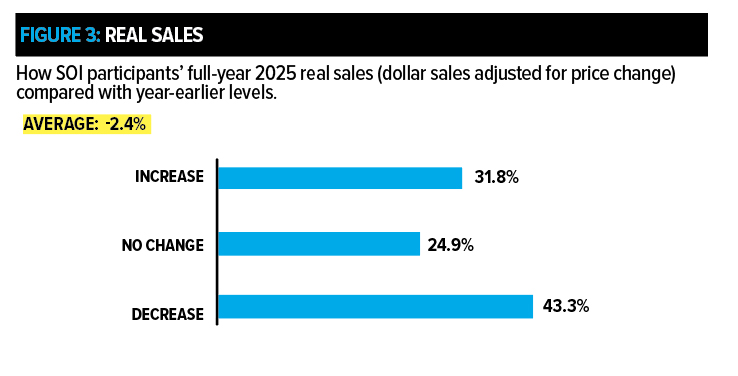
Real Sales: How SOI participants’ full-year 2025 real sales (dollar sales adjusted for price change) compared with year-earlier levels.
→ Purchasing Habits: Just because sales are tight doesn’t mean there aren’t real opportunities out there. Customers aren’t backing away from print entirely, they are just looking for more targeted, impactful pieces — and printers who can help them make sense of the data. Shorter runs with faster turnaround times dominate customer requests, and that isn’t likely to change any time soon. If anything, expect the runs to get even shorter and the turnaround windows to get even narrower.

Key Trends in Client Purchasing Habits
How SOI participants responded to this question: For your clients in general, which of the following are true?
→ It’s not all bad news though. While the type of print might be shifting, the demand is still very much there. Print-on-demand and Web-to-print are both seeing strong and growing demand, while services like marketing, embellishments, and data management — areas where printers can charge a premium rather than compete on price alone — are all gaining ground.
The annual State of the Industry report goes more into detail on all of these areas and more, and is worth checking out. It is a way to keep a proverbial finger on the pulse of what’s actually happening right now in the print industry, giving you data points that can help shape your plans and give you an edge. Growth doesn’t happen by accident — if you want to be one of the “haves” and not a “have-not” the time to start making moves is right now.

- Categories:
- Business Management - Operations
Toni McQuilken is the senior editor for the printing and packaging group.
 Devyn Cretz Traded the Softball Diamond for Direct Mail — and the Lessons Still Apply
 Preserving Institutional Knowledge | Part 3: How AI Can Help
 Five OSHA Compliance Priorities
 Dave Leskusky to Retire After 31 Years
Preserving Institutional Knowledge | Part 2: How to Capture It Before It Walks Out the Door
Dave Leskusky to Retire After 31 Years
Preserving Institutional Knowledge | Part 2: How to Capture It Before It Walks Out the Door
 Bethany Press Announces Permanent Closure
