Driving Print’s Future: Barbara McManus on the Evolution of HP PageWide


Barbara McManus, General Manager and Vice President of HP PageWide
Today’s commercial printing industry is amid one of its most significant transitions since the introduction of digital technology, as a mix of aging analog equipment, changing labor dynamics, and rising demand for personalization are forcing print service providers (PSPs) to rethink how they print, and how they profit from it.
One significant technology in that transformation is HP’s PageWide inkjet platform. In a recent interview, Barbara McManus, General Manager and Vice President of HP PageWide, shared how inkjet is reshaping commercial printing, what is currently driving growth, and why automation and AI will define the next generation of production environments.
Two Paths to Digital Growth
McManus says HP’s strategy for expanding PageWide adoption reflects a market evolving from multiple directions at once. She described opportunity as unfolding across two fronts.
“I think we look at this market from two fronts, one front is those who are already digital, and whether or not they should buy HP or buy an inkjet printer.”
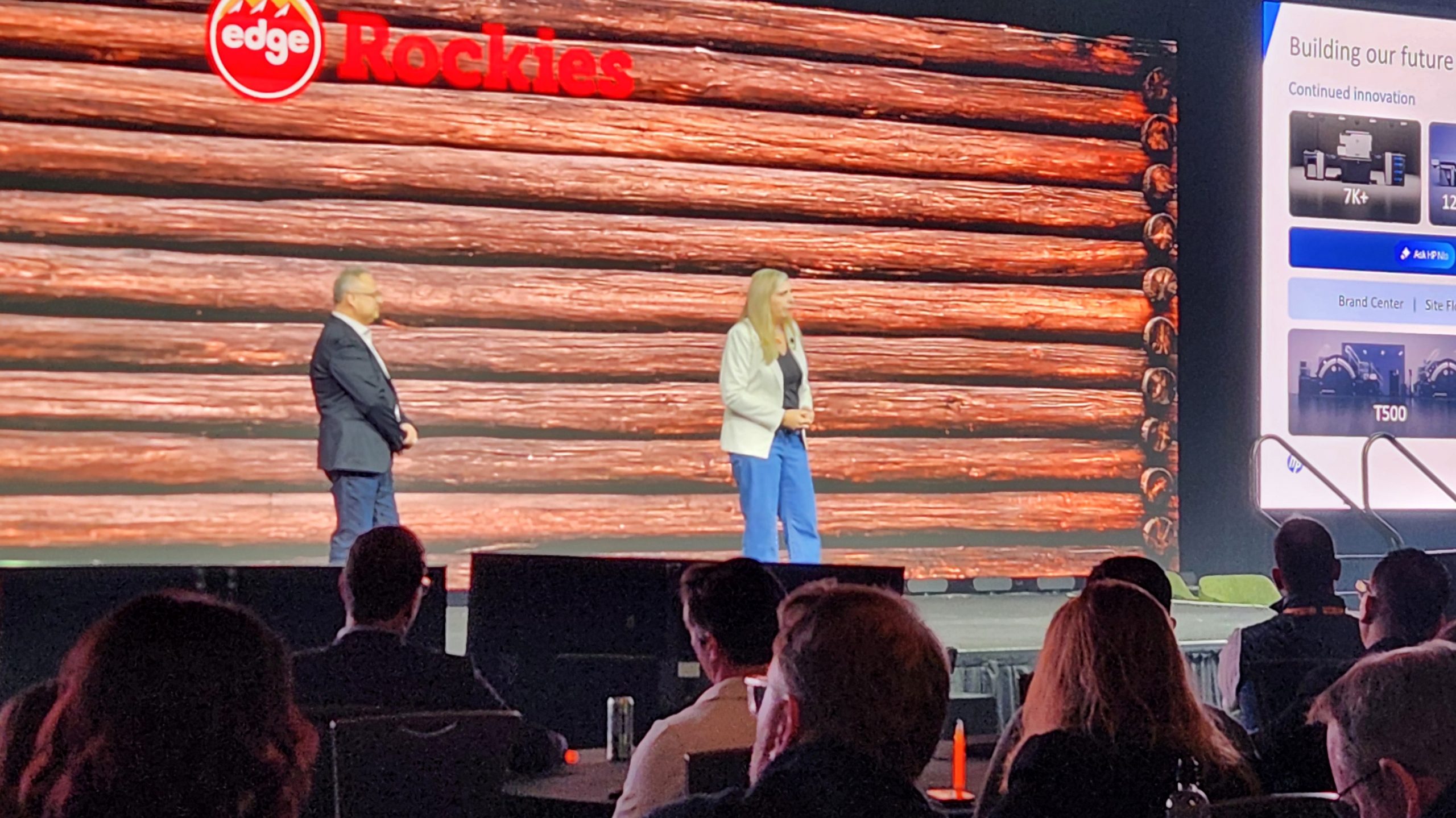
Barbara McManus (right) speaks at the recent Dscoop Edge Rockies event in Denver, Colorado.
Many of those customers already operate digital technologies such as HP Indigo presses but are experiencing volume growth that demands additional productivity and capacity. Inkjet becomes a logical addition to their portfolio as they grow. “For a customer who is experiencing significant page growth, adding an inkjet press can be the right next step,” she explains.
At the same time, she believes entire segments of the industry are shifting business models. Transactional printers are moving into direct mail; commercial printers are diversifying their applications; and companies entering new markets may reevaluate their technology partners along the way. “They might not have had HP at first, and now they’re moving to new markets and looking for new providers,” McManus notes. “HP wants those opportunities as well.”
A second strong opportunity lies in converting traditional analog printers.
HP’s wide-format inkjet portfolio, including 42” and newer 55” press models, targets offset-heavy environments that are ready for modernization. That said, convincing analog printers to embrace digital remains both challenging and rewarding. “It’s often more traditional companies,” McManus said. “You’re convincing people to make a big capital investment and a big digital transformation.”
That process involves more than simply selling equipment. She says HP must also demonstrate the broader value proposition of digital printing, including factors such as labor efficiency, application versatility, and workflow flexibility. “You really take customers through that journey and say, ‘Yes, you do want to move these pages to digital, and here’s why.’”
Labor, Market Pressures, and the Tipping Point
While technology innovation drives headlines, McManus emphasizes that workforce realities may be the strongest force accelerating digital adoption. Publishing, she says, offers a clear example. Book publishers increasingly demand shorter runs, print-on-demand capabilities, and flexible production capable of handling both large and small orders. “You can see lower and lower copy counts for books,” she explains. “Publishers want one printer that can do both books on demand, as well as higher-count runs.”
Labor has also become a challenge in the commercial printing space: offset equipment across the industry is reaching end-of-life at the same experienced press operators are reaching retirement. “It’s become so hard to find somebody qualified anymore,” McManus says. “Even if you can keep your analog press alive, you may not have an operator to run it.”
She believes digital presses can fundamentally change the labor equation. Training timelines can shrink dramatically, and the operator skill set shifts toward technical familiarity rather than mechanical mastery. “You get someone technically savvy and comfortable with technology, and generally they can run one of our presses,” she explains. “It’s very different from the years it would take to become proficient on an offset press.”
The workplace environment itself has also become a factor in recruitment. McManus describes visiting print facilities where traditional pressrooms contrast sharply with the modern digital production areas. “You walk into the digital room — the white room — and it’s quiet and clean,” she says. “That’s where people want to work.”
As printing evolves, it increasingly resembles a technology sector as opposed to a traditional manufacturing environment. She says that shift can help attract younger talent and perhaps provide a solution to the segment’s long-standing labor shortages.
Opportunities in Direct Mail, High-Value Print
McManus shares that not every PageWide application unfolded as originally expected. Early in development, she says, HP anticipated strong adoption in digital newspaper production. “We built the 30” platform specifically to do newspapers,” McManus recalls. “We were going to be an awesome digital newspaper printer, but that has not come to fruition.”
Instead, one of the most dynamic growth areas has been direct mail, particularly in North America. McManus says, “The direct mail space is one of the most exciting spaces.”
And while rising postal rates, labor costs, and paper prices have created economic pressure for marketers and print providers alike, she says inkjet offers a solution by increasing the effectiveness of each printed piece via thoughtful personalization. “Digital can help solve those challenges because every piece can be made more valuable,” McManus explains. “Instead of bulk mailers, we’re doing customized pieces.”
Further, she says the value-driven nature of digital printing is expanding into commercial print segments once assumed to remain offset strongholds. For example, customers are producing ballots, catalogs, and local magazines, with results exceeding expectations. “We have customers turning off their offset presses because they’re able to make high value at higher copy counts than they expected,” McManus says. “The quality is just beyond fantastic.”
Still, she stresses that digital is not about eliminating offset entirely: “There’s always going to be a place for offset. The question is always, ‘what’s your copy count, and where is digital the right answer?’”
Optimization and the Future of Print
From its earliest days, McManus says HP’s PageWide program focused on integration rather than isolation, which means perfecting the print engine while, at the same time, partnering with finishing and workflow providers to build complete production ecosystems.
“We decided we were going to be the experts at the print engine and partner for the entry and the exit,” she clarifies.
That same philosophy now enables highly automated production environments capable of extraordinary efficiency. “You could have one person running an entire operation … rolls of paper coming in and completely bound books coming out,” she says.
Automation represents the next major competitive frontier. Rather than robotics alone, McManus describes a future centered on minimizing human intervention through smarter systems. Features such as predictive maintenance, intelligent diagnostics, and remote monitoring can enable supervisors to oversee multiple presses simultaneously while reducing downtime and service calls. “We want to reduce any reason to call us,” McManus says. “The press knowing a lot more — that’s the vision.”
Artificial intelligence (AI), McManus says, is playing an increasingly important role in automation. She says HP is deploying AI-driven tools that help operators diagnose issues independently, while machine learning enhances onboard vision systems capable of distinguishing real defects from acceptable image variations. “We’ve been using machine learning to understand better what the press is seeing,” she explains. “That’s coming along faster than ever.”
Beyond productivity gains, McManus believes inkjet helps secure the long-term health of print itself. HP positions PageWide as both a technological and environmental advancement, using aqueous-based inks and global regulatory foresight to improve sustainability outcomes. “We want to be good stewards of the print industry and good stewards of the environment,” she says. “And give our customers the tools to understand their footprint and create the best product possible.”
- People:
- Barbara McManus
Dan Marx, Content Director for Wide-Format Impressions, holds extensive knowledge of the graphic communications industry, resulting from his more than three decades working closely with business owners, equipment and materials developers, and thought leaders.