


2025 Innovator of the Year: Cober Turns a Century of Print Into a Digital Future

Editor's Note: Innovation takes many forms. Whether by leveraging new technology, building smart investment plans, initiating strategic acquisitions, placing a focus on workforce practices, or refining processes, industry leaders set themselves apart as true innovators.
Each year, we ask printing industry experts and consultants to nominate the print service providers they believe embody the term “innovation.” Our five Printing Impressions' 2025 Innovators of the Year are recognized for pushing boundaries and shaping the future of the field. It’s our hope that their approaches and philosophies may spark ideas to help other businesses reach new heights.
The summary of Cober that follows shares what makes this company innovative, interesting, and exceptional.
Over the years, businesses have withstood recessions, the COVID-19 pandemic, and trade imbalances. Print service providers (PSPs) were no exception, and those unwilling to adapt often closed their doors in the aftermath. That wasn’t the case for Cober — a 109-year-old, fourth-generation family PSP based in Kitchener, Ontario, with facilities in Barrie and Calgary.
It’s not every day a PSP makes it past its centennial, but Cober — a PRINTING United Alliance member — has proven its worth with President Todd Cober at the helm. “A core fabric of our business is not allowing ourselves to continue to get comfortable with where we sit,” he says.
Cober’s use of automation, robotics, and forward-looking culture earned it recognition as one of the 2025 Printing Impressions Innovators of the Year. Industry consultant and Cober nominator David Zwang, of Zwang & Company, says Todd’s “understanding of the importance of connected data and technologies being the key to flexibility and profitability are ingrained in the corporate culture.”
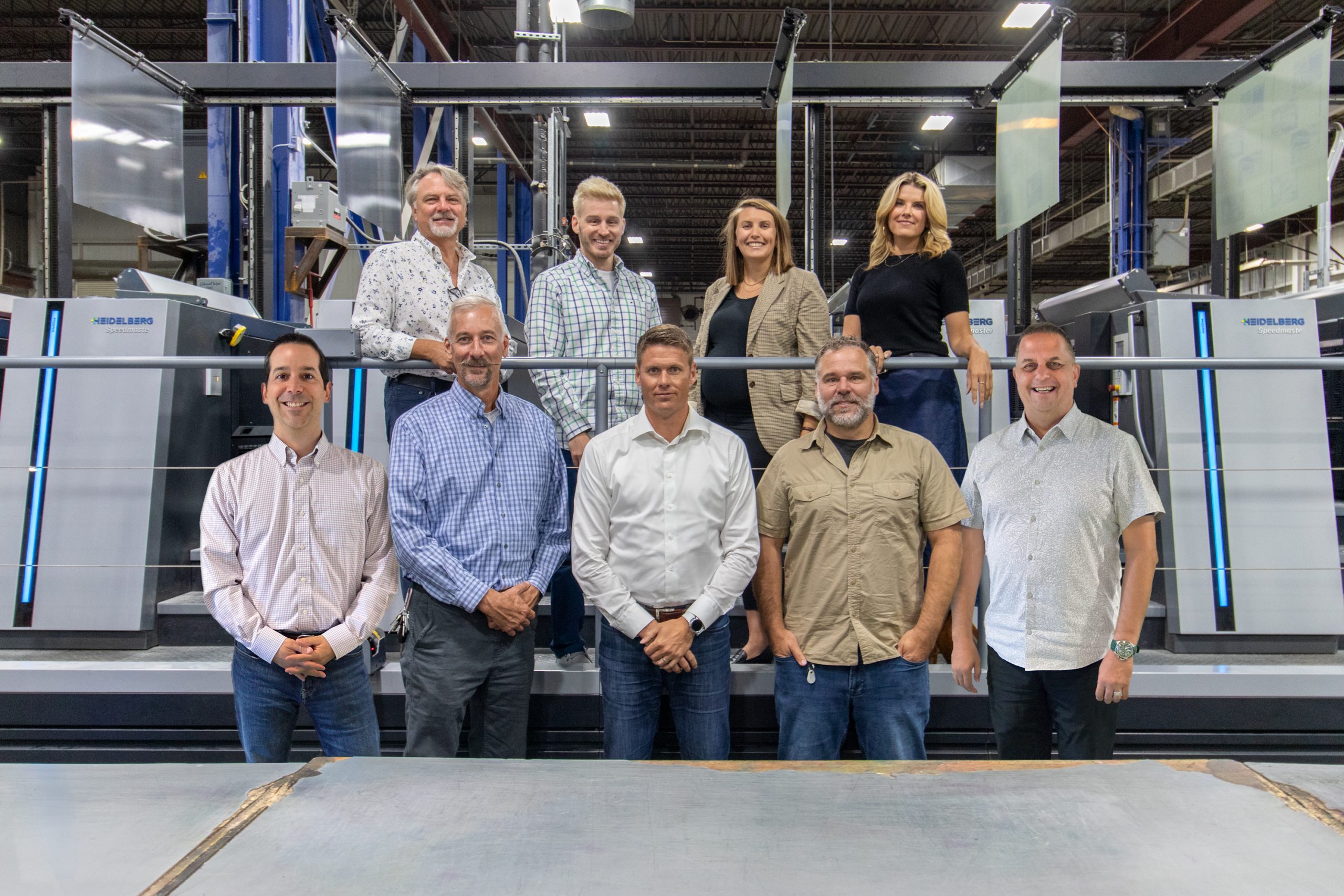
Management’s role is not only to hire the right people but also to keep them fulfilled and happy. | Credit: Cober
Zwang adds that the 43-year-old industry leader has advanced that culture “by implementing highly automated digital and digitalized analog equipment, and developing internal systems when necessary to bring all of it together into an agile and manageable production environment.”
Yet, ask Todd what truly defines his company, and the conversation quickly shifts from technology to people. “We’re really a people-first business internally,” he says of his 300-person staff. “Our team is so incredibly important to our success.”
A Family Legacy
The Cober story begins in the 1900s, when Todd’s great-grandfather, who owned a corner store in Kitchener, purchased a hand-fed foot-powered printing press to print flyers for his shop. The intention wasn’t to join the printing space, but once word spread, growth followed. Soon the basement operation took over the house, leading the family to purchase the neighbor’s property and connect the two.
Todd’s grandfather ran the company until the 1980s, when his father and aunt moved operations to its first commercial space. The business evolved into a medium-sized commercial printer with 40" offset presses.
A turning point came in 2003 with the purchase of an HP Indigo Digital Press, ushering in a new era for the business that included B2B Web-to-print, mailing, and fulfillment.
For Todd, there was never any doubt about his career. As a child, he played in the paper stacks; by his mid-teens, he understood impositions and how presses worked. “It was cool to contribute,” he says. “I had this absolute clarity that [print] was the thing I wanted to do for the rest of my life, and I feel so fortunate that I was in that position.”
He attended Ryerson University (now known as Toronto Metropolitan University), completing a degree in graphic communications management. After graduation he returned to the family business in a sales and customer service capacity, where he started to understand the operations side. In 2014, he bought the business from his father, and in 2023, he purchased the company’s real estate from his parents. His father retired in 2019.
Before fully taking over, Todd was already thinking ahead. “I really had to continue to figure out where the value lay in print for consumers and where it was going to be a good future,” he says.
By late 2012, he realized that Web-to-print in the B2B space was maturing. “There wasn’t the same energy behind that movement, and so I made the conscious decision to transition that skill set into the consumer side,” he says.
Cober expanded into consumer fulfillment partnerships, producing print for online consumer brands. Today, the company’s revenue is evenly split: 50% B2B and 50% online fulfillment, which Todd believes is a “very good mix.” The model stabilizes sales and has cultivated expertise in producing high volumes of micro-orders.
“That has taught us to be incredibly lean and automated, and those learnings have allowed us to be much more successful on the B2B commercial side as well,” he says.
Innovation as Culture
At Cober, innovation is synonymous with company culture. “I would say innovation is our company culture and our team,” Todd says. “They love innovating.”
To back that up, the company invests more than 10% of payroll into research and development, including a defined AI program where 20 employees dedicate part of their week to learning and experimenting.
“We understood that we weren’t necessarily in the best position to succeed [in AI], so we have invested heavily in this, and we brought a third party in to hold our hand through it and teach us what that means,” he says. “I think that continual investment into our people so that they can take that mindset into our business — that’s the key fabric to it all.”
What excites Todd about new technologies isn’t just immediate gains. He likes to play the long game. “I don’t need a three-to-five-year return on things,” he says. “More so, I’m concerned and cognizant of where do I believe — or where does our team believe — that print will be and will add value down the road. Or maybe it isn’t even print. Maybe it’s where things like 3PL and print come together or wide-format and print or wall art and print.”
The challenge, he admits, is executing that vision while keeping the business viable today. “You can focus so much on innovation that you lose sight of your actual business at that moment in time,” he says. “I could [lose my mind] just investing in automation and AI and lose sight of the fact that I got to make books today.”
Automation and Robotics
Automation handles the intake, batching, and imposition of files, preparing jobs for the most efficient production. “Our development team here helps us, and we continue to invest heavily in automation,” he says. “Taking our equipment, connecting it to our workflow, getting information out of our equipment. Feeding information into our equipment. But all of those things happen with information, data, and code. They don’t necessarily include robotics.
“A lot of new equipment now has the ability to get data and give data, and we’ve been able to navigate our way to leverage that data to automate our workflows, so that when we receive a file, it’s batched with like files,” he continues. “It helps our team on the shop floor be more successful in their roles.”
On the robotics side, Cober installed its first autonomous guided vehicle (AGV) about six years ago. “You could send it places or call for it and put stuff on it,” Todd recalls. “And that was this first kind of aha moment of ‘OK, I don’t think we’re really leveraging this to its full extent, but we see that there’s something here that we need to sink our teeth into.’”
In 2022, the company installed a new Heidelberg Speedmaster XL 106-8P with plate-to-unit robotics. To prevent bottlenecks, more equipment followed.
A new Heidelberg Stahlfolder TH 82 with PFX Feeder and a six-axis Heidelberg StackStar P industrial robot were added to match the speed of the Speedmaster.
“We started to look at how fast we could fold 16-page signatures, and to expect a human to keep up with that was unrealistic,” Todd told Printing Impressions Content Director Ashley Roberts in a recent article, titled “How Robotics are Reshaping Productivity & Workforce Dynamics.”
The next phase, Todd says, is having autonomous vehicles move equipment and materials to work centers when required and using data to schedule jobs to optimize the shop floor, which he believes is “so critical” to the future of the business.
As for challenges, Todd says no one printer has relationships with a single vendor. As a result, there’s no communication system that ties all the different equipment together.
“As a printer, we have to create this kind of umbrella,” Todd says. “We call it ‘octopus’ internally at our plant. [It’s] this overarching workflow tool that connects everything and it’s like the central brain. That’s a challenge because every piece of equipment wants to give you data differently.
“We’ve gotten around that by simplifying it to a barcode scanner at the entry of a machine or the exit of a machine that’s scanning,” he adds. “We put barcodes on every piece that gets produced in our business, and with that we know where every job is at any given time and we can start to extrapolate out efficiencies of equipment, how fast equipment is running, and when equipment needs more of a product.”
Still, technology is only part of the story. Early on, Todd learned that employee perception mattered as much as machine performance. “That was my biggest takeaway: At the end of the day, this is a people business and as we implement robotics or automation or autonomous vehicles, it has to be in conjunction with our manufacturing team,” Todd says. “They need to be a key part of that so that they embrace that and recognize why we’re doing it.”
Betting on Growth
Not too long after installing its Heidelberg machines, in early 2024, Cober nearly doubled its headquarters footprint from 80,000 sq. ft. to 195,000 sq. ft. The company was renting outside warehouse space. Cober owned both the external warehouse property and the land for the current facility, which made it possible to expand operations on-site.
“I knew that as a business, we were never going to get where I wanted to be if we didn’t make a jump,” Todd says. “Bet on yourself, bet on your organization, bet on your team.”
The gamble was worth it. He says the new 100,000 sq. ft. is 50% full. The shop floor production space grew by almost 20% as warehousing moved off the main floor.
Growth has also come through acquisition. In 2023, Cober acquired the print division of West Canadian Digital Imaging, retaining the manufacturing team and expanding its reach.
“I’m all in on acquisitions,” Todd says. “The right acquisitions for strategic reasons, I would say, not just to add sales, but yeah, it’s going to be a part of our future.”
The Long Game
Todd’s passion for his team shines through when he speaks about them. His advice for his industry peers is simple: Invest heavily in your team. That team will stand by you as the industry evolves — which brings us back to the long game.
When asked what he wants readers to take away from this discussion, he says he wants people to know Cober is committed to being relevant and adding value to its partners.
“By no means are we perfect,” he acknowledges. “We are humble, we make mistakes, but we own them, and I would say the character of our business is high and people buy from people still.”
- Categories:
- Business Management - Industry Trends
Elise Hacking Carr is managing editor for PRINTING United Journal, and the special projects editor.


