


What Printing Companies Can Learn From Google’s Multi-Modal Gemini Release

For decades, the commercial printing industry has been chasing the holy grail of communication: true omni-channel marketing. We’ve moved from standalone direct mail bursts to variable data printing (VDP), integrated QR codes, and campaigns that trigger simultaneous emails and social media ads. Yet, despite these advancements, many printing companies and their clients still struggle to connect the dots. The data remains siloed, the messaging often feels fragmented, and the true context of the customer journey is lost in the whitespace between mediums.
Enter Google’s newest iterations of Gemini: Gemini Omni, a natively "multi-modal" AI model designed to process text, image, audio, and video seamlessly.
While a generative AI model might seem worlds away from the physical hum of an offset press or the digital precision of an HP Indigo, the architectural philosophy behind Gemini Omni holds a profound lesson for commercial printing company owners, C-suite executives, and print marketers. The multi-modal approach to data processing is strikingly akin to the multi-channel and omni-channel marketing strategies that printing companies have championed for years.
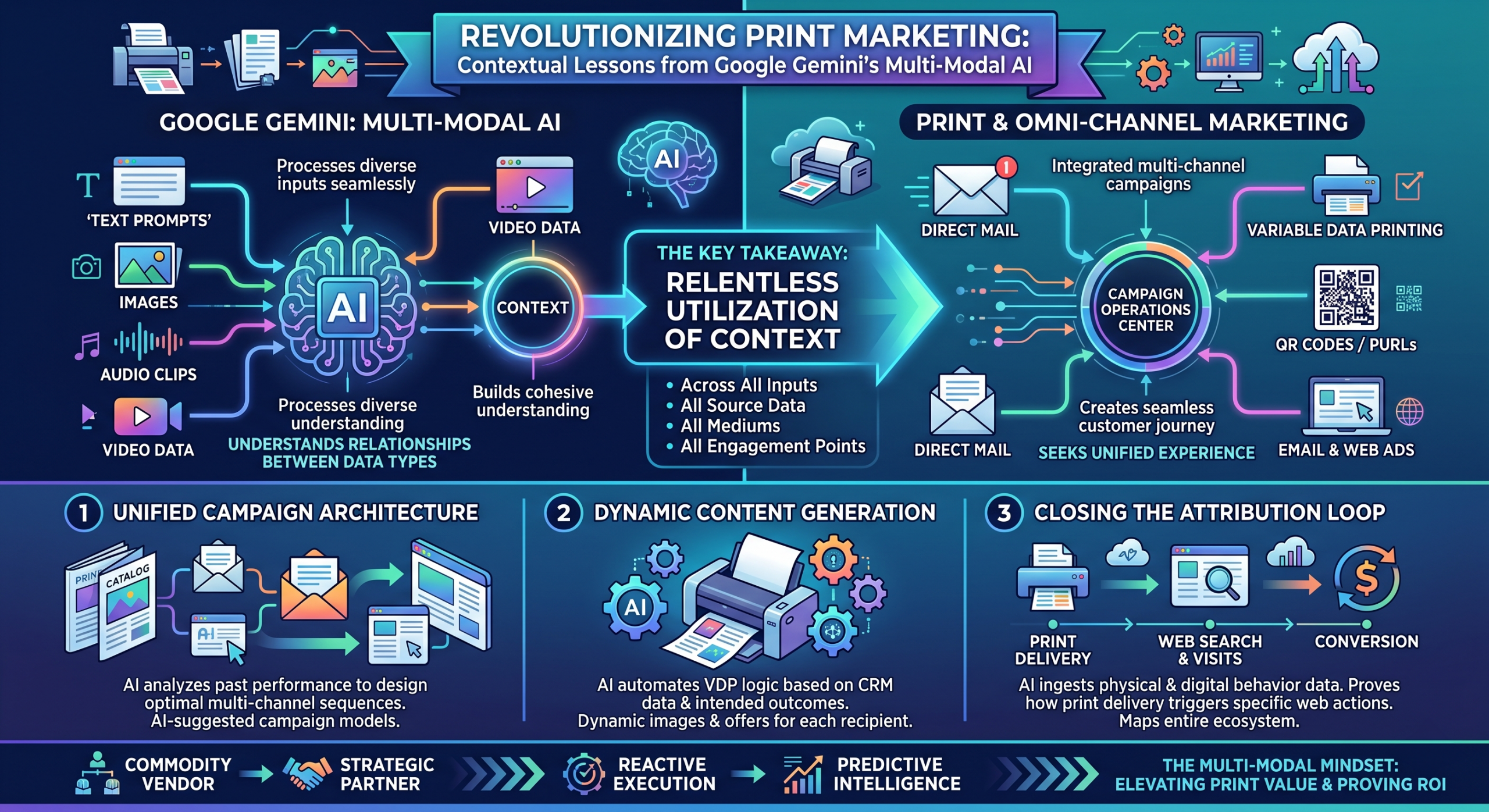
But there is one massive takeaway that the print industry must adopt from this AI evolution: the relentless, unified utilization of context across all inputs, all source data, all mediums, and all engagement points.
The Parallel: Multi-Modal AI and Omni-Channel Print
To understand the lesson, we must first understand the technology. Traditional AI models were unimodal. They processed text to generate text, or images to generate images. They were highly specialized but fundamentally limited, much like a marketing strategy that relies solely on direct mail without any digital follow-up.
Gemini Omni was built from the ground up to be natively multi-modal. It doesn’t just translate an image into text and then analyze the text, it understands the visual context of the image, the tone of an attached audio clip, and the semantic meaning of the accompanying text all at the exact same time. It builds a cohesive understanding of a complex request by analyzing the relationships between these different data types.
For a commercial print executive, this should sound incredibly familiar. This is the exact promise of omni-channel marketing.
Multi-channel marketing simply means using multiple channels (print, email, web) to communicate. Omni-channel marketing means those channels are communicating with each other to create a seamless user experience.
When a multi-modal AI model generates an output, it does so based on pattern, context, relevance, and intended outcomes derived from multiple diverse inputs. When a print service provider executes a successful omni-channel campaign, they should be doing the exact same thing: using the context of a customer’s online browsing behavior to trigger a highly personalized, physically printed catalog, which then utilizes an individualized PURL (Personalized URL) to drive them back to a custom digital landing page.
The philosophy is identical. The execution, however, is where the print industry can level up by embracing AI.
The Big Takeaway: Context is the Ultimate Currency
The true genius of a multi-modal AI system like Gemini isn't just that it can "see" and "read" simultaneously; it is that it maintains absolute context across all those inputs. It remembers the constraints, understands the historical data it was fed, and aligns every piece of generated output with the desired goal.
In the print industry, a lack of context is the enemy of ROI.
How often do we print a massive direct mail run for a client, only to hand over the postal receipts and hope for the best? How often do we fail to capture the downstream digital behaviors that our print pieces initiate?
By leveraging the power of modern AI and machine learning, printing companies are now able to better contextualize results and behavior from their marketing efforts. We can finally map the entire ecosystem of an omni-channel campaign with the same contextual awareness as a multi-modal AI.
Contextualizing the Print Experience
Here is how the multi-modal AI approach translates to contextualizing print:
- All Inputs - In AI, inputs are text prompts, audio files, and uploaded images. In print marketing, inputs are demographic data, previous purchase history, CRM data, and current digital engagement scores. AI allows us to ingest massive, disparate datasets and synthesize them into a cohesive understanding of the target audience before a single drop of ink hits the paper.
- All Source Data - AI can analyze not just the client's direct customer list, but broader market trends, seasonal buying patterns, and local economic indicators. This ensures that the messaging on a printed piece isn't just personalized with a first name, but highly relevant to the recipient's immediate reality.
- All Mediums - A true omni-channel campaign acknowledges that print is a high-value node in a larger network. AI tools can help marketers determine the exact right sequence of mediums. Does the customer respond best to an email followed by a postcard, or a premium printed catalog followed by a targeted social ad? AI identifies the patterns that human analysts might miss.
- All Engagement Points - This is where the ROI is proven. By integrating AI analytics into the campaign, print companies can track how a physical piece of mail influences digital behavior. We can track the time between delivery (using intelligent mail barcodes) and website visits, analyzing the context of the user's journey to prove that the printed piece was the catalyst for conversion.
Moving from 'Spray and Pray' to Predictive Intelligence
For the C-suite executive steering a commercial print operation, the integration of AI isn't about replacing your creative or production teams; it’s about transforming your company from a commodity print vendor into an indispensable strategic partner.
When you start treating marketing campaigns like multi-modal AI models treat data, you shift from reactive execution to predictive intelligence.
1. Unified Campaign Architecture
Just as Gemini synthesizes video, text, and audio to answer a complex query, your marketing strategy must synthesize print, digital, and experiential touchpoints to solve a client's acquisition or retention problem. AI tools can now evaluate the historical performance of your clients' multi-channel campaigns, identifying which specific combinations of print and digital yielded the highest conversion rates, and then auto-suggesting campaign architectures for future initiatives.
2. Dynamic Content Generation based on Intended Outcomes
Multi-modal AI generates responses based on the intended outcome of the user. In print, variable data printing has allowed us to change text and images on the fly. Now, AI allows us to automate the logic behind those changes. By feeding an AI model your client's CRM data and their ultimate goal (e.g., "increase average order value by 15%"), the AI can help dictate not just the names and addresses, but the specific imagery, offer types, and copy length that will mathematically perform best for each individual segment of a mailing list.
3. Closing the Attribution Loop
The most significant hurdle for commercial print has always been attribution. Digital marketers point to click-through rates and immediate conversions, leaving print marketers to argue for the value of "brand awareness" and tactile engagement.
AI bridges this gap. By utilizing AI-driven analytics platforms, print companies can ingest massive amounts of data from both physical and digital engagement points. The AI can look at the pattern:
- Print piece delivered on Tuesday;
- Spike in organic search traffic in that exact zip code on Wednesday;
- Increased conversion rate on Thursday.
The AI provides the context, proving to your clients that the multi-channel approach, anchored by your print products, is driving their revenue.
Embracing the Multi-Modal Mindset
The release of Google's Gemini and its omni-modal capabilities is a wake-up call for every industry, but it serves as a perfectly tailored blueprint for the commercial print sector.
The days of viewing print as a standalone entity are over. The most successful printing companies of the next decade will be those that view themselves as managers of complex, multi-modal communication streams. They will use AI not just to write better copy or speed up prepress workflows, but to fundamentally understand the context of the end consumer.
By treating print marketing, multi-channel strategies, and omni-channel executions with the same contextual rigor that AI models use to process data, you elevate the value of physical media. Print becomes the tangible anchor in a sea of digital noise, a highly targeted, data-driven, and fully contextualized touchpoint that drives measurable results.
The technology to connect these dots is no longer theoretical. The multi-modal era is here, and it is time for the printing industry to capitalize on the context.
The preceding content was provided by a contributor unaffiliated with Printing Impressions. The views expressed within may not directly reflect the thoughts or opinions of the staff of Printing Impressions. Artificial Intelligence may have been used in part to create or edit this content.
- Categories:
- Artificial Intelligence (AI)
Alyssa Summers is the CEO of Pryntbase, a marketing service and solutions provider for full service print companies. She brings a deep background in digital strategy and a proven track record in agency and industry leadership. Alyssa has helped hundreds of print businesses drive visibility, leads, and sales through smart use of technology and marketing automation. Known for her practical approach and deep industry insight, she is a digital marketing thought leader focused on helping printers thrive in the digital age. You can reach her at alyssa@pryntbase.com.


