The Future of SEO for Print — From Search to Signals


From SEO to GEO - How Search is Changing for the Print Industry
There was a time when SEO was simple.
In the 1990s, ranking on search engines required little more than stuffing keywords onto a page, building a few backlinks, and waiting for Google to take notice. People searched in simple ways, "flyer printing," "local print shop," or "business cards," and search engines matched those queries with static, keyword-heavy content.
That era is long gone!
Search behavior has become significantly more sophisticated. Users now expect context-aware results. Search engines factor in intent, location, timing, and even behavioral signals to return the most relevant answers, not just the most optimized pages.
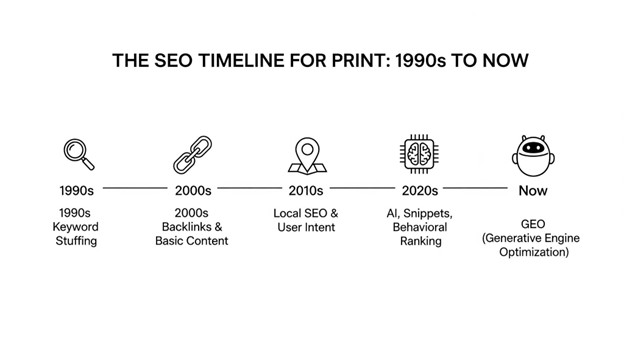
Click to enlarge.
For the print industry, this evolution brings both challenges and opportunities.
How Search Changed - Local Context, Use Case Nuance, and Machine Learning
As search matured, it began to incorporate location-based modifiers and contextual cues. Google realized that someone looking for an ice cream shop is likely making a hyper-local query, something to fulfill a need within minutes. In contrast, someone searching for a luxury vacation or new car is willing to travel hours or even cross state lines.
Print exists somewhere in the middle of that spectrum.
- Urgent needs (next-day printing, event signage)
Users often default to local print shops for speed and trust. - Planned purchases (invitations, collateral for events)
Users may choose either local or national providers based on cost, quality, or online experience. - Specialized needs (commercial print, niche verticals)
Geographic limits vanish. Expertise outweighs proximity.
If you're a print provider with a track record in specific verticals, say, private schools, HVAC companies, or real estate as examples, those niche capabilities allow you to attract national attention. In these cases, search optimization is no longer about being local; it’s about being relevant to a specific customer’s needs.
Why “Traditional” SEO Doesn't Work Well for Print Companies (At Least Not on Its Own)
The way most commercial printers still approach SEO is outdated. Many believe that if they just have a web page for “brochure printing” or “postcard printing” with the right keywords, they’ll rank well and attract leads.
But that’s rarely true anymore.
Generic print terms are dominated by large e-commerce platforms. Google recognizes that when someone types “brochure printing,” they’re likely looking for an instant, low-cost, high-speed e-commerce experience. Those searches are commoditized, and dominated by the “Vistaprints” of the world.
Many local or regional commercial print shops don’t want that business anyway. They want complex projects, higher volumes, and strategic campaigns. And that means traditional SEO won’t help you win.
Instead, SEO today requires understanding how search results are constructed
- Core website pages (home, about, services), best for building foundational visibility.
- Content marketing pages (blogs, guides), great for capturing informational intent.
- Product pages (especially e-commerce), ideal for transactional keywords.
If you're not blending all three strategically, you're missing out on organic visibility.
The Shift to AI - From Featured Snippets to Generative Search
Over the past few years, Google has been investing in AI to make its search experience smarter, and faster. What started with featured snippets and voice search has evolved into AI-generated summaries and experimental experiences like Search Generative Experience (SGE) and AI Mode.
Here's what’s happening now
- AI snippets pull content from multiple sources and present users with direct answers, bypassing traditional search results.
- AI Mode, currently available on personal Google accounts, introduces a radically different search interface focused on conversation, context, and guided browsing.
- Content creators are no longer just competing for rankings, they’re competing for inclusion in AI responses.
But it’s not perfect.
Today’s AI-generated responses often blend steps from unrelated platforms or industries. In the print space, you may find how-to advice that applies to DIY crafting but not commercial printing, confusing users and undermining credibility. Google knows this, and they’re working on it. But it proves a bigger point: “Content needs to be more than just optimized.”
It needs to be trustworthy, differentiated, and experience-driven.
Content in an AI-Dominated Future: What's Still Worth Creating?
If AI can synthesize answers from millions of existing sources, what’s the incentive to keep writing blog posts?
The answer: You must create what AI cannot, yet.
That includes content such as…
- Authoritative thought leadership based on firsthand experience
- Unique case studies and frameworks that demonstrate your process
- New ideas and insights that don’t yet exist online
AI models are great at summarizing what’s already out there. But at some point, that becomes an echo chamber, just louder and faster.
Print companies that test new campaign ideas, document results, and publish real-world strategies will stand out. You’re not just adding content, you’re adding value no machine can replicate yet.
Introducing GEO - Generative Engine Optimization
We're now entering a new era of online optimization: GEO, or Generative Engine Optimization.

GEO isn’t just about ranking in Google anymore. It’s about showing up in AI-powered experiences
- In Google’s SGE or Perplexity’s answers
- In ChatGPT and Gemini-style summaries
- In podcast recommendations, video transcripts, visual search, and smart assistants
To succeed in GEO, brands must consider:
- Where their content appears (not just websites, but across platforms)
- How their voice is represented (tone, media type, brand positioning)
- Why their insights matter (is it original? insightful? usable?)
Just like SEO has tactics (keywords, links, schema), GEO will have its own playbook. And the earliest adopters, especially in the print world, will have a significant edge.
What Print Companies Should Be Doing Right Now
We can’t give you a bulletproof blueprint for succeeding in GEO just yet. But we can tell you what matters most today.
- Stay informed. Watch how Google/Gemini, OpenAI, Cluade, and others roll out new features
- Be present. Expand beyond your website, get active in videos, podcasts, and panels
- Be original. Create content only your team can, your process, your insights, your results
- Partner wisely. Work with marketers who understand how search is shifting
- Use AI tools to uncover hidden opportunities and content gaps
Most importantly, stay awake! Don’t let the print industry fall behind again like it did during the past digital transformation. This time, you can be at the front of it.
From Search to Signals
Search is no longer a keyword game. It’s a behavioral ecosystem.
Where you show up, how you're referenced, what people say about you, and how your brand lives across platforms, these are the signals generative engines will use to shape the next era of digital visibility.
We’ve moved from SEO to GEO.
If you’re ready to embrace it, the opportunities for print are massive. Stay aware. Stay agile. And stay relevant.

The preceding content was provided by a contributor unaffiliated with Printing Impressions. The views expressed within may not directly reflect the thoughts or opinions of the staff of Printing Impressions. Artificial Intelligence may have been used in part to create or edit this content.
- Categories:
- Artificial Intelligence (AI)
Alyssa Summers is the CEO of Pryntbase, a marketing service and solutions provider for full service print companies. She brings a deep background in digital strategy and a proven track record in agency and industry leadership. Alyssa has helped hundreds of print businesses drive visibility, leads, and sales through smart use of technology and marketing automation. Known for her practical approach and deep industry insight, she is a digital marketing thought leader focused on helping printers thrive in the digital age. You can reach her at alyssa@pryntbase.com.