


Should Printing Companies Use ChatGPT?

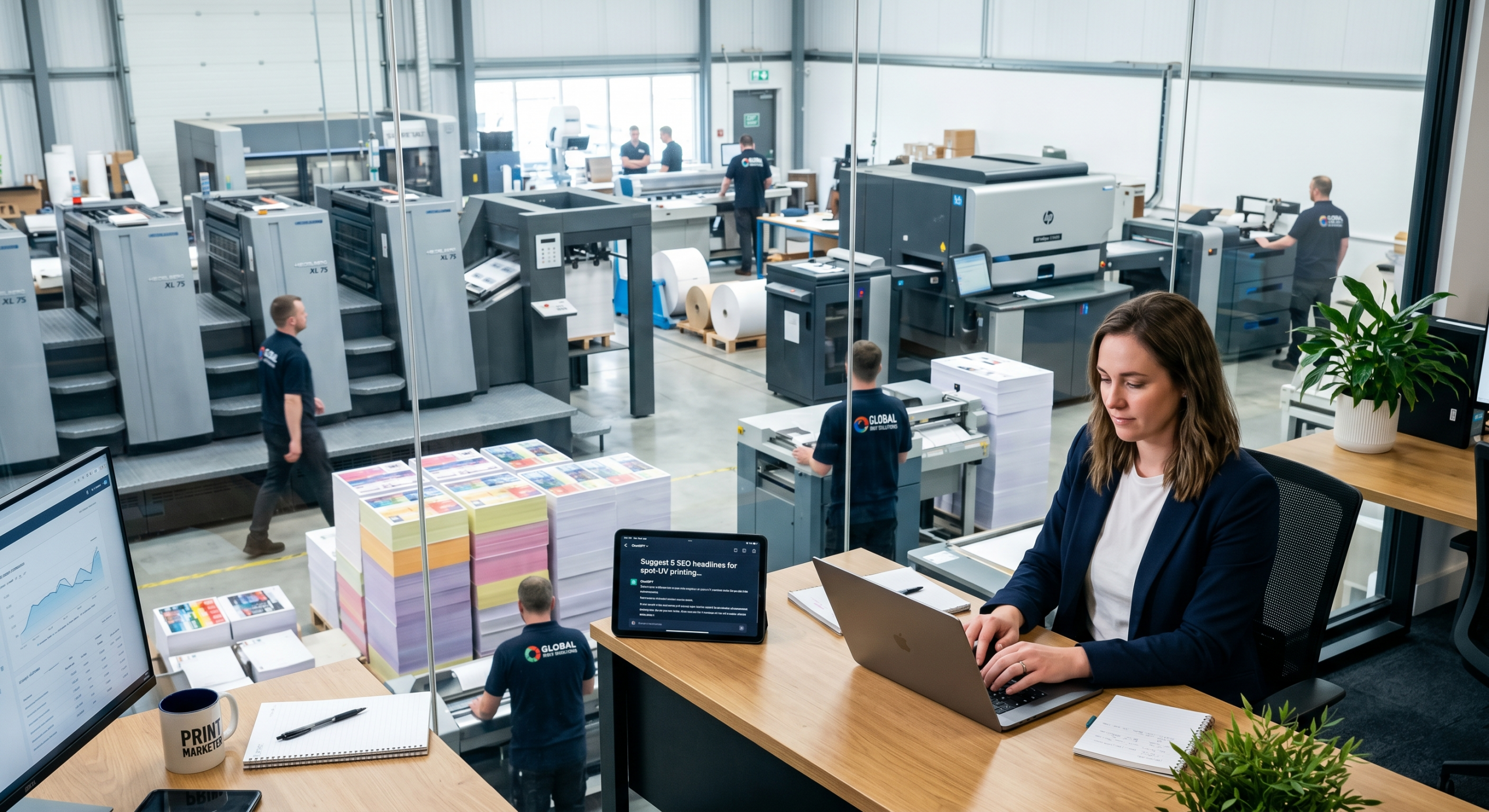
The print industry has always been a landscape of rapid technological evolution, from the Gutenberg press to the advent of high-speed digital inkjet and automated finishing. Today, the conversation has shifted from hardware to software, specifically Large Language Models (LLMs) like ChatGPT. As print shop owners and production managers look for ways to increase margins and improve throughput in a hyper-competitive market, a critical question arises: Should print companies use ChatGPT?
The answer is a resounding "Yes," but with significant caveats. While ChatGPT offers unprecedented opportunities for streamlining customer communication, marketing, and internal documentation, it also introduces specific vulnerabilities. Mismanaged AI use can lead to data breaches, technical production errors, and damaged client relationships.
In this comprehensive guide, we will explore how the print industry is currently adopting AI, identify the "easy wins," highlight the high-risk zones, and define the boundaries where AI should never be allowed to cross.
How Printing Companies are Currently Using ChatGPT
Forward-thinking print service providers (PSPs) are moving beyond viewing ChatGPT as a novelty and are beginning to integrate it into the "front-end" of their business. Most current usage falls into three main categories:
1. Enhanced Customer Communication
Customer service teams are using ChatGPT to draft professional responses to complex inquiries. For instance, if a client asks why a specific Pantone color cannot be perfectly replicated on a textured linen substrate, a CSR can use ChatGPT to draft a clear, technical, yet polite explanation. This reduces the time spent on "email gymnastics" and allows staff to focus on production-heavy tasks.
2. Marketing and Content Creation
Marketing for print is notoriously difficult because it requires explaining physical processes in a digital world. Print shops are using AI to generate SEO-optimized blog posts, social media captions for showcasing recent projects (like a complex die-cut brochure or a foil-stamped invitation), and personalized email campaigns. By feeding the AI specific details about their finishing capabilities, they can generate compelling sales copy that resonates with graphic designers and agency buyers.
3. Administrative Efficiency
From drafting internal memos to summarizing long meeting notes regarding equipment upgrades, ChatGPT acts as a force multiplier for the administrative side of a print shop. It allows smaller "mom-and-pop" shops to project the professional image of a much larger corporation.
The 'Easy Wins': Low Risk, High Reward
For print companies hesitant to dive into AI, there are several "low-hanging fruit" use cases that provide immediate value with minimal risk:
- Drafting Standard Operating Procedures (SOPs): Every print shop has "tribal knowledge," specific ways to load a certain substrate or clean a specific print head. ChatGPT can take a rough, bulleted list of steps and turn it into a professional, easy-to-read SOP manual for new hires.
- Subject Line and Headline Generation: Use AI to generate 10 variations of an email subject line for your monthly newsletter to see which yields the highest open rate.
- Job Postings: Quickly create detailed job descriptions for specialized roles like "Prepress Technician," "Bindery Operator," or "VDP Specialist" based on industry standards.
- Summarizing Feedback: Paste anonymous customer reviews into the interface to identify common themes (e.g., "Our quality is praised, but customers find our turnaround time on quotes too slow").
High-Risk Use Cases: The Security Concerns
Security is the most significant hurdle for any print company using a public AI interface. When you type information into the standard ChatGPT interface, that data may be used to train future iterations of the model unless you are using specific enterprise-grade privacy settings or "Temporary Chat" modes.
1. Client Proprietary Data
Print companies often handle sensitive intellectual property. If a client sends over an unreleased marketing plan or a confidential internal document to be printed, never upload that text into ChatGPT to "summarize" or "edit" it. If the AI ingests this data, fragments of that proprietary information could theoretically appear in responses to other users globally.
2. Mailing Lists and PII (Personally Identifiable Information)
This is the single most dangerous mistake a print company can make. Uploading customer mailing lists (Excel or CSV files) to ChatGPT for "cleaning" or "formatting" is a massive breach of PII. This can violate GDPR, CCPA, and other privacy regulations, potentially leading to lawsuits and the loss of mail-house certifications.
3. Internal Pricing Formulas
Uploading your company’s internal pricing spreadsheets to ask the AI to "find areas for better margin" exposes your competitive advantage. If that data is ingested into the public model, you are essentially training the AI on how your business competes.
The 'Error Zone': Use Cases Prone to Failure
Print is a game of millimeters, microns, and precise chemistry. This is where ChatGPT’s "hallucination" problem becomes a liability. ChatGPT is a language model, not a math or engineering engine.
Technical Specifications
Asking ChatGPT to calculate "the correct spine width for a 300-page book on 80lb gloss text" is risky. While it might provide a formula, it often makes subtle errors in decimal placement or fails to account for the specific "bulk" of a particular paper brand. In print, a mistake of 0.03 inches is the difference between a professional perfect-bind and a rejected job.
Prepress and Software Troubleshooting
Relying on AI to give advice on "how to fix a transparency flattener error in Acrobat" or "how to set up a spot varnish layer in InDesign" can lead to outdated or flat-out wrong instructions. AI may suggest a workaround that worked in a 2018 version of the software but will corrupt a modern PDF/X-4 workflow.
Areas Where the ChatGPT Interface Should NOT Be Used
While AI APIs can be integrated into secure workflows, the public ChatGPT interface should be strictly off-limits for the following areas:
- Legal Contracts and NDAs: While AI can review a contract for "general tone," it should never be the final word on Non-Disclosure Agreements or Service Level Agreements (SLAs). The nuance of print-specific liability (such as "industry-standard over/under-run percentages") is often missed by general AI.
- Detailed Financial Audits: Keep your P&L statements and balance sheets out of the public interface.
- Direct Variable Data Processing (VDP): Never use the interface to manage the logic for variable data jobs (e.g., matching names to specific discount codes). The risk of data misalignment is high, and the security risk to the customer's database is even higher.
The Strategy: 'Human-in-the-Loop'
The successful print company of the future will not replace its staff with AI; it will augment them. The "Human-in-the-Loop" (HITL) model is the only responsible way to use ChatGPT in print.
This means:
- Verification: Every piece of output, whether a technical explanation to a client or a marketing post, must be verified by a human subject matter expert.
- Data Masking: If using AI to help draft a response to a customer complaint, employees should be trained to remove names, order numbers, and specific company names before pasting the text into the AI.
- Policy Creation: Every print shop needs a written "AI Usage Policy" that clearly outlines what can and cannot be shared with an LLM.
So Should You Use It?
So, should print companies use ChatGPT? Yes. It is a powerful tool for overcoming "blank page syndrome" in marketing, improving the tone of customer service, and organizing internal knowledge.
However, it is not a prepress engineer, a lawyer, or a secure data vault. By focusing on the "easy wins" and maintaining strict boundaries around client data and technical math, print providers can use AI to sharpen their competitive edge without compromising the integrity of their craft.
The goal is to use AI to handle the language, while your experts handle the print.
The preceding content was provided by a contributor unaffiliated with Printing Impressions. The views expressed within may not directly reflect the thoughts or opinions of the staff of Printing Impressions. Artificial Intelligence may have been used in part to create or edit this content.
- Categories:
- Artificial Intelligence (AI)
Alyssa Summers is the CEO of Pryntbase, a marketing service and solutions provider for full service print companies. She brings a deep background in digital strategy and a proven track record in agency and industry leadership. Alyssa has helped hundreds of print businesses drive visibility, leads, and sales through smart use of technology and marketing automation. Known for her practical approach and deep industry insight, she is a digital marketing thought leader focused on helping printers thrive in the digital age. You can reach her at alyssa@pryntbase.com.


