


HP Accelerates Shift to Industrial Digital Printing
Eighteen months after drupa 2024, HP announced sustained customer momentum across its HP Indigo and HP PageWide installed base worldwide. Accelerated customer investment, rising production volumes, and deeper adoption of automation and software are reinforcing a structural shift in the print industry toward industrial-scale digital manufacturing.
 “drupa 2024 marked a clear inflection point for the industry,” said Haim Levit, SVP and Division President, HP Industrial Print. “What we have seen since then is not incremental adoption, but a fundamental rethinking of how production is designed and operated. Customers are unlocking profitable growth powered by nonstop digital printing, investing with confidence in high-productivity, AI-enabled digital platforms that deliver consistency, predictability, and scalability. That confidence is translating into faster growth, smarter operations, and structurally stronger businesses.”
Globally, customers have expanded deployment of HP Indigo LEP and LEPx technologies alongside HP PageWide high-performance Thermal Inkjet platforms. Increasingly, these presses are implemented as part of an integrated, AI-enabled production ecosystem, supported by HP PrintOS and intelligent workflow solutions. Together, hardware, software, and data create a connected digital foundation that is redefining productivity, quality control, and operational intelligence across industrial print environments.
Industry Validation: Digital Production Moves to the Core
The acceleration of digital printing across commercial print, labels, and packaging reflects a broader industrial shift toward flexible, software-driven manufacturing. Demand for shorter runs, increased SKU complexity, faster turnaround times, and measurable sustainability benefits is pushing converters to standardize on digital platforms capable of delivering industrial productivity with consistent quality at scale.
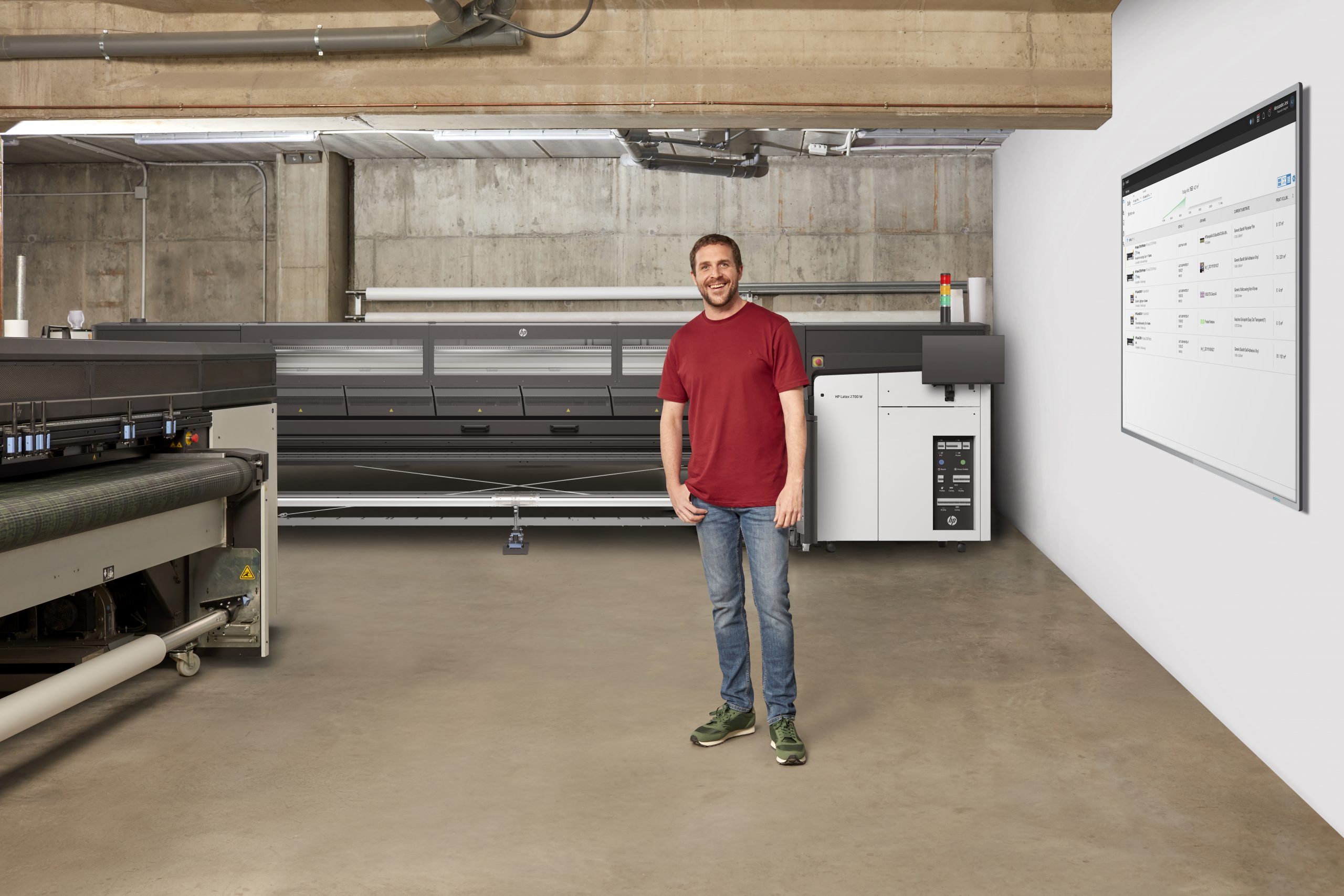
HP Latex
Since drupa 2024, B2-format digital production has emerged as one of the strongest growth vectors in the market. Printers are consolidating analog volumes onto fewer, more productive presses to simplify operations and increase asset utilization. HP Indigo B2 platforms, including the HP Indigo 120K, have seen rapid adoption and rising utilization rates, particularly among high-volume commercial printers and packaging converters transitioning to nonstop, lights-out production models. This momentum reflects a decisive shift from digital as a complementary capability to digital as the backbone of industrial production.
More specifically in labels, digital printing continues to expand beyond short-run applications, increasingly supporting a digital-first production model capable of absorbing core label volumes. SKU proliferation, regulatory variation, brand versioning, and faster product refresh cycles are reshaping label manufacturing requirements, favoring platforms that combine speed, uptime, and automation with consistent quality. HP Indigo is accelerating this shift with the HP Indigo V12, powered by LEPx technology, which delivers industrial-level productivity, high availability, and end-to-end automation in a digital label press. By enabling converters to transition larger, traditionally analog workloads to digital at scale, the HP Indigo V12 represents a pivotal step in making digital printing the default operating model for high-volume label production.
At the same time, flexible packaging has become the fastest-growing segment in the print industry, driven by brand owners’ need for agility, personalization, sustainability, and shorter product lifecycles. HP continues to strengthen its leadership position in digital flexible packaging, gaining market share through the scalability, repeatability, and material versatility of HP Indigo LEP and LEPx technologies. What began as pilot deployments has increasingly matured into full-scale production, with digital flexible packaging now embedded in mainstream manufacturing strategies alongside, and increasingly in place of analog processes.
“Our 2025 IDC MarketScape reflects these dynamics clearly,” said Tim Greene, Research Director, IDC. “HP continues to set the pace for industrial digital print. Its LEP and LEPx technologies, combined with one of the industry’s largest cloud-connected installed bases, give converters the productivity and consistency required for high-speed digital environments. Platforms such as the HP Indigo V12, delivering speeds of up to 117.5 meters per minute, demonstrate how digital performance continues to advance. When paired with HP PrintOS, customers gain the data visibility and workflow intelligence needed to reduce waste, maximize uptime, and modernize operations.”
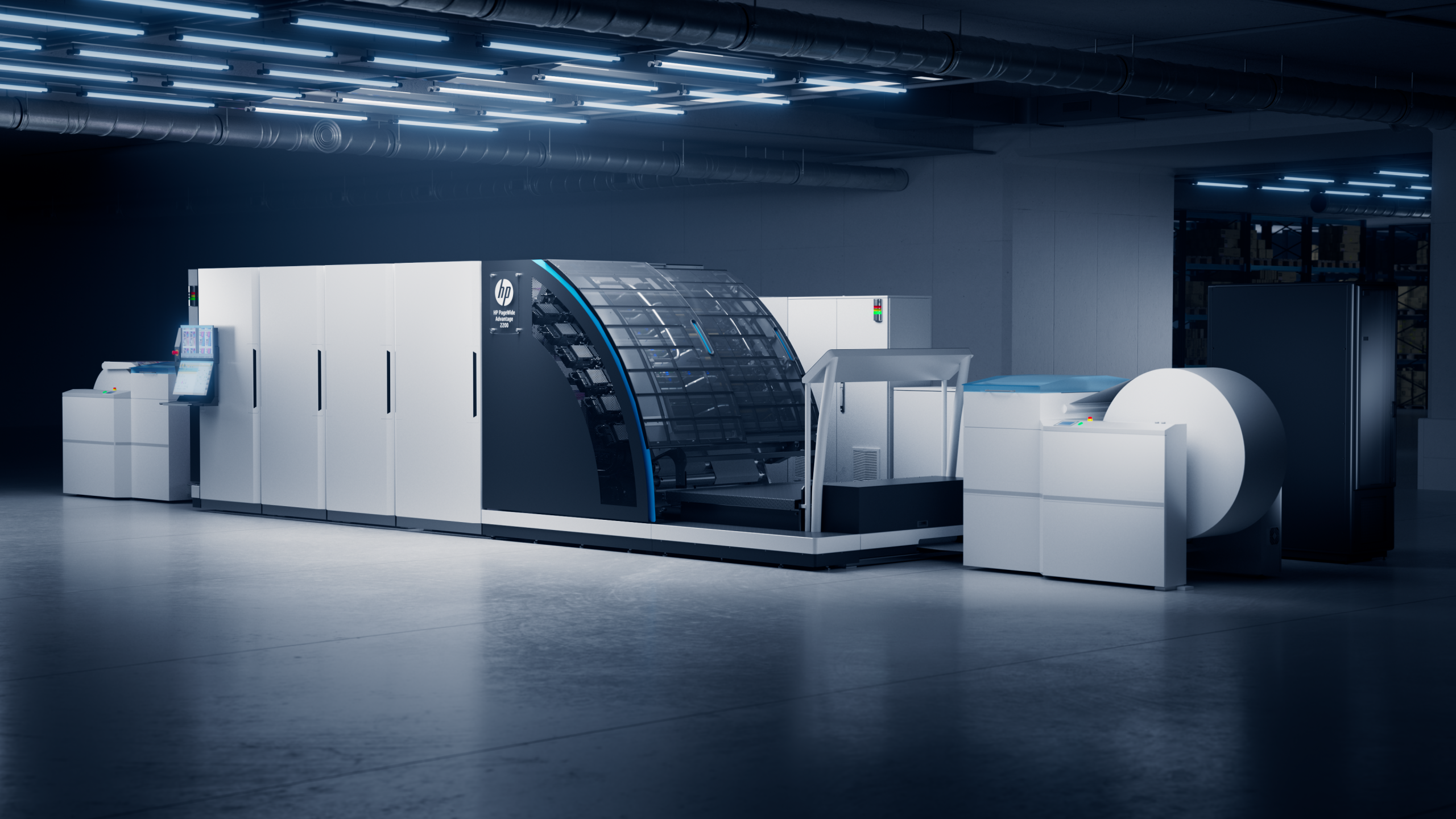
HP PageWide Advantage 2200
In high-volume commercial print, HP PageWide remains a critical engine of the industry’s transition from analog to digital. Platforms such as the HP PageWide Advantage 2200 combine cost-efficient production, offset-class quality, and operational simplicity, making them a preferred solution for publishing, direct mail, and transactional applications where scale, consistency, and reliability are essential. Over the past 18 months, momentum has been driven by sustained share gains, which has become a reference platform for cost-efficient, high-volume digital production.
Elsewhere, the introduction of the HP PageWide T4250 HDR further extends PageWide’s industrial reach, delivering offset-class quality at higher productivity tiers while reducing energy consumption and operational complexity. The platform enables customers to modernize legacy workflows and migrate increasing volumes to digital production with confidence.
Cimpress: Industrializing Digital Production at Global Scale
Cimpress exemplifies the speed and scale at which digital transformation is unfolding. Since drupa 2024, Cimpress has added sixteen HP Indigo presses, including ten HP Indigo 120K systems, expanding production capacity across Vistaprint Windsor, Pixartprinting, IPI, and Vistaprint Venlo. The group has now surpassed three million impressions, with European operations maintaining S4 and S5 OEE above 60 percent, while Pixartprinting USA achieved LS Mark Champion status at 180 percent.
“The HP Indigo 120K has fundamentally changed how we run our production,” said Robert Keane, Founder and CEO, Cimpress. “It delivers the stability, predictability, and throughput we need to operate efficiently at global scale, while maintaining consistency across regions and applications.”
HP continues to support Cimpress through advanced reliability, performance optimization, and automation programs as production volumes continue to grow.
RRD: Executing a Multi-Segment Digital Strategy
As global print demand shift towards high volumes, faster turnaround and greater efficiency, another best-in-class example is HP’s work with RRD, who continues to accelerate its digital transformation with HP. Following the strategic collaboration announced at drupa 2024, RRD has expanded installations of both HP PageWide and HP Indigo platforms across multiple regions. These deployments support growth across direct mail, labels, packaging, and commercial print, including installations of the HP PageWide T4250 HDR. Through high-definition recirculating nozzle architecture, efficient drying technology, and data-driven production capabilities, the HP PageWide T4250 HDR enables RRD to increase productivity while reducing waste and energy consumption, strengthening cost efficiency at scale.
Continuing Momentum
In May 2024, HP and Canva set out a shared ambition to simplify how ideas move from screen to print at global scale. Since then, Canva’s 2025 Wrap highlights the commercial impact of this shift, with 260 million monthly active users, operations across 190 countries, and $3.5 billion in revenue. HP’s Industrial Print infrastructure has helped translate this creative scale into high quality, localised print output, supporting personalised and on demand applications while enabling a more efficient and responsive print ecosystem.
The momentum of the past 18 months signals a definitive industry transition. Digital print is no longer an emerging alternative, it is becoming the operating standard by which printers and converters compete, scale, and differentiate. Building on this shift, HP will continue to advance press innovation, intelligent automation, software, and services to shape a Future of Work where industrial print production is simpler to operate, easier to scale, and structurally stronger for customers worldwide.
The preceding press release was provided by a company unaffiliated with Printing Impressions. The views expressed within may not directly reflect the thoughts or opinions of the staff of Printing Impressions.
 Fujifilm Expands Toner Portfolio for REVORIA PRESS
 Konica Minolta Named a Leader in IDC MarketScape
 'Make More' with FUJIFILM at PRINTING United Expo
 How Alliance/NAPCO Research Supports Growth in Label and Packaging Manufacturing
 Fujifilm Hosts Open House with SumnerOne and PPS
 Fujifilm and SumnerOne Partner for Print Solutions
